Layered Comfort Is Taking Over: Why Designers Are Moving Beyond Minimalist Interiors
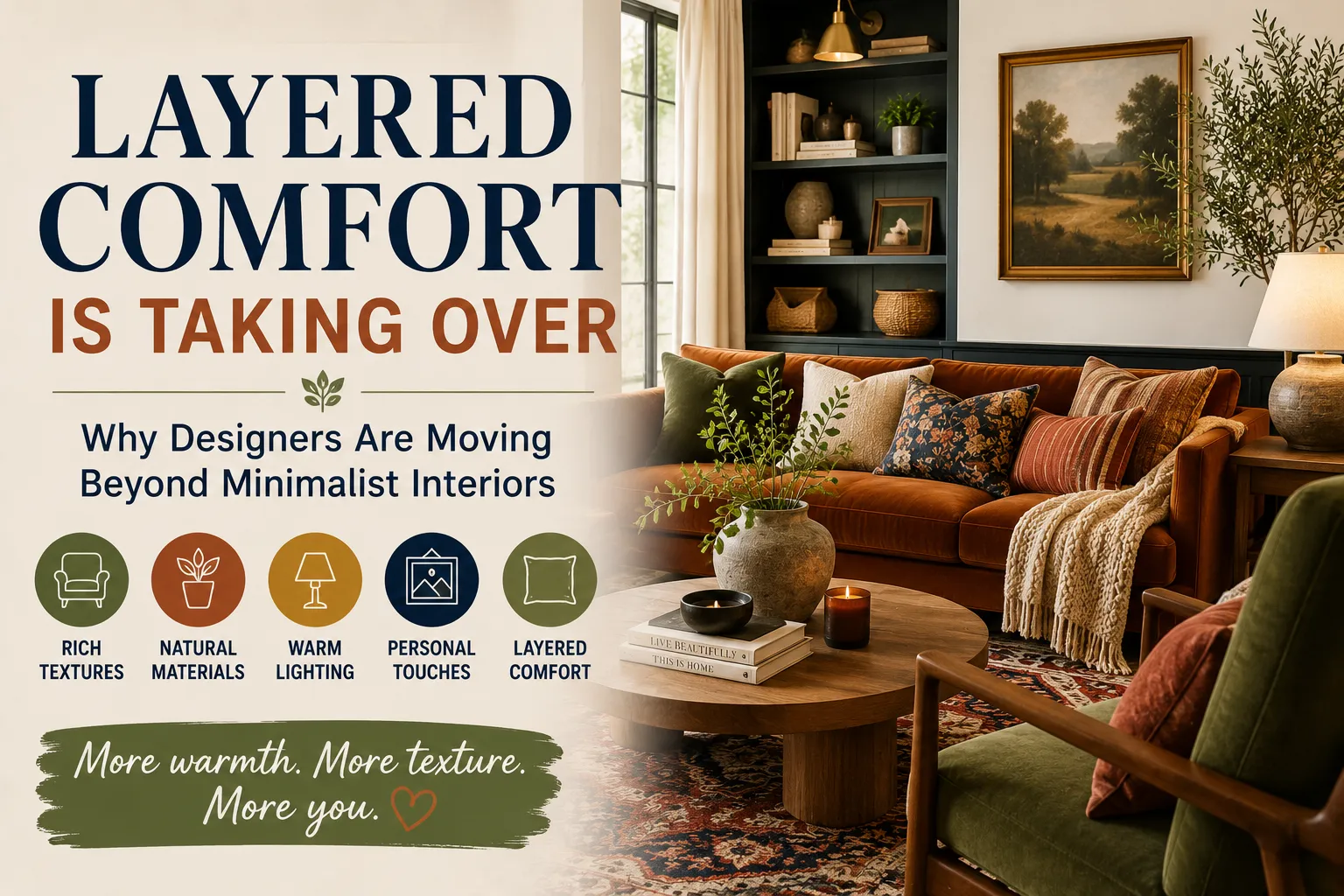
Layered Comfort Is Taking Over: Why Designers Are Moving Beyond Minimalist Interiors
For years, minimalist interiors dominated design conversations. White walls, uncluttered surfaces, clean lines, neutral furniture and carefully edited rooms became shorthand for a modern home.
In 2026, however, designers are increasingly making the case for something warmer.
The emerging direction is not necessarily a rejection of simplicity. Instead, it is a move toward layered comfort—spaces that combine texture, color, pattern, natural materials, vintage pieces, soft furnishings and personal objects without becoming visually chaotic.
Recent design forecasts from Architectural Digest and ELLE Decor point to the same broad shift: designers are embracing richer colors, tactile materials, curves, traditional details, vintage furnishings and more personalized rooms after years of pared-back interiors.
The result is a home that feels less like a showroom and more like somewhere people actually want to live.
What Is Layered Comfort?
Layered comfort is less a strict decorating style than a way of building atmosphere.
Instead of relying on one dominant design language, a layered room combines different elements that work together:
- Soft textiles
- Rugs
- Curtains
- Cushions and throws
- Artwork
- Books
- Plants
- Natural materials
- Vintage furniture
- Decorative objects
- Warm lighting
- Multiple colors and tones
- Different patterns and textures
The objective is not to fill every available surface.
It is to create depth, warmth and personality.
A room with a neutral sofa, for example, can feel completely different when paired with a textured wool rug, linen curtains, patterned cushions, wooden furniture, warm lighting and artwork collected over time.
That approach creates visual interest without requiring every object to make a dramatic statement.
Why Minimalism Is Losing Some of Its Appeal
Minimalism is unlikely to disappear. Clean, uncluttered interiors remain appealing because they can feel calm, organized and timeless.
But an overly minimalist room can also feel impersonal.
The design industry is increasingly responding to a desire for interiors that communicate something about the people who live in them.
Architectural Digest’s 2026 interior design forecast describes the current direction as a move away from pared-back, monastic spaces toward self-expression, eclecticism and warm layers of color, pattern and ornament.
That does not mean homeowners suddenly want clutter.
Instead, many are looking for a middle ground between empty minimalism and uncontrolled maximalism.
The room should feel edited—but not sterile.
For another look at how designers are moving away from dated minimalist formulas, see Designers Are Declaring War on Dated 2010s Interiors.
Comfort Is Becoming a Design Priority
One reason layered interiors are gaining attention is straightforward: people want their homes to feel comfortable.
A visually impressive room is not necessarily an inviting room.
A comfortable interior might include:
- A deep sofa
- Soft upholstery
- A thick rug
- Adjustable lighting
- Curtains that soften natural light
- Cushions in different textures
- A comfortable reading chair
- Warm wood
- Personal photographs or artwork
These details affect how a room feels physically as well as visually.
The emphasis is increasingly on creating environments that encourage people to sit, relax, read, entertain and spend time together.
The same emphasis on livability can be seen in the growing preference for more personal interiors, as explored in Interior Designers Move Away From Perfect Showrooms Toward More Personal Homes.
Texture Is Doing More of the Design Work
One of the easiest ways to introduce layered comfort is through texture.
Current 2026 design coverage highlights combinations of materials such as velvet, wool, rattan and linen as designers seek interiors that feel tactile and lived-in.
Imagine a living room containing:
- A linen sofa
- A wool rug
- A wooden coffee table
- A woven basket
- A velvet cushion
- A ceramic lamp
- A cotton throw
None of these elements needs to be particularly extravagant.
Together, however, they create depth.
Smooth Meets Rough
Texture works especially well when contrasting surfaces are placed together.
Think:
Smooth + rough
Soft + structured
Glossy + matte
Woven + solid
Old + new
These contrasts prevent a room from feeling flat.
The growing interest in tactile materials also connects with broader Nordic design ideas highlighted in Formex 2026 Reveals the Nordic Interior Trends Set to Shape Homes Next.
Warm Neutrals Are Replacing Sterile Whites
Neutral interiors are not disappearing. Their character is changing.
Instead of relying heavily on bright white, designers are increasingly working with warmer shades such as:
- Mushroom
- Taupe
- Greige
- Warm beige
- Cognac
- Olive
- Muted brown
- Soft clay
Recent design coverage has highlighted “dirty neutrals”—earthier shades that introduce more depth and warmth than stark white or cool gray.
These colors can provide a quiet backdrop for furniture, artwork and textiles without making the room feel clinical.
The benefit is versatility.
A warm neutral wall can accommodate colorful artwork, dark wood, brass fixtures or patterned upholstery without competing with them.
For a closer look at one of the strongest color directions within this warmer palette, see Behr Reveals Its 2027 Color of the Year as Earthy Green Takes Center Stage.
Color Is Becoming More Emotional
Another major shift is the willingness to use color for atmosphere rather than simply decoration.
Designers surveyed by ELLE Decor for 2026 reported greater interest in warmer and deeper colors, including walnut, merlot, dusty greens and combinations with stronger contrast.
This is part of a broader movement toward rooms that have a distinct emotional identity.
A bedroom might use deep green to create a cocoon-like atmosphere.
A dining room might use a darker palette to feel intimate.
A reading area might use warm brown, amber and burgundy tones.
The objective is not to make every room colorful.
It is to give each space a reason for its particular palette.
The renewed interest in earthy tones is also reflected in Warm Earth Tones Continue to Dominate Interior Design.
Pattern Is Coming Back—But With More Control
Minimalist interiors often rely on solid colors and limited visual variation.
Layered interiors are more willing to introduce pattern.
Designers are using patterns across:
- Wallpaper
- Curtains
- Upholstery
- Rugs
- Cushions
- Bedding
- Artwork
ELLE Decor reports a resurgence in pattern-on-pattern layering, with designers emphasizing thoughtful combinations rather than simply placing multiple competing prints together.
A useful approach is to choose one dominant pattern and support it with quieter patterns.
For example:
- Large floral wallpaper
- Small geometric cushion
- Plain textured sofa
- Subtle striped curtain
The room feels layered without becoming overwhelming.
The broader return of decorative textiles and furnishings can also be seen in The Home Design Trends Emerging From Intertextile Shanghai 2026.
Vintage Pieces Are Adding Character
One of the strongest ways to make a home feel personal is to mix old and new.
Vintage furniture, antiques and inherited objects can introduce qualities that are difficult to reproduce with mass-produced décor.
These pieces can bring:
- History
- Patina
- Craftsmanship
- Unusual proportions
- Imperfections
- Personal meaning
Recent design coverage has highlighted a renewed interest in vintage and antique furnishings, including projects that combine historic architectural details with contemporary comfort.
This is also closely connected to the idea of slow decorating—buying and collecting intentionally rather than attempting to complete an entire room in one shopping trip.
The renewed appreciation for earlier design eras is particularly visible in 1980s Style Is Back—but Designers Are Doing It Differently.
The Rise of Slow Decorating
Layered comfort works particularly well when a room develops gradually.
The concept of slow decorating encourages homeowners to live in a space before making every design decision.
Instead of purchasing an entire matching furniture set immediately, homeowners can:
- Establish the basic layout.
- Live with it.
- Identify what is missing.
- Add meaningful pieces gradually.
- Replace items only when necessary.
- Allow the room to evolve.
Recent designer commentary on slow decorating emphasizes patience, reusing existing pieces and waiting for objects that genuinely add meaning to the space.
The result can feel more authentic than a room decorated entirely in one afternoon.
Why Matching Everything Is Becoming Less Popular
A perfectly coordinated room can look polished, but excessive matching can also make an interior feel predictable.
Layered design allows different materials and finishes to coexist.
For example, a room might combine:
- Walnut furniture
- A brass lamp
- Cream upholstery
- A patterned rug
- A vintage side table
- Contemporary artwork
The pieces do not have to come from the same collection.
They simply need enough visual relationships to make the room feel intentional.
This is the difference between coordinating everything and curating a room.
That philosophy is also evident in the furniture and décor ideas presented at ABCASA Fair 2026: Home Décor Trends and Design Ideas to Watch.
Natural Materials Make Rooms Feel More Grounded
Natural materials are particularly well suited to layered interiors.
Popular choices include:
- Wood
- Stone
- Linen
- Wool
- Rattan
- Wicker
- Clay
- Ceramic
- Leather
These materials often have visible textures and imperfections that add character.
Recent 2026 design coverage has also highlighted growing appreciation for natural and raw materials such as lime plaster, solid oak, walnut, natural stone, wool and linen.
Natural materials can also balance stronger colors.
A deep green wall, for example, may feel less dramatic when paired with warm oak furniture and woven textiles.
The same movement toward tactile furniture and decorative materials is visible in ABUP Show 2026: The Furniture and Home Décor Trends to Watch This Week.
Lighting Is Essential to Layered Comfort
Even a beautifully decorated room can feel uncomfortable if the lighting is wrong.
Layered interiors benefit from layered lighting.
Instead of depending entirely on one ceiling fixture, consider combining:
Ambient Lighting
Provides general illumination.
Task Lighting
Supports activities such as reading, cooking or working.
Accent Lighting
Highlights artwork, architectural features or decorative objects.
Decorative Lighting
Adds personality through lamps, pendants and chandeliers.
Dimmable lighting is particularly useful because the same room may need different levels of brightness throughout the day.
A bright living room in the afternoon can become a softer, more intimate environment in the evening.
Technology can also play a role in this process, particularly as How AI Is Changing the Way People Design Their Homes explores the changing relationship between digital tools and interior planning.
Curtains Are Becoming More Important
Minimalist interiors sometimes treat window coverings as secondary.
Layered design gives them a much bigger role.
Curtains can introduce:
- Color
- Pattern
- Texture
- Softness
- Height
- Acoustic comfort
Floor-to-ceiling curtains can also emphasize ceiling height and make a room feel more substantial.
Lined drapery, sheers and layered window treatments are among the details being highlighted in the broader return to “dressed” interiors.
The goal is not simply to cover a window.
It is to make the window part of the overall composition.
Curved Furniture Softens Minimalist Architecture
Another emerging design direction is the return of curves.
Curved sofas, rounded chairs, circular tables and arched architectural details can make rooms feel softer.
ELLE Decor identifies curved furniture and curved architectural details among the ideas gaining momentum in 2026.
Curves are particularly useful in rooms dominated by:
- Straight walls
- Rectangular furniture
- Square windows
- Hard architectural lines
A single rounded coffee table or curved armchair can introduce enough contrast to soften an otherwise rigid room.
The “Dressed Room” Is Back
Another way to understand the shift is through the return of the dressed room.
A dressed room contains more visual detail:
- Molding
- Drapery
- Upholstery
- Rugs
- Artwork
- Decorative objects
- Architectural trim
- Layered lighting
Rather than stripping away every nonessential detail, designers are using those details to create character.
This is particularly noticeable in newer homes, where homeowners may want to add architectural interest to spaces originally designed around simple walls and clean lines.
The scale of this movement can be seen in major industry events such as The Block 2026 House Reveals, where residential design choices demonstrate how contemporary homes can balance practicality with personality.
Maximalism Does Not Mean Clutter
The rise of layered interiors is sometimes described as a return to maximalism.
There is some truth to that, but the distinction matters.
Maximalism is not simply having more things.
Architectural Digest describes successful maximalist design as an intentional and curated approach to combining color, pattern and layering.
A room can contain many elements and still feel organized.
The secret is repetition and hierarchy.
For example, a room could repeat:
- One wood tone
- Two complementary colors
- A particular metal finish
- Similar textile textures
Those recurring elements create cohesion.
The New Luxury Is Livability
One of the most important changes in interior design is the changing definition of luxury.
Luxury once often meant:
- Expensive materials
- Oversized rooms
- Designer furniture
- Perfect finishes
- Highly coordinated décor
Today, designers are increasingly questioning whether expensive automatically means better.
Recent designer commentary has criticized oversized or impractical “luxury” features in favor of thoughtful design, functionality and personalization.
A luxurious home can simply be one that:
- Feels comfortable
- Works for its occupants
- Has good lighting
- Contains quality materials
- Reflects the owner’s personality
- Ages gracefully
That is a more sustainable definition of luxury.
The same tension between technology, convenience and human comfort is explored through the idea of creating spaces that deliberately reduce digital distractions in The Analog Room Is the Latest Interior Design Trend for Homes Trying to Escape Screens.
How to Create a Layered Interior Without Overdoing It
You do not need to redesign your entire home.
Start with the room that feels the most sterile or unfinished.
Step 1: Establish a Base
Choose a comfortable sofa, bed or primary furniture arrangement.
Step 2: Add a Rug
A rug can visually anchor the room and introduce texture.
Step 3: Introduce Window Treatments
Curtains can immediately soften hard architectural lines.
Step 4: Add Different Textures
Combine linen, wool, wood, ceramic, leather or woven materials.
Step 5: Introduce One Strong Pattern
Choose wallpaper, upholstery, artwork or a rug as the main patterned element.
Step 6: Add Personal Objects
Books, photographs, artwork and meaningful objects make the room feel lived in.
Step 7: Improve the Lighting
Add floor lamps, table lamps or accent lighting rather than relying exclusively on overhead fixtures.
Step 8: Edit
Layering does not mean keeping everything.
Remove anything that does not contribute to the room.
How to Layer a Room on a Budget
You do not need expensive furniture to create warmth.
Some of the most effective changes can be relatively inexpensive.
Try:
- Secondhand furniture
- Vintage artwork
- Thrifted ceramics
- New cushion covers
- Affordable throws
- Plants
- Floor lamps
- Books
- Removable wallpaper
- Repainting one wall
- Rearranging existing furniture
The principle of slow decorating is particularly useful here: do not buy something simply because you need to fill an empty corner.
Wait until you find something that genuinely works.
Layered Comfort Works in Small Homes Too
Small spaces do not have to remain minimalist.
The key is to distinguish between visual layering and physical clutter.
You can add warmth without taking up much floor space through:
- Wall-mounted artwork
- Curtains
- Mirrors
- Textiles
- Lighting
- Shelving
- Plants
- Decorative objects
Multifunctional furniture can also provide comfort without overwhelming the room.
A storage ottoman, for example, can function as seating, a footrest and hidden storage.
For furniture designed specifically around compact living, the approach explored in IKEA’s New KOMPISHÄNG Collection Targets Small Spaces With Furniture Designed to Move illustrates how flexibility can become part of the design itself.
What Designers Are Moving Away From
The shift toward layered comfort does not mean every minimalist feature is outdated.
Rather, designers are increasingly moving away from overly predictable versions of minimalism.
That can include:
- Entirely white rooms
- Identical furniture sets
- Excessively sterile surfaces
- Gray-on-gray interiors
- Decoration with no personal meaning
- Rooms designed primarily for photographs
- Technology that dominates the space
The goal is not to reject simplicity.
It is to avoid personality-free simplicity.
Recent collections also show how designers are approaching the relationship between comfort, recreation and multifunctional living, including the gaming-focused ideas explored in IKEA and Xbox Gaming Furniture Collection Gets Major Reveal at Gamescom.
Minimalism Still Has a Place
It would be inaccurate to suggest that minimalism is disappearing.
Minimalist design remains valuable for people who prefer:
- Clean lines
- Visual order
- Fewer possessions
- Neutral palettes
- Functional furniture
- Calm environments
Architectural Digest continues to feature minimalist designers whose work demonstrates that simplicity and restraint can still produce comfortable, sophisticated interiors.
The more interesting development is that homeowners now have a wider range of choices between strict minimalism and full maximalism.
Layered comfort occupies that middle ground.
The broader design conversation is also increasingly shaped by events and exhibitions that explore where residential interiors are heading, including the ideas highlighted by the Interior Design Summit Puts AI and Digital Design Tools in Spotlight.
A Better Way to Think About Interior Design in 2026
The biggest change may not be about adding more decoration.
It is about adding meaning.
A layered interior asks:
- What materials feel good?
- What colors make this room feel right?
- What objects tell my story?
- Where should people sit?
- How does the room feel at night?
- Which pieces will still matter in five years?
- What can I keep rather than replace?
- What does this room need to function better?
Those questions lead to better interiors than simply asking what is trending on social media.
The renewed emphasis on nature and wellbeing is also reflected in JIA Curated 2026 Puts Biophilic Design in the Spotlight, reinforcing the idea that successful interiors should respond to how people actually experience their homes.
Why Layered Comfort May Outlast the Trend Cycle
The move beyond minimalism is not really about replacing one trend with another.
It reflects a broader change in how people think about home.
After years in which highly edited interiors dominated design imagery, homeowners and designers are showing renewed interest in spaces that feel warm, tactile, personal and lived-in. The 2026 forecasts from major design publications consistently point toward richer colors, more texture, vintage pieces, architectural details and intentional layering.
That does not make minimalism wrong.
It simply means that restraint is no longer the only definition of good design.
A comfortable home can have a neutral sofa and a colorful painting. It can combine contemporary furniture with an antique table. It can have clean architecture and heavily textured fabrics. It can be organized without looking empty.
The strongest interiors of 2026 are increasingly proving that comfort and character do not have to compete with good design.
In the end, the goal is not to make a home look fuller.
It is to make it feel fuller—of warmth, texture, personality and life.