IKEA's New KOMPISHÄNG Collection Targets Small Spaces With Furniture Designed to Move
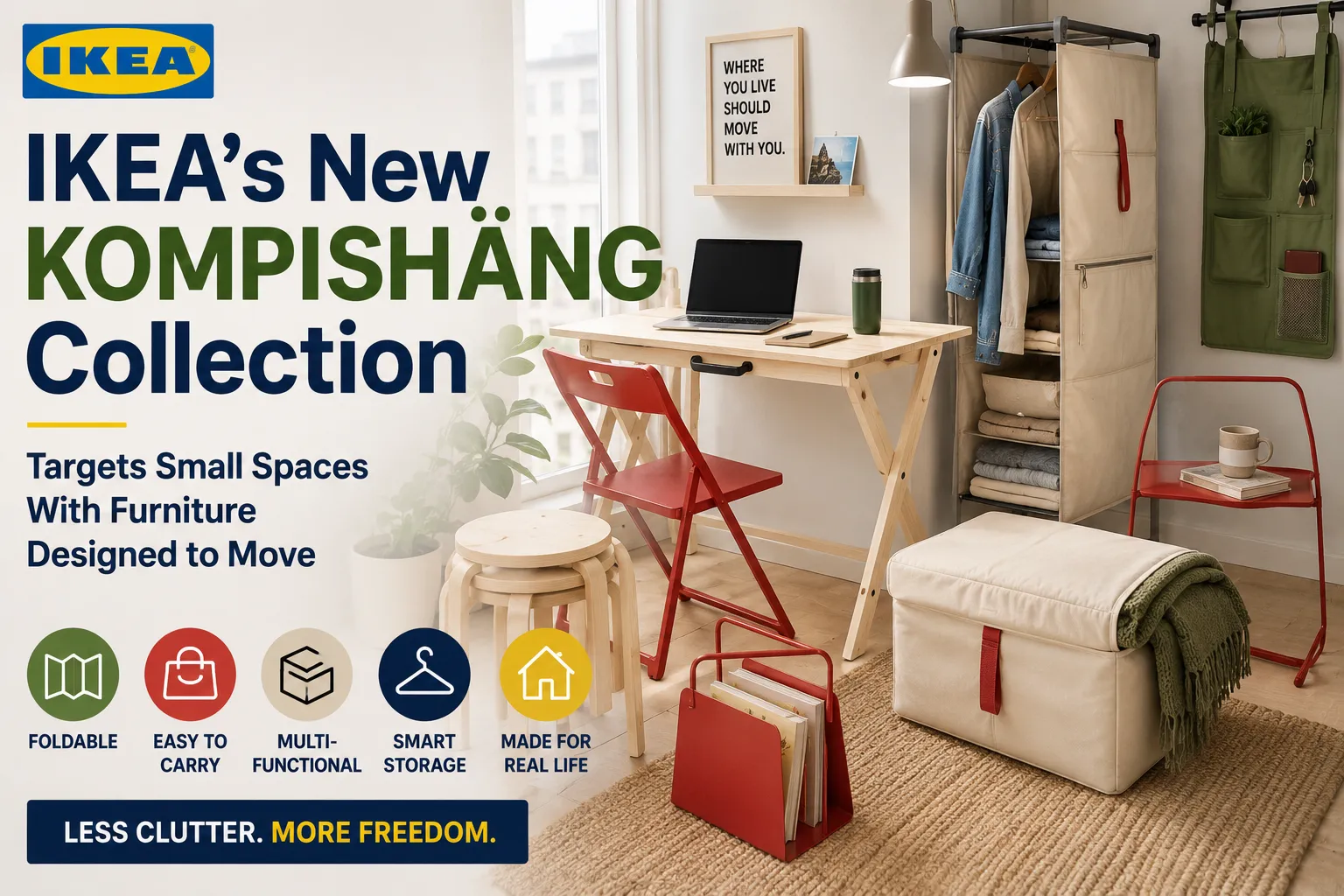
IKEA’s New KOMPISHÄNG Collection Targets Small Spaces With Furniture Designed to Move
For people living in small apartments, rental homes or constantly changing city addresses, furniture can create a surprisingly difficult problem: it needs to work in the space you have today without becoming a burden when you move tomorrow.
IKEA’s new KOMPISHÄNG collection takes that problem as its starting point.
Launching globally in August 2026, the collection is designed around portability, multifunctionality and compact living. IKEA developed the range for young urban residents who may move frequently because of work, housing costs, education or changing lifestyles. Rather than treating furniture as something permanently tied to one room, KOMPISHÄNG treats it as something that can travel with its owner.
The result is a collection of lightweight furniture and home accessories that can be folded, carried, stacked, hung or transformed for different purposes.
For a broader look at how adaptable furniture fits into the shift toward more comfortable, flexible interiors, see how layered comfort is changing modern interior design.
Why IKEA Is Designing Furniture for People Who Move
Traditional furniture is generally designed around permanence.
A desk is assembled in one room. A wardrobe occupies a particular wall. A bookshelf is installed in a specific location. Moving these items often requires disassembly, a vehicle and sometimes professional help.
But urban living does not always work that way.
IKEA says its designers spent time with people aged 20 to 28 living in central London and found that frequent moves were shaping how they bought and used furniture. People were repurposing moving boxes as furniture, improvising storage solutions and carefully selecting possessions that could follow them from one rental to another.
That research became the foundation for KOMPISHÄNG.
The underlying idea is simple: if people are moving more often, furniture should make moving easier rather than harder.
What Makes KOMPISHÄNG Different?
Portability is not an additional feature added after the furniture has been designed.
According to IKEA, it was the starting point for the collection.
The pieces are made using materials including solid pine, powder-coated steel and durable canvas, with designs intended to be easy to carry, store and reuse in different homes.
The collection includes furniture and accessories designed around several principles:
- Compact dimensions
- Multifunctional use
- Foldable construction
- Integrated handles
- Stackable designs
- Hanging storage
- Portable soft furnishings
- Rental-friendly installation
- Easy transportation
This combination makes the collection particularly relevant to smaller homes where every square meter needs to work harder.
A Desk Designed to Move With You
One of the clearest examples of KOMPISHÄNG’s philosophy is its portable desk.
IKEA says the solid-pine desk can be set up without tools or lengthy assembly. Two pulls and two clicks are enough to unfold it, while a built-in handle beneath the tabletop allows it to be carried from one location to another.
That design addresses two problems at once.
First, the desk can provide a workspace in a small apartment without permanently occupying a large amount of floor space.
Second, it can be moved when the room needs to serve another purpose.
IKEA also says the desk can be stored under a bed, in a closet or behind curtains when it is not needed.
For people working from home in multipurpose rooms, that flexibility could be particularly useful.
The Side Table Folds Away
The collection also includes a compact side table designed to be easy to transport and store.
IKEA describes it as a table that can be carried over the shoulder and folded almost completely flat.
That makes it less dependent on a particular room layout.
In a small living space, the same table could potentially serve as a bedside table, occasional work surface, snack table or temporary surface for entertaining guests.
Once it is no longer needed, it can be folded away rather than permanently consuming floor space.
Furniture That Does More Than One Job
Multifunctionality is another major theme throughout KOMPISHÄNG.
That matters in small homes because a single piece of furniture that performs two or three functions can eliminate the need for several separate objects.
IKEA’s collection includes a mattress/pouffe that can function as additional seating and unfold into a sleeping surface. It is also equipped with adjustable shoulder straps, allowing it to be carried more easily when moving.
This type of design is particularly suited to homes where an occasional guest bed might otherwise require valuable storage space.
Instead of keeping a dedicated guest bed permanently available, the same item can function as seating most of the time.
Stackable Stools Become More Than Seating
Another interesting example is the KOMPISHÄNG stool.
The stools can be stacked together and used in different configurations. IKEA says two stools can fit together to create a compact surface for displaying items such as plants or books.
That turns a basic seat into a flexible piece of small-space furniture.
When guests arrive, it can provide additional seating.
When they leave, the stools can be combined or stored more efficiently.
The approach reflects a broader shift in compact-home design: furniture does not necessarily need one permanent function.
Storage That You Can Carry
Storage is one of the biggest challenges in small apartments, especially rental properties where drilling into walls may not be permitted.
KOMPISHÄNG addresses this with portable and hanging storage solutions.
The collection includes a hanging wardrobe organizer that can be converted into a carry bag using a zipper. IKEA describes it as a way to transport clothes while keeping them organized during a move.
That means the storage system itself becomes part of the moving process.
Instead of packing clothing into separate boxes and reconstructing the organization after arriving, the storage unit can travel with the contents already arranged.
Door Storage Without Drilling
KOMPISHÄNG also includes door hangers designed to add storage without requiring permanent installation.
IKEA says one version uses washable canvas while another is made from pine and includes 12 hooks. Both attach using straps rather than screws.
This is particularly relevant to renters.
A door can become additional storage space without drilling holes into a wall or permanently modifying the property.
It is a simple example of how rental restrictions can become a design opportunity.
A Bookend Designed for Homes Without Bookshelves
Another small but distinctive product is the KOMPISHÄNG metal bookend.
Made from red steel, the freestanding design can hold books without requiring a conventional bookshelf. IKEA describes it as having handles that make it easier to transport.
For someone living in a studio apartment, that can be useful.
A full bookcase might occupy too much space, while a small portable book holder can keep a collection organized without committing an entire wall to storage.
The product also reflects one of KOMPISHÄNG’s recurring ideas: portable objects can still contribute to a sense of permanence and personality.
IKEA Wants Rentals to Feel Like Home
Portability is only half of the collection’s design philosophy.
The other half is making temporary housing feel personal.
Renters often face restrictions on drilling, painting and making permanent changes. That can make a home feel temporary even when someone expects to live there for several years.
KOMPISHÄNG includes several pieces designed to add personality without requiring permanent installation.
Its solid-pine mirrors, for example, have slots that can hold photographs, ticket stubs and other personal items.
Instead of simply reflecting the room, the mirror becomes a display for memories.
That distinction is important.
IKEA isn’t only trying to make furniture easier to move. It is trying to make the process of moving less disruptive to people’s sense of home.
This idea also connects with the growing preference for homes that feel individual rather than perfectly coordinated. Interior designers are moving away from showroom-perfect interiors toward more personal homes, and portable pieces can make that personalization easier for renters and frequent movers.
Even the Plant Pot Is Designed for Moving
Perhaps the most unusual example is the KOMPISHÄNG jute plant pot.
Plants can be surprisingly difficult to move. They are fragile, awkwardly shaped and often require additional packaging.
IKEA designed the pot with an integrated cover that can be rolled out to protect the plant during transportation. Large handles make it easier to carry. Once the move is complete, the protective cover can be rolled back into a concealed compartment.
It is a small design detail, but it demonstrates how deeply portability has been incorporated into the collection.
The designers weren’t simply asking, “How do we make furniture lighter?”
They were asking, “What makes moving an entire home difficult, and how can the objects themselves help?”
The Collection Uses a Calmer Visual Language
Small rooms can quickly feel crowded when furniture contains too many competing colors, shapes and patterns.
IKEA says two young industrial design graduates were embedded in the KOMPISHÄNG project and contributed to six of the products during a five-month internship. They pushed the design direction toward natural pine, soft beige and restrained red and green accents.
The resulting aesthetic is relatively understated.
That matters because multifunctional furniture can already introduce visual complexity into a small room.
A calmer palette allows individual pieces to perform several roles without making the entire space feel overly busy.
The emphasis on natural materials and restrained styling also echoes broader Nordic design influences. Similar ideas can be seen in the Nordic interior trends highlighted by Formex, where warmth, functionality and livability remain important parts of contemporary interiors.
KOMPISHÄNG Is Built Around Urban Mobility
The collection reflects a broader change in how many people think about home.
For previous generations, furniture purchases were often associated with settling into a long-term property.
Today, a person’s housing situation may change several times in a relatively short period.
Someone might move from:
student accommodation → shared apartment → studio → larger rental → first owned home.
Furniture that works across those stages has a different kind of value.
A compact table that works in a studio does not necessarily become useless when someone moves into a larger apartment. It can become a side table or additional workspace.
That is the idea behind designing furniture for transitions rather than a single address.
Small-Space Living Is Becoming More Flexible
KOMPISHÄNG also reflects a larger interior-design movement toward adaptable spaces.
Instead of giving every room one fixed purpose, homeowners and renters increasingly need rooms that can change throughout the day.
A living room might become:
- A home office in the morning
- A dining area at lunchtime
- A workout space in the afternoon
- An entertainment area in the evening
Furniture that folds, stacks or moves easily can make these transitions easier.
The benefit isn’t necessarily having less furniture.
It is having furniture that can do more.
The Collection Could Appeal Beyond Young Renters
Although IKEA specifically developed KOMPISHÄNG around young adults in urban environments, the underlying design principles have broader appeal.
The collection could also make sense for:
- Students
- Frequent movers
- Remote workers
- People living in studios
- First-time renters
- People furnishing temporary accommodation
- Guest-room owners
- People who frequently rearrange their homes
- Anyone trying to maximize limited floor space
The portability concept can even be useful in larger homes.
A folding desk, portable side table or flexible seating system can make it easier to change the purpose of a room without buying additional furniture.
Portability Could Also Change How People Think About Furniture
Furniture has traditionally been evaluated using criteria such as appearance, price, comfort and durability.
KOMPISHÄNG adds another consideration:
How easily can I move this?
That question can become surprisingly important.
A beautiful piece of furniture may become a problem if it requires three people to carry it downstairs.
A desk that can be folded and carried by one person may be more useful to someone who expects to move several times.
This suggests that portability could become a more significant consideration in furniture design as housing becomes more flexible.
The Collection Balances Temporary Living With Long-Term Use
One of the most interesting aspects of KOMPISHÄNG is that IKEA does not present the products as disposable solutions for temporary homes.
Instead, the company says the collection is designed to follow people from one home to another and work equally well in a first apartment, a shared home or a longer-term residence.
That creates a different relationship between portability and permanence.
The furniture can move without looking like moving equipment.
The objective is to make the pieces feel like legitimate parts of a home rather than temporary objects waiting for the next relocation.
How KOMPISHÄNG Could Change Small-Space Decorating
The collection suggests a useful principle for anyone furnishing a compact home:
Buy for flexibility, not just for the room you have today.
A piece of furniture can provide more long-term value when it can adapt to different spaces and purposes.
For example, instead of buying a large permanent desk that occupies one corner of a studio, a foldable desk might allow the same room to serve multiple purposes.
Instead of a full guest bed, a mattress/pouffe can provide seating most of the year and sleeping space when needed.
Instead of installing permanent shelving, portable book storage and door-mounted organizers can provide flexible alternatives.
These decisions can help reduce visual clutter while making a small home more adaptable.
KOMPISHÄNG Is Part of a Bigger IKEA Design Direction
KOMPISHÄNG is not IKEA’s first attempt to address small-space living.
The company’s products have long included folding tables, modular storage, multifunctional seating and compact furniture.
What distinguishes KOMPISHÄNG is the extent to which movement itself becomes part of the design brief.
The collection doesn’t simply ask how furniture can fit into a small room.
It asks how furniture can fit into a changing life.
That is a subtle but significant difference.
Availability and Launch Timing
IKEA announced KOMPISHÄNG in July 2026 and said the collection would launch globally in August. Availability and the exact number of products can vary by market: IKEA’s global newsroom describes a 13-piece collection, while the U.S. announcement refers to 11 pieces and a specific U.S. rollout schedule.
IKEA’s global collection page says the range would arrive online and in stores from August 2026.
For shoppers, that means local IKEA websites and stores are the best places to check which KOMPISHÄNG products are actually available in their market.
Why Moveable Furniture Could Matter More in the Future
The most interesting thing about KOMPISHÄNG may not be any individual desk, stool or storage solution.
It is the assumption behind the entire collection.
Home does not necessarily have to mean one permanent address.
People can move for work, education, relationships, affordability or lifestyle reasons. They may live in several different types of homes over the course of a few years.
Furniture designed around that reality can reduce some of the friction involved in those transitions.
KOMPISHÄNG consequently represents more than another IKEA collection for small apartments. It is an example of how interior design is adapting to increasingly flexible patterns of urban living.
The future of small-space furniture may not be about making everything smaller. It may be about making every piece more adaptable—easy to fold, carry, store, repurpose and take with you when the next home comes along.