The Analog Room Is the Latest Interior Design Trend for Homes Trying to Escape Screens
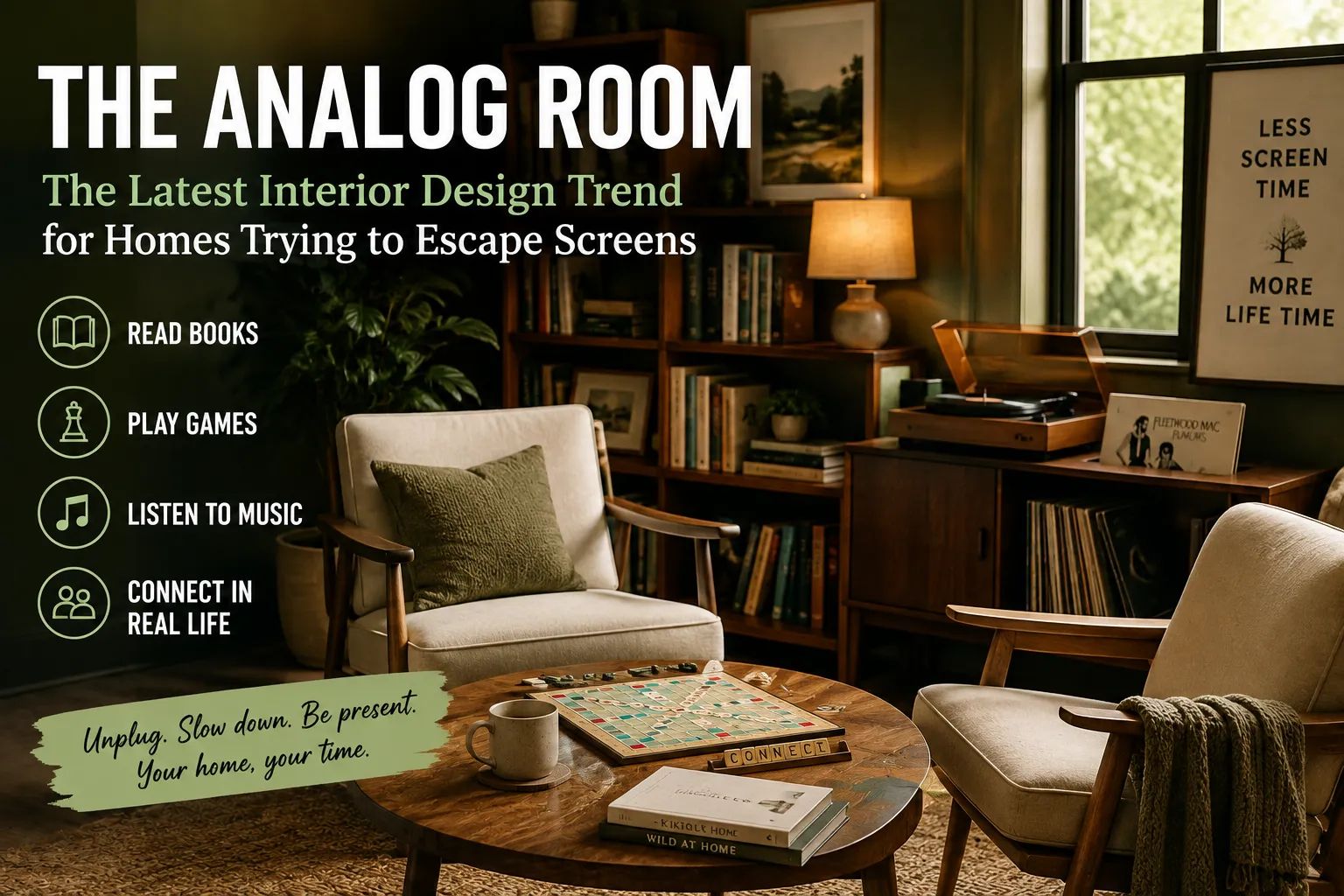
The Analog Room Is the Latest Interior Design Trend for Homes Trying to Escape Screens
For years, the smartest home was supposed to be the most connected one.
Televisions became thinner, speakers became smarter, appliances learned to communicate with phones, and homeowners increasingly embraced technology designed to make everyday life more convenient. But in 2026, a different idea is gaining attention in interior design: the analog room.
Instead of adding another screen, smart display, or connected device, these spaces are deliberately designed around what happens when technology disappears.
An analog room can be a library, music room, games room, reading nook, conversation lounge, creative studio, or simply a quiet corner of a home. What unites them is the absence—or deliberate minimization—of digital distractions. Designers are increasingly describing these spaces as places for reading, listening to music, playing games, creating, talking, and relaxing without a phone or television dominating the experience.
For a broader look at the shift toward warmer, more layered interiors, see Layered Comfort Is Taking Over: Why Designers Are Moving Beyond Minimalist Interiors.
What Is an Analog Room?
An analog room is essentially a purposeful screen-free space within the home.
There is no requirement for the room to look old-fashioned. The concept is less about rejecting modern design and more about creating an environment that encourages offline activities.
A typical analog room might contain:
- Bookshelves filled with physical books
- Comfortable chairs or sofas
- Board games and puzzles
- A writing desk or journal
- Musical instruments
- Vinyl records and a turntable
- Art supplies
- A piano or other acoustic instruments
- Warm, layered lighting
- Natural materials such as wood, linen, leather, and ceramic
- Artwork and objects with personal meaning
The room might have electricity, heating, and ordinary household infrastructure. What it generally avoids is technology that constantly demands attention.
That distinction is important. An analog room is not necessarily an attempt to eliminate technology from the home. It is about giving people one environment where technology is not the center of attention.
Why Homeowners Are Turning Toward Analog Spaces
The popularity of analog rooms reflects a broader change in how people think about their homes.
For much of the smart-home era, technology was marketed as something that could improve almost every room. The kitchen could become connected, the bedroom could become automated, and entertainment could be available instantly.
Now some homeowners are looking for the opposite experience.
Design publications and professionals have reported growing interest in spaces dedicated to reading, music, puzzles, games, and face-to-face interaction.
The underlying appeal is straightforward: homeowners want spaces that help them do something rather than simply consume something.
A television encourages watching. A phone encourages scrolling. A computer encourages working or browsing.
A table with a chessboard encourages playing. A piano encourages making music. A bookshelf encourages reading. Two comfortable chairs facing each other encourage conversation.
The design of the room can therefore influence what people naturally do once they enter it.
The Television Is No Longer Automatically the Room’s Focal Point
Traditional living rooms are frequently arranged around a television.
The sofa faces the screen. Chairs point toward it. Coffee tables are positioned to accommodate viewers. Even architectural features such as fireplaces and built-in shelving can be designed around entertainment systems.
Analog rooms reverse that logic.
Furniture may instead face inward, creating a conversational arrangement. A large table might become the centerpiece rather than a television. A piano, fireplace, bookshelf, artwork, or game table can become the visual and functional focal point.
Designers have noted that analog spaces often change the relationship between furniture and activity, creating environments where people interact with one another rather than orienting themselves toward a screen.
This makes the trend particularly interesting from an interior-design perspective. It is not simply about removing a television. It is about redesigning the room around a different behavior.
Warm Materials Make the Space Feel More Tactile
Analog design also tends to emphasize physical sensations.
Designers working on these spaces have highlighted materials such as wood, linen, paper, ceramic, and leather, along with earthy colors and layered textures.
That can produce a very different atmosphere from the polished, technology-heavy interiors often associated with modern connected homes.
Think:
- Wooden shelving instead of glossy built-ins
- Linen curtains instead of automated blinds
- A textured rug beneath a seating area
- Ceramic lamps and decorative objects
- Leather or fabric furniture
- Handcrafted accessories
- Framed artwork
- Books and physical collections displayed openly
These elements make the room feel more personal and tactile.
The objective is not necessarily to make the space look vintage. A contemporary analog room can still have clean architecture and modern furniture. The important factor is that the environment encourages people to interact with physical objects and one another.
That preference for tactile, natural finishes also connects with the continued popularity of Warm Earth Tones in contemporary interiors.
Lighting Becomes More Important
Lighting can dramatically influence how a room feels, and analog spaces are often designed around softer, layered illumination.
Instead of relying entirely on a bright overhead fixture, designers may combine table lamps, floor lamps, wall lighting, reading lights, and other sources at different heights.
The result is a room that can shift between activities.
A reading corner might need focused lighting. A conversation area may benefit from softer illumination. A games table needs enough light to see the board without making the entire room feel harsh.
Multiple light sources can also help make the room feel more intimate, particularly when combined with natural materials and softer furnishings.
Analog Rooms Do Not Have to Be Entire Rooms
Perhaps the most practical part of the trend is that homeowners do not necessarily need an extra room.
A small apartment can have an analog corner.
A window seat with a comfortable chair, reading lamp, bookshelf, and notebook can serve the purpose. A dining table can become a permanent puzzle or board-game station. An unused corner can become a listening area with a record player and comfortable seating.
Analog spaces can range from full rooms to smaller technology-free areas.
This makes the idea accessible even to people without large homes.
A Small Analog Space Could Include
| Element | Purpose |
|---|---|
| Comfortable chair | Reading or relaxing |
| Floor lamp | Focused illumination |
| Small bookshelf | Physical reading material |
| Side table | Holds books, tea, games or journals |
| Plants | Adds natural texture |
| Artwork | Creates visual interest |
| Analog clock | Provides time without a phone |
| Puzzle or board game | Encourages offline activity |
| Notebook | Supports writing and reflection |
The key is intentionality rather than size.
Music Is Becoming a Natural Centerpiece
Music is another major component of the analog-room concept.
Instead of streaming music through a smart speaker while simultaneously using a phone, homeowners can create dedicated listening environments around physical records, instruments, or other forms of music-making.
A listening room might contain a record player, vinyl collection, acoustic instruments, comfortable seating, and carefully considered acoustics.
Some designers are taking the idea even further. One Washington, D.C., home featured an analog room designed around family music-making, with acoustic treatment and space for instruments. The homeowners also use the room for board games and family interaction.
The important distinction is that music becomes an activity, not merely background content.
Games and Hobbies Give People a Reason to Stay
An empty screen-free room can quickly become unused.
Successful analog spaces therefore give people something to do.
A large table can support:
- Chess
- Cards
- Jigsaw puzzles
- Board games
- Drawing
- Painting
- Model building
- Crafts
- Writing
- Playing musical instruments
This is one reason the trend fits naturally with the renewed interest in libraries, games rooms, music rooms, and other purpose-specific spaces.
The strongest analog room is not simply a room where technology has been removed. It is a room where offline life has been deliberately added.
The Design Is Really About Human Behavior
That may be the most significant idea behind the trend.
Interior design has always influenced behavior.
A kitchen island encourages people to gather around food preparation. A home office separates work from other activities. A reading nook encourages quiet time.
The analog room applies the same principle to digital behavior.
Instead of telling people to put their phones down, the room creates an environment where putting the phone down makes sense.
A comfortable chair and a good book create one invitation.
A game table creates another.
Two sofas facing each other create another.
A musical instrument sitting within easy reach creates yet another.
The architecture and furniture become subtle behavioral cues.
Creating an Analog Room Without Remodeling
For homeowners interested in the idea, a major renovation is unnecessary.
Start by choosing one activity the space should encourage.
If the goal is reading, prioritize a comfortable chair, good lighting, bookshelves, and a quiet location.
If the goal is family connection, use seating that faces one another and add games, puzzles, or a large table.
If music is the priority, build the space around instruments, records, comfortable seating, and suitable acoustics.
If relaxation is the goal, focus on texture, lighting, natural materials, and comfortable furniture.
Then establish a simple technology boundary.
That could mean leaving phones outside the room, removing the television, avoiding smart displays, or simply agreeing that devices are not used during certain activities.
The Nordic design movement also offers useful inspiration here, particularly in its emphasis on comfort, natural materials, and human-centered spaces. Formex 2026 Reveals the Nordic Interior Trends Set to Shape Homes Next explores some of those broader interior-design ideas.
Don’t Turn the Analog Room Into Another Design Performance
There is also a danger in making the concept too complicated.
An analog room does not need expensive vintage furniture, rare records, designer lighting, or a dedicated renovation budget.
The underlying idea is much simpler.
A room should contain things that make you want to be there.
A secondhand bookshelf can be more useful than an expensive decorative shelving system if it encourages you to read. A simple table can become the heart of a family games room. A comfortable chair beside a window can create a better retreat than an elaborate entertainment space.
The goal is not to recreate a particular historical period.
It is to create a place where people can spend time without constantly being asked to look at a screen.
Why the Analog Room Could Have Staying Power
Like many interior design trends, the name itself may eventually change.
But the need behind it is broader than a particular decorating style.
As technology becomes increasingly embedded in everyday life, homeowners may continue to look for ways to create boundaries between connected and disconnected experiences.
That could mean a dedicated library, listening room, hobby room, meditation space, games room, or simply a comfortable corner where phones are deliberately left elsewhere.
Design publications have identified analog spaces as part of a broader movement toward homes that act as refuges from digital noise, while other designers have described growing demand for tech-free rooms.
That suggests the most enduring part of the trend may not be the phrase “analog room.”
It may be the underlying principle: designing homes around how people want to live, rather than around how many devices a home can accommodate.
Designing a Home That Gives Attention Back
The rise of the analog room represents an intriguing reversal in interior design.
For years, homeowners were encouraged to make their houses smarter. Now some are deliberately creating spaces that are less connected.
The result is not necessarily anti-technology. Instead, it is about balance.
A home can have smart appliances, fast internet, automated lighting, streaming entertainment, and connected security while still containing one room where none of those things matter.
That room might hold a stack of books, a deck of cards, a guitar, a record player, a puzzle, or simply two comfortable chairs.
And perhaps that is the real appeal of the analog room: it gives the home a place where nothing needs to be updated, charged, streamed, or scrolled—people can simply sit down and be there.