Designers Are Declaring War on Dated 2010s Interiors
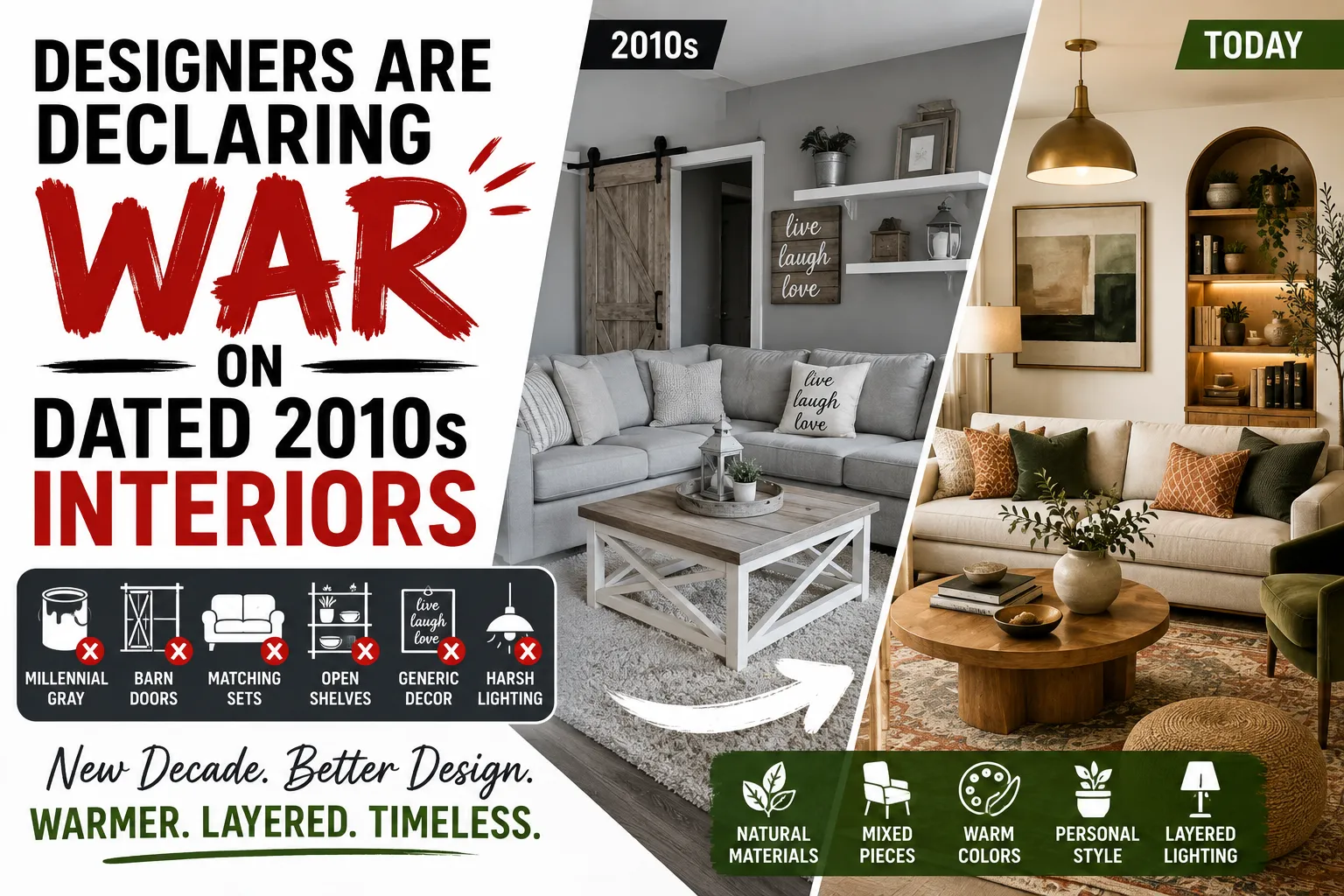
Designers Are Declaring War on Dated 2010s Interiors
For years, the 2010s had a remarkably recognizable interior-design formula: cool gray walls, white kitchens, farmhouse accents, barn doors, open shelving, matching furniture and carefully coordinated neutral décor.
At the time, the look felt fresh, clean and aspirational. Today, designers increasingly see some of those same choices as visual shorthand for a home that has not been updated in years.
The shift is not simply about replacing one trend with another. In 2026, designers are increasingly favoring warmth, individuality, natural materials, layered lighting, vintage pieces and interiors that look collected rather than purchased as a complete package. This broader movement fits into the shift toward layered comfort in interior design rather than simply replacing one rigid decorating formula with another.
That does not mean every home with gray paint or a white kitchen is suddenly “wrong.” Good design is rarely that absolute. Instead, the industry is moving away from interiors that appear designed around a single formula.
Why 2010s Design Is Suddenly Looking Dated
The 2010s were heavily influenced by the rise of Pinterest, Instagram, home-improvement television and highly shareable room makeovers.
Design ideas could spread extraordinarily quickly. A particular kitchen style or color palette could move from a designer showroom to thousands of homes in a remarkably short period.
That created a paradox.
The more popular a look became, the less individual it eventually felt.
A room could be attractive, expensive and professionally renovated while still looking remarkably similar to thousands of other homes.
The current backlash is partly a reaction to that sameness.
1. The End of the “Millennial Gray” Era
Perhaps no color is more strongly associated with 2010s interiors than cool gray.
Gray walls, gray sofas, gray flooring and gray accessories became a common combination because the color was easy to coordinate and appeared sophisticated without demanding much visual commitment.
But designers increasingly favor warmer neutrals.
The change does not necessarily mean covering every gray wall with bright color.
Instead, homeowners can introduce warmth through:
- Cream and warm-white paint
- Natural wood
- Beige and taupe
- Terracotta
- Caramel and cognac tones
- Warm stone
- Brass and bronze finishes
- Textured fabrics
The result is a space that feels softer and more layered rather than uniformly cool.
This preference for warmer palettes is also reflected in the growing interest in warm earth tones across contemporary interiors.
2. All-White Kitchens Are Losing Their Monopoly
The all-white kitchen was one of the defining looks of the 2010s.
White cabinets, white backsplash tile, white countertops and stainless-steel appliances created a clean appearance that photographed exceptionally well.
But the downside became increasingly apparent: without contrasting materials, many kitchens began to look interchangeable.
Designers are now experimenting with:
- Wood cabinetry
- Colored cabinets
- Natural stone
- Handmade-looking tiles
- Aged metals
- Darker islands
- Statement countertops
- Mixed cabinet finishes
The lesson isn’t that white kitchens are obsolete.
White can still be timeless.
The issue is using white everywhere without introducing texture, contrast or personality.
3. Farmhouse Style Is Getting a Reality Check
Modern farmhouse design was enormously influential during the 2010s.
Shiplap walls, barn doors, distressed finishes, galvanized accessories and rustic signage became staples of the look.
But the formula eventually became so recognizable that designers began questioning whether the farmhouse aesthetic had become more of a decorating template than an authentic architectural style.
That distinction is important.
A genuine farmhouse can absolutely look beautiful.
The problem is adding farmhouse elements to an otherwise unrelated home simply because they were fashionable.
Today’s approach is more likely to borrow individual elements—perhaps reclaimed wood, a vintage cabinet or traditional hardware—without turning the entire room into a themed set.
4. Matching Furniture Sets Are Falling Out of Favor
Buying a complete bedroom or living-room furniture set used to be an easy way to create a coordinated interior.
But highly coordinated furniture can also make a room feel like a showroom.
Designers increasingly favor collected interiors, where different periods, materials, colors and silhouettes coexist.
Instead of purchasing:
Sofa + matching loveseat + matching chair + matching tables
a more contemporary approach might combine:
- A modern sofa
- A vintage side table
- An antique-style cabinet
- A sculptural chair
- A handmade rug
- Different lighting styles
- Personal artwork
The goal is not deliberate randomness.
It is creating a room that looks as though it developed naturally over time.
5. Fast Furniture Is Facing a Character Problem
The 2010s helped normalize inexpensive, rapidly produced furniture and décor.
The advantage was obvious: homeowners could completely transform a room without spending a fortune.
The disadvantage is that mass-market pieces can make thousands of homes look almost identical.
Current design thinking is increasingly interested in longevity, craftsmanship and individuality.
That doesn’t mean every homeowner needs expensive antiques.
A more individual room can be created by combining affordable contemporary furniture with:
- Secondhand finds
- Vintage accessories
- Handmade objects
- Family heirlooms
- Local artwork
- Natural materials
One distinctive object can sometimes contribute more personality than an entire shelf of coordinated accessories.
6. Open Shelving Is Being Reconsidered
Open shelving became a major kitchen trend during the 2010s.
It promised an airy, minimalist appearance and created an opportunity to display attractive dishes and accessories.
But there is a practical problem: open shelves require maintenance.
Everything is visible.
Dust accumulates. Items need to be organized. Everyday objects can quickly become visual clutter.
That has contributed to renewed interest in closed storage and a mixture of open and concealed cabinetry.
The broader design principle is becoming increasingly important:
A beautiful home still has to work for the people who live there.
A design decision that looks excellent in a photograph may not necessarily be the best choice for a busy household.
7. Accent Walls Are Being Replaced by More Cohesive Color
The classic 2010s accent wall often involved painting one wall a dramatically different color while leaving the remaining walls neutral.
It was an easy way to introduce color without committing to an entire room.
Today, designers are increasingly experimenting with more immersive approaches, including:
- Color drenching
- Wallpaper across multiple walls
- Tonal interiors
- Coordinated ceilings
- Deeper colors
- Layered shades of the same hue
The result can feel more intentional than simply creating one isolated feature wall.
That said, accent walls have not disappeared completely.
The more important question is whether the color has a meaningful relationship with the room’s architecture, furniture and lighting.
8. Gray Flooring Is Losing Ground to Natural Wood
Gray flooring was another defining feature of many 2010s renovations, particularly in homes using engineered flooring and luxury vinyl products.
Its popularity made sense. Gray floors worked with cool neutral walls and created a contemporary appearance.
But today’s interiors increasingly favor warmer wood tones.
Natural-looking materials are becoming particularly important because they add variation that manufactured uniformity often lacks.
Wood grain, stone variation and textured surfaces can make a room feel more organic.
9. Minimalism Is Becoming Warmer
One of the biggest misconceptions about the current design shift is that designers have abandoned minimalism completely.
They haven’t.
Instead, cold minimalism is giving way to warmer minimalism.
The difference can be subtle.
Cold minimalism
- Stark white
- Polished surfaces
- Chrome
- Hard geometric lines
- Minimal decoration
- Limited texture
Warmer minimalism
- Warm whites
- Natural wood
- Stone
- Soft textiles
- Aged metals
- Sculptural objects
- Layered lighting
- Carefully selected artwork
The objective remains restraint.
But restraint no longer has to mean sterility.
10. Personality Is Becoming the New Luxury
Perhaps the biggest change is philosophical.
For much of the 2010s, luxury could mean having the “right” kitchen, the “right” sofa and the “right” neutral palette.
In today’s design conversation, luxury is increasingly associated with authenticity and individuality.
That can mean:
- A painting you actually love
- A chair inherited from a relative
- A handmade ceramic collection
- A vintage rug
- Books that reflect your interests
- Travel objects
- Unusual lighting
- Colors that have personal meaning
This is an important distinction.
A home does not need to look expensive to look sophisticated.
It needs to look considered.
What Designers Are Choosing Instead
The emerging alternative to the 2010s formula can be summarized in a simple comparison:
| 2010s Approach | Emerging Direction |
|---|---|
| Cool gray | Warm neutrals |
| All-white kitchens | Mixed materials and color |
| Matching furniture | Collected furniture |
| Mass-produced décor | Vintage and personal pieces |
| Barn-door décor | Architectural authenticity |
| Gray flooring | Warm natural wood |
| Open shelving everywhere | Balanced storage |
| Single accent walls | Cohesive color |
| Harsh overhead lighting | Layered lighting |
| Generic wall signs | Original artwork |
| Fast furniture | Durable, distinctive pieces |
| Photo-ready rooms | Livable rooms |
This does not mean every item on the left should immediately be removed.
Good interior design is not a race to erase the previous decade.
How to Update a 2010s Home Without Remodeling Everything
The easiest mistake is assuming that making a home feel current requires a complete renovation.
It usually doesn’t.
Start With Lighting
Replace harsh, single-source overhead lighting with layers.
Use:
- Table lamps
- Floor lamps
- Wall lighting
- Pendant fixtures
- Dimmable lights
- Accent lighting
Layered lighting can dramatically change the atmosphere of a room without changing its architecture.
Introduce Natural Materials
Wood, linen, stone, wool, rattan and ceramics can soften an overly uniform interior.
Replace Generic Artwork
Take down mass-produced signs and decorative phrases if they no longer reflect your taste.
Replace them with artwork you genuinely enjoy.
Break Up Matching Sets
You don’t necessarily have to throw away your furniture.
Introduce one or two contrasting pieces instead.
Add Color Gradually
Try:
- Throw pillows
- Curtains
- Artwork
- Rugs
- Lamps
- Accent chairs
- Painted cabinetry
before committing to an entire room.
Mix Old and New
A contemporary sofa can work beautifully with a vintage table.
An antique mirror can complement modern lighting.
The contrast is often what makes the room interesting.
Not Every 2010s Trend Needs to Disappear
It is worth resisting the temptation to declare an entire decade aesthetically obsolete.
Some 2010s ideas remain useful.
Open-plan layouts can still work extremely well. Neutral colors remain versatile. Minimalism can create calm, functional environments. Mid-century modern furniture continues to have enduring appeal.
Even trends that designers once considered dated can return in modified form.
A 2026 interior does not necessarily need to reject everything associated with 2010–2019.
That is how design cycles usually work.
The past rarely disappears.
It gets edited.
The Real Shift Is From Trend-Driven to Character-Driven
The backlash against 2010s interiors isn’t really about gray paint, barn doors or white cabinets.
It is about over-standardization.
The internet made it easier than ever for homeowners to discover beautiful rooms. It also made it easier for everyone to buy the same furniture, copy the same kitchen and reproduce the same aesthetic.
Now designers are increasingly encouraging homeowners to create spaces that are:
- More personal
- More comfortable
- More durable
- More layered
- More tactile
- More sustainable
- Less dependent on short-lived trends
That shift is closely connected to the broader movement toward homes that feel less like carefully staged showrooms and more like genuine reflections of the people who live in them.
The Home You Love Matters More Than the Home That Trends
The easiest way to avoid having a dated home five years from now is surprisingly simple: stop designing exclusively for the current trend cycle.
Choose materials you genuinely like. Buy furniture that works for your lifestyle. Keep pieces with history. Add color because you enjoy it, not because an algorithm says it is fashionable. And when you renovate, prioritize proportion, functionality, quality and architecture before chasing whatever aesthetic dominates social media.
The 2010s taught homeowners the power of simplicity and visual cohesion.
The next era of interior design appears to be keeping those lessons while adding something the trend-driven decade often lacked: character.