Upholstery Cleaning Guide: How to Clean Furniture
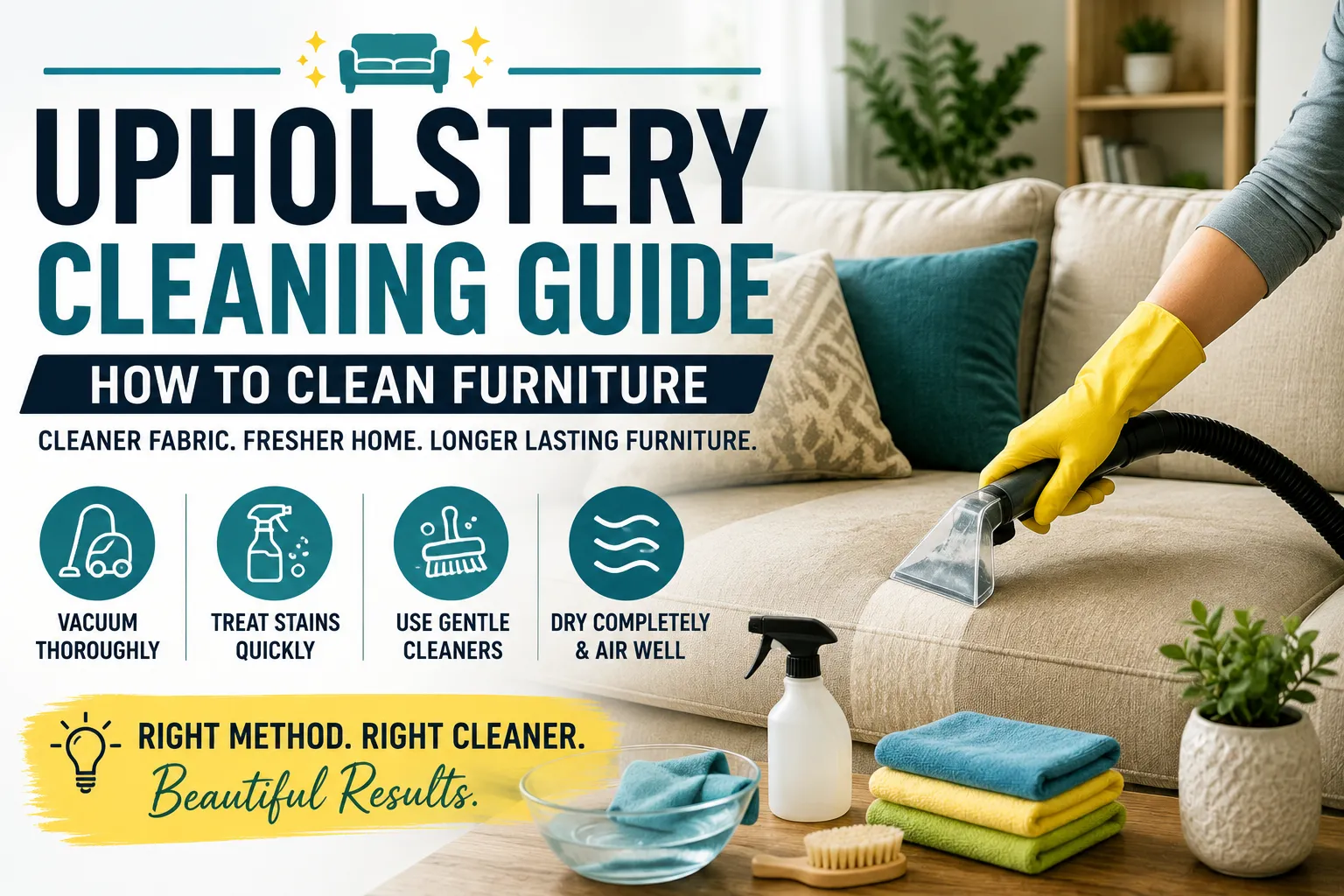
Upholstery Cleaning Guide: How to Clean Furniture
Upholstered furniture is one of the hardest-working parts of a home.
Sofas, armchairs, dining chairs, ottomans and fabric headboards absorb everyday dust, body oils, food crumbs, spills and odors. Over time, even furniture that looks reasonably clean can develop dull fabric, stains and unpleasant smells.
The good news is that upholstery doesn’t always need professional cleaning every time it gets dirty. With the right method, many everyday problems can be handled at home.
The important part is knowing what type of fabric you’re dealing with, what the manufacturer’s care instructions say, and which cleaning method is appropriate.
Using too much water, the wrong detergent or excessive scrubbing can permanently damage some upholstery. That’s why cleaning furniture should be approached more carefully than cleaning a hard floor or countertop. For a broader approach to maintaining a clean home, see The Ultimate Guide to Cleaning Your Home.
Here’s a practical guide to cleaning upholstered furniture safely, removing common stains, controlling odors and knowing when it’s time to call a professional.
Why Regular Upholstery Cleaning Matters
Upholstery collects more than visible dirt.
Fabric furniture can accumulate:
- Dust
- Food crumbs
- Pet hair
- Body oils
- Sweat
- Skin flakes
- Allergens
- Spilled drinks
- Grease
- Odors
- Pet accidents
Regular cleaning helps keep furniture looking better and can extend the useful life of the fabric.
It can also make a room feel noticeably fresher.
However, upholstery should not be aggressively cleaned simply because it looks slightly dusty. Different materials respond differently to moisture, heat, detergents and agitation.
The safest approach is clean according to the fabric and manufacturer’s instructions.
Before You Clean: Check the Upholstery Care Label
This is the most important step.
Many upholstered furniture pieces have a cleaning code attached underneath a cushion, beneath the furniture or on a manufacturer’s label.
Common codes include:
W — Water-Based Cleaning
The fabric can generally be cleaned with water-based upholstery products.
S — Solvent-Based Cleaning
The fabric should generally be cleaned with an appropriate solvent rather than water.
WS or SW — Water or Solvent
Either type of cleaning method may be appropriate, depending on the manufacturer’s instructions.
X — Vacuum Only
The upholstery should generally not be cleaned with water or solvents at home.
If your furniture has an “X” code, don’t assume that a homemade cleaning solution is safe.
When in doubt, check the manufacturer’s instructions or consult a professional upholstery cleaner.
Why Fabric Identification Matters
“Fabric sofa” isn’t a sufficiently specific description.
Upholstery can be made from:
- Cotton
- Linen
- Wool
- Polyester
- Nylon
- Acrylic
- Rayon
- Velvet
- Microfiber
- Leather
- Faux leather
- Blended fabrics
Each material can react differently to moisture and cleaning products.
Some fabrics can shrink.
Others can develop water rings.
Some colors may bleed.
Some delicate fabrics can be permanently damaged by aggressive brushing.
The safest cleaning technique is therefore determined by the specific material and care instructions, not simply by how dirty the furniture looks.
Gather Your Cleaning Supplies
For routine upholstery cleaning, you may need:
- Vacuum cleaner with upholstery attachment
- Soft-bristled brush
- Microfiber cloths
- Clean white towels
- Mild upholstery cleaner
- Appropriate water-based or solvent-based cleaning product
- Soft sponge
- Spray bottle if permitted by the care instructions
- Fan for drying
- Bucket where appropriate
Avoid automatically reaching for strong household chemicals.
A product that works well on a bathroom floor may be completely inappropriate for upholstery. Choosing appropriate products is also covered in Cleaning Products Explained.
Always Test a Cleaning Product First
Before cleaning the entire sofa, test the product on a small, inconspicuous area.
Look for:
- Color transfer
- Fading
- Bleeding
- Texture changes
- Shrinking
- Water marks
- Surface damage
Allow the test area to dry completely before deciding whether the method is safe.
A small hidden test can prevent a large and expensive mistake.
Step 1: Remove Loose Cushions
If the cushions are removable, take them outside or into another area before cleaning.
Check underneath them.
You may find:
- Crumbs
- Pet hair
- Dust
- Coins
- Dirt
- Small objects
This is also a good opportunity to inspect the entire furniture frame.
Step 2: Vacuum Thoroughly
Vacuuming should usually be the first actual cleaning step.
Use an upholstery attachment if you have one.
Work slowly across:
- Seat cushions
- Back cushions
- Armrests
- Sides
- Crevices
- Under cushions
- The back of the furniture
- Areas around seams
Pay particular attention to corners and gaps where debris collects.
For a broader look at household vacuuming equipment and other useful cleaning equipment, see Cleaning Tools: Complete Guide to Household Tools & Uses.
Don’t Forget the Furniture Frame
People often clean only the cushions.
But dust can accumulate along:
- Armrests
- Side panels
- Back panels
- Under the sofa
- Wooden or metal components
Vacuum the entire piece where accessible.
Step 3: Deal With Pet Hair
If vacuuming doesn’t remove all pet hair, try a slightly damp microfiber cloth or a suitable pet-hair removal tool.
A rubber glove can also help gather hair from some fabrics.
Work gently.
Aggressive rubbing can push hair deeper into the upholstery.
Step 4: Identify Stains Before Cleaning
Don’t treat every stain the same way.
Try to determine what caused it.
Common upholstery stains include:
- Coffee
- Tea
- Juice
- Wine
- Grease
- Food
- Ink
- Mud
- Makeup
- Blood
- Pet urine
- Vomit
The appropriate treatment can differ significantly depending on the substance.
For additional guidance on dealing with different household stains, see the Stain Removal Guide.
The Golden Rule for Fresh Spills
Blot—don’t scrub.
When a liquid is spilled, immediately use a clean, absorbent cloth to gently blot the area.
Start from the outside of the spill and work toward the center.
The goal is to lift liquid from the fabric rather than push it deeper.
Scrubbing can:
- Spread the stain
- Damage fibers
- Create a larger wet area
- Push the substance deeper into the cushion
How to Remove a Water-Based Spill
For an upholstery fabric labeled appropriate for water-based cleaning:
- Blot the spill immediately.
- Remove as much liquid as possible.
- Use the recommended upholstery cleaner.
- Apply the smallest practical amount.
- Gently work the product according to its instructions.
- Blot away residue.
- Allow the fabric to dry thoroughly.
Avoid saturating the cushion.
The inside of a thick cushion can remain wet long after the surface appears dry.
How to Clean Coffee and Tea Stains
Fresh coffee and tea should be addressed quickly.
Step 1
Blot as much liquid as possible.
Step 2
Use an upholstery cleaner compatible with the fabric.
Step 3
Apply it carefully rather than soaking the area.
Step 4
Blot and repeat if necessary.
Step 5
Allow the area to dry completely.
Don’t aggressively scrub the stain in an attempt to remove it quickly.
How to Clean Food Stains
Remove solid food first.
Use a spoon or dull edge to lift material without grinding it into the fabric.
Then:
- Vacuum loose particles.
- Blot any remaining moisture.
- Use a fabric-appropriate cleaner.
- Work gently from the outside inward.
- Remove residue as directed.
- Dry thoroughly.
Greasy foods may require a different approach from water-based foods.
How to Remove Grease and Oil
Oil-based stains can be particularly stubborn.
Avoid immediately adding large amounts of water.
For upholstery that permits solvent-based cleaning, use an appropriate upholstery solvent according to its instructions.
For fabrics labeled for water-based cleaning, use a product specifically designed for grease removal on upholstery.
Always test first.
If grease has also accumulated elsewhere in your home, see How to Remove Kitchen Grease Buildup for broader cleaning guidance.
How to Remove Ink
Ink can be difficult to remove because different inks contain different dyes and solvents.
Don’t immediately experiment with household alcohol, bleach or other strong chemicals.
The wrong product can spread the ink or damage the fabric.
Use a manufacturer-approved upholstery stain remover or consult a professional cleaner if the stain is significant.
How to Handle Makeup Stains
Makeup can contain oils, pigments and waxes.
Remove excess material carefully without spreading it.
Then use an upholstery-safe cleaner appropriate for the fabric.
Avoid rubbing aggressively.
For delicate or light-colored upholstery, professional cleaning may be the safest option.
How to Deal With Pet Accidents
Pet urine presents two separate problems:
- The visible stain
- The odor and contamination that may remain inside the cushion
Surface cleaning alone may not completely remove the problem.
If the liquid has penetrated deeply into the cushion, professional extraction may be necessary.
An enzyme-based cleaner specifically designed for pet accidents may help with certain washable upholstery, but it should only be used when compatible with the fabric.
Never assume that a product safe for carpets is automatically safe for every upholstery fabric.
How to Remove Odors From Upholstery
Odors can come from:
- Sweat
- Food
- Pets
- Smoke
- Moisture
- Spills
- General buildup
Start by thoroughly vacuuming the furniture.
Then improve ventilation and allow the upholstery to dry completely.
For some fabrics, an appropriate upholstery deodorizer may help.
However, masking an odor with fragrance doesn’t remove its source.
If the smell keeps returning, something may be trapped inside the cushion.
For broader strategies for identifying and eliminating household smells, see the Odor Removal Guide: How to Remove Household Smells.
What About Baking Soda?
Baking soda is sometimes used as a household deodorizer.
For upholstery, however, don’t assume it is appropriate for every fabric.
If the manufacturer permits dry deodorizing methods, a small amount may be used carefully, followed by thorough vacuuming.
But excessive powder can become difficult to remove from tightly woven fabrics and cushions.
When manufacturer instructions prohibit powders, follow those instructions instead.
Deep Cleaning Upholstery
Routine vacuuming and spot cleaning are useful, but furniture may eventually need deeper cleaning.
Depending on the fabric and care code, deep cleaning may involve:
- Upholstery extraction
- Low-moisture cleaning
- Dry cleaning
- Steam cleaning where specifically permitted
- Professional solvent cleaning
The correct method depends on the material.
If you’re trying to determine how often different parts of your home require deeper cleaning, see How Often Should You Deep Clean?.
Is Steam Cleaning Safe for Upholstery?
Not always.
Steam involves heat and moisture, and some fabrics can be damaged by either.
Potential problems include:
- Shrinking
- Color bleeding
- Water marks
- Adhesive damage
- Texture changes
- Moisture trapped inside cushions
Never steam-clean upholstery simply because you have a steam cleaner.
Check the manufacturer’s instructions first.
Can You Use a Carpet Cleaner on a Sofa?
Sometimes specialized upholstery attachments can be used with machines designed for upholstery.
But a carpet-cleaning machine isn’t automatically suitable for every sofa.
The main concerns are:
- Excess moisture
- Strong detergents
- Suction strength
- Fabric sensitivity
- Cushion construction
If the manufacturer doesn’t approve machine cleaning, don’t assume the machine is safe.
How to Clean a Microfiber Sofa
Microfiber upholstery is relatively common and can be durable, but cleaning instructions still vary.
Start by:
- Checking the care code.
- Vacuuming thoroughly.
- Testing the recommended cleaner.
- Treating stains individually.
- Avoiding excessive moisture.
- Allowing the fabric to dry completely.
Some microfiber fabrics can develop temporary texture changes after cleaning.
A soft brush may help restore the surface once it is completely dry if the manufacturer permits it.
How to Clean Velvet Upholstery
Velvet requires particular care.
Avoid aggressive scrubbing and excessive moisture.
Depending on the type of velvet, cleaning may require specialized techniques.
Always follow the manufacturer’s care instructions.
If the velvet is expensive, antique or especially delicate, professional cleaning is generally the safer choice.
How to Clean Linen Upholstery
Linen can be attractive and breathable but may be sensitive to moisture and agitation.
Potential problems include:
- Shrinkage
- Wrinkling
- Water marks
- Color changes
Use only a cleaning method approved for the particular fabric.
Don’t assume that because linen clothing can be washed, a linen-upholstered sofa can be treated the same way.
How to Clean Cotton Upholstery
Cotton upholstery can often be cleaned successfully, but the specific fabric construction and dye determine what is safe.
Some cotton upholstery can tolerate water-based cleaning.
Others may require professional or specialized cleaning.
Again, the care label comes first.
How to Clean Leather Furniture
Leather is different from fabric upholstery.
Start by removing dust with a soft cloth or suitable vacuum attachment.
Then use a leather cleaner and conditioner specifically intended for the type of leather.
Avoid:
- Harsh detergents
- Excessive water
- Household disinfectants
- Abrasive scrubbing
- Products not designed for leather
Different types of leather—including aniline, semi-aniline and protected leather—can require different care.
What About Faux Leather?
Synthetic leather can often be wiped more easily than fabric, but it isn’t indestructible.
Avoid strong solvents and abrasive cleaning tools unless specifically approved by the manufacturer.
Regular gentle cleaning can help prevent dirt and oils from building up.
Don’t Saturate Upholstered Furniture
This is one of the most important rules of upholstery cleaning.
A sofa cushion is much thicker than a shirt.
If you soak the surface, water can penetrate deep into:
- Foam
- Padding
- Batting
- Fabric backing
- Wood components
This can create prolonged drying times and potentially lead to:
- Musty odors
- Mold or mildew growth
- Fabric damage
- Cushion deformation
Use the minimum amount of moisture necessary for the approved cleaning method.
Drying Is Part of Cleaning
Cleaning isn’t finished when the stain disappears.
The furniture also needs to dry properly.
After appropriate cleaning:
- Increase air circulation
- Open windows when conditions allow
- Use fans
- Keep cushions separated where possible
- Avoid sitting on damp upholstery
- Allow the interior to dry fully
Don’t cover wet furniture with blankets or plastic.
How Long Does Upholstery Take to Dry?
Drying time varies depending on:
- Fabric
- Cushion thickness
- Cleaning method
- Humidity
- Air circulation
- Amount of moisture used
A lightly damp surface may dry relatively quickly.
A heavily saturated cushion can take much longer.
Don’t judge dryness solely by touching the surface.
The inside may still be damp.
How Often Should You Clean Upholstered Furniture?
There isn’t one universal schedule.
A practical routine is:
Weekly
- Vacuum high-use furniture
- Remove crumbs
- Address fresh spills
Monthly
- Vacuum more thoroughly
- Check cushions and crevices
- Inspect for developing stains and odors
Every 6–12 Months
Consider a deeper cleaning depending on:
- Household traffic
- Pets
- Children
- Allergies
- Smoking
- Furniture use
- Fabric type
High-use furniture may need more frequent attention.
Homes With Pets Need More Frequent Cleaning
Pets can introduce:
- Hair
- Dirt
- Oils
- Odors
- Outdoor debris
- Accidental stains
If pets regularly use the sofa, vacuum more frequently.
Wash removable covers according to their care instructions.
Consider using washable throws or furniture covers in areas where pets spend the most time.
Homes With Children Need a Different Strategy
Children can turn a clean sofa into a snack table surprisingly quickly.
Useful habits include:
- Treating spills immediately
- Vacuuming crumbs regularly
- Keeping food in designated areas
- Using washable throws
- Keeping appropriate stain-removal supplies nearby
The goal isn’t to prevent every spill.
It’s to make cleanup easier when spills happen.
Upholstery Cleaning for Allergy-Sensitive Homes
Fabric furniture can hold dust and other particles.
Regular vacuuming with an appropriate vacuum cleaner can help reduce accumulated dust.
Focus on:
- Sofas
- Armchairs
- Fabric headboards
- Cushioned dining chairs
- Curtains
- Decorative cushions
If someone in the household has significant allergies or respiratory problems, discuss appropriate cleaning strategies with a healthcare professional rather than relying on household cleaning claims.
Should You Remove Cushion Covers?
Only if they’re designed to be removable and washable.
Check the care label before putting them in a washing machine.
Potential problems from incorrect washing include:
- Shrinkage
- Color bleeding
- Zipper damage
- Fabric distortion
- Covers no longer fitting the cushion
A removable cover isn’t automatically machine washable.
Don’t Assume “Dry Clean Only” Means You Can Wash It
If a manufacturer’s instructions specify dry cleaning or professional cleaning, don’t experiment with water-based washing.
Some fabrics can look fine immediately after washing but shrink or distort as they dry.
Replacing an entire cushion cover can be far more expensive than professional cleaning.
Common Upholstery Cleaning Mistakes
1. Scrubbing Too Hard
Aggressive rubbing can damage fibers and spread stains.
2. Using Too Much Water
Over-wetting is one of the biggest upholstery problems.
3. Ignoring the Care Label
The wrong cleaning method can permanently damage furniture.
4. Using Household Bleach
Bleach can discolor or weaken upholstery.
5. Mixing Cleaning Chemicals
Different cleaning products can react with each other and create dangerous fumes or unwanted chemical reactions.
Never mix cleaning products unless the manufacturer specifically says the combination is safe.
6. Skipping the Patch Test
Always test unfamiliar products.
7. Not Drying Properly
Moisture trapped inside cushions can create persistent problems.
8. Cleaning the Stain but Ignoring the Source
If a pet repeatedly soils the same cushion, removing the surface stain won’t solve the underlying issue.
Why White Cloths Are Useful
When cleaning upholstery, a clean white or light-colored cloth can help you see whether:
- Dirt is transferring
- Dye is bleeding
- The cleaning product is lifting color
A brightly colored cloth can itself transfer dye onto light upholstery.
For this reason, white microfiber cloths are often a safer choice for spot cleaning.
What Not to Use on Upholstery
Unless specifically approved for your fabric, avoid experimenting with:
- Household bleach
- Strong disinfectants
- Abrasive powders
- Undiluted acids
- Harsh solvents
- Strong degreasers
- Nail-polish remover
- Excessive ammonia
- Unverified DIY mixtures
The fact that a chemical removes a stain from a hard surface doesn’t mean it is safe for fabric.
Why Vinegar Isn’t a Universal Upholstery Cleaner
Vinegar is frequently recommended online as a natural cleaning solution.
It can be useful for some household applications, but it shouldn’t automatically be used on every sofa.
Potential concerns include:
- Fabric sensitivity
- Color changes
- Odor
- Interaction with existing cleaning products
- Manufacturer restrictions
If you use vinegar for any upholstery application, first confirm that it is compatible with the material and care instructions.
What About Dish Soap?
Dish soap is designed to remove grease from dishes, not necessarily to clean upholstery.
Some mild formulations may be suitable for certain water-cleanable fabrics, but using too much can leave residue.
If the manufacturer doesn’t recommend it, a purpose-designed upholstery cleaner is generally a safer choice.
How to Remove Water Rings
Water rings can occur when a liquid dries unevenly.
Before attempting to fix the mark, identify the fabric’s cleaning code.
For water-cleanable fabrics, a professional or manufacturer-approved method may involve treating a broader area rather than repeatedly spot-cleaning the ring itself.
Repeated localized wetting can sometimes make the appearance worse.
How to Prevent Water Rings
When cleaning a stain, avoid creating a tiny, heavily saturated spot surrounded by completely dry fabric.
Follow the recommended cleaning technique for the entire affected area.
Most importantly, don’t improvise if the care instructions prohibit water.
How to Deal With Smoke Odors
Smoke can penetrate upholstery deeply.
Vacuuming can help remove surface particles, but persistent smoke odor may remain inside cushions and padding.
Ventilation, professional upholstery cleaning and source removal may be necessary.
If the furniture has been exposed to substantial smoke from a fire, professional restoration is generally preferable to attempting aggressive household cleaning.
How to Deal With Musty-Smelling Furniture
A musty smell can indicate prolonged moisture.
First investigate the source.
Check for:
- Damp cushions
- Moisture underneath the furniture
- Leaks
- High indoor humidity
- Previous spills
- Water damage
Don’t simply cover the smell with fragrance.
If mold or significant water damage is suspected, professional assessment may be appropriate.
When Professional Upholstery Cleaning Makes Sense
Professional cleaning can be worthwhile when:
- The furniture is expensive
- The fabric is delicate
- The stain is large
- There is extensive pet contamination
- The furniture has persistent odors
- Water has penetrated deeply
- DIY cleaning could cause damage
- The care label requires professional treatment
- The upholstery hasn’t been professionally cleaned for years
Professionals may have specialized equipment and products that aren’t practical for routine household use.
Professional Cleaning Doesn’t Mean Every Sofa Needs It
If your furniture is regularly vacuumed and spills are addressed quickly, you may not need frequent professional cleaning.
Professional cleaning should complement routine care rather than replace it.
Think of it like car maintenance.
Regular basic care keeps the furniture in better condition between deeper services.
How to Choose an Upholstery Cleaning Service
Before hiring a cleaner, ask:
- Do you clean this specific fabric?
- What cleaning method will you use?
- Are you familiar with the manufacturer’s care code?
- Do you test for colorfastness?
- How much moisture will be used?
- How long should drying take?
- Are your cleaning products appropriate for this material?
- Do you have experience with pet stains?
- What happens if a stain doesn’t come out?
A reputable professional should be willing to explain the process rather than simply promising perfect results.
Be Careful With “100% Stain Removal” Claims
Some stains permanently alter or damage fabric.
Examples can include:
- Bleach stains
- Dye transfer
- Long-standing ink
- Certain chemical burns
- Deeply set discoloration
Professional cleaners can often improve the appearance of difficult stains, but no legitimate service can guarantee that every stain will disappear.
How to Keep Furniture Cleaner for Longer
Prevention can reduce the amount of deep cleaning required.
Try:
- Vacuuming regularly
- Treating spills immediately
- Keeping food away from upholstered furniture
- Using washable throws
- Rotating cushions
- Keeping pets clean
- Avoiding shoes on furniture
- Keeping windows and ventilation systems reasonably clean
- Addressing stains before they set
Small habits make a substantial difference.
Rotate and Fluff Cushions
If cushions are designed to be rotated, turn them periodically.
This can help distribute:
- Wear
- Pressure
- Body oils
- Compression
Fluffing cushions according to the manufacturer’s instructions can also help maintain their shape.
Don’t rotate cushions that aren’t designed to be reversible.
Protect High-Traffic Areas
If one seat is used constantly, it will naturally experience more wear.
You can protect it with:
- Washable throws
- Removable covers
- Decorative blankets
- Appropriate fabric protectors
However, make sure any protective product is compatible with the upholstery.
For more guidance on protecting materials and finishes throughout the home, see How to Protect Household Surface Finishes.
Should You Use Fabric Protector?
Fabric protectors can make some upholstery more resistant to spills and staining.
But they aren’t universally appropriate.
Before applying one, check:
- Manufacturer approval
- Fabric type
- Cleaning code
- Product ingredients
- Whether professional application is recommended
A fabric protector should be viewed as an additional layer of protection—not permission to ignore spills.
Furniture Cleaning and Sustainability
Keeping furniture clean and maintaining it properly can extend its useful life.
That matters because replacing furniture creates additional:
- Material consumption
- Manufacturing demand
- Transportation
- Packaging
- Waste
Good maintenance can therefore be both economical and environmentally sensible.
Instead of replacing a sofa because it looks tired, consider whether cleaning, repairing or reupholstering it could give it several more years of use.
When Reupholstery Is Better Than Replacement
If the frame is structurally sound but the fabric is badly worn, reupholstery may be an option.
It can make sense when:
- The furniture is well constructed
- The shape still works for your home
- The frame is solid
- You like the piece
- Replacement would be expensive
However, compare the cost of reupholstery with buying a new piece before deciding.
A Simple Upholstery Cleaning Routine
For most households, a straightforward routine is enough.
Every Week
Vacuum the furniture.
Whenever a Spill Happens
Blot immediately.
Every Month
Inspect for stains, odors and wear.
Every Few Months
Perform a more thorough vacuuming and clean removable covers where permitted.
Periodically
Consider professional cleaning based on usage, fabric and household conditions.
This prevents dirt from accumulating until cleaning becomes much more difficult.
Quick Stain Response Guide
| Stain | First Response | Important Note |
|---|---|---|
| Water or juice | Blot | Avoid oversaturating |
| Coffee/tea | Blot quickly | Use fabric-compatible cleaner |
| Food | Remove solids, then blot | Treat grease separately |
| Grease | Blot/remove excess | Use appropriate upholstery product |
| Ink | Don’t rub | Consider professional cleaning |
| Makeup | Remove excess carefully | Avoid spreading pigments |
| Pet urine | Blot immediately | Deep contamination may require extraction |
| Mud | Let dry, then vacuum | Avoid grinding wet mud into fabric |
| Unknown stain | Blot and identify | Avoid random chemical treatments |
Always prioritize the furniture manufacturer’s cleaning instructions over a generic stain-removal recipe.
A Practical 30-Minute Sofa Refresh
If your sofa isn’t heavily stained but simply looks tired, try this:
1. Remove Cushions
Take off removable cushions.
2. Vacuum Everything
Use an upholstery attachment and reach into the crevices.
3. Remove Hair
Use an appropriate hair-removal tool where necessary.
4. Inspect Stains
Identify problem areas.
5. Spot Clean
Use an approved cleaner and test first.
6. Air It Out
Improve ventilation.
7. Fluff and Replace Cushions
Restore the furniture’s shape.
This simple routine can make a noticeable difference without deep-cleaning the entire sofa.
The Best Upholstery Cleaner Is the Right One for Your Fabric
There is no universal “best upholstery cleaner.”
A product that works beautifully on one sofa may damage another.
The safest choice depends on:
- Fabric
- Dye
- Construction
- Care code
- Type of stain
- Manufacturer recommendations
This is why reading the label is more important than following a viral cleaning hack.
A Cleaner Sofa Starts With Better Habits
Upholstery cleaning doesn’t have to become a major household project.
Vacuum regularly.
Treat spills quickly.
Use the correct cleaning method.
Avoid excessive moisture.
Test products before using them widely.
Dry furniture thoroughly.
And call a professional when the material or stain is beyond what you can safely handle at home.
The biggest mistake is assuming that more cleaning means cleaner furniture. With upholstery, the right cleaning method is more important than aggressive cleaning.
A sofa that is gently maintained on a regular basis will generally be easier to keep looking fresh than one that is ignored for years and then subjected to an aggressive deep-cleaning session.
Keeping Your Furniture Fresh for Years
Well-maintained upholstery can remain comfortable and attractive for a surprisingly long time.
The formula is simple: vacuum regularly, protect high-use areas, deal with spills immediately, follow the manufacturer’s care instructions and avoid experimenting with harsh cleaning chemicals.
When a stain is stubborn, an odor keeps returning or you’re dealing with delicate or valuable furniture, professional cleaning can be a much safer investment than trying increasingly aggressive DIY solutions.
Ultimately, good upholstery care isn’t about making a sofa look brand new every week. It’s about preventing everyday dirt and spills from becoming permanent damage—and giving the furniture you already own the best chance of staying clean, comfortable and useful for years to come.