How to Prune and Maintain Garden Plants for Healthy Growth
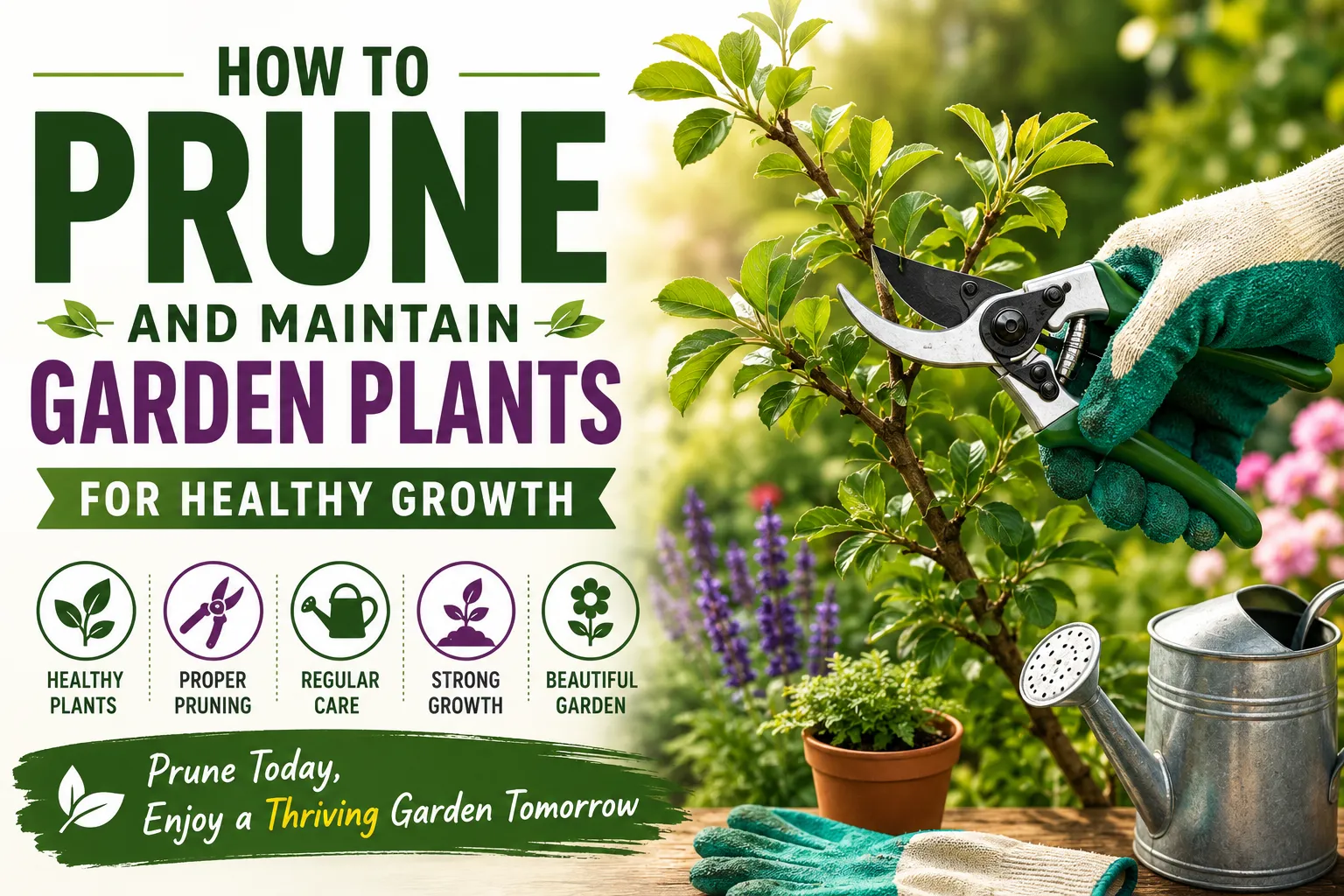
How to Prune and Maintain Garden Plants for Healthy Growth
Healthy gardens rarely happen by accident. Plants need the right combination of light, water, nutrients, space and ongoing care to grow well. Among the most useful maintenance practices is pruning, which can help control plant shape, remove damaged growth and encourage healthier development when done correctly.
But pruning is not simply a matter of cutting branches whenever a plant becomes too large. Cutting at the wrong time, removing too much growth or using unsuitable tools can weaken a plant rather than improve it.
Understanding why plants are pruned, when different types should be cut and how pruning works alongside watering, feeding, mulching and pest management can make garden maintenance more effective.
For a broader look at how pruning fits into overall garden planning and plant care, see the Complete Guide to Flower Gardening.
What Is Plant Pruning?
Pruning is the deliberate removal of selected parts of a plant, such as:
- Branches
- Stems
- Shoots
- Leaves
- Flowers
- Dead or damaged growth
Gardeners prune for different reasons depending on the plant.
Pruning may be used to:
- Remove dead or diseased material
- Improve the plant’s structure
- Encourage new growth
- Control size
- Improve air circulation
- Increase light penetration
- Encourage flowering or fruit production
- Remove hazardous branches
- Maintain a desired shape
Good pruning works with the natural growth pattern of a plant rather than fighting against it.
Why Pruning Matters for Plant Health
Plants constantly produce new growth while older parts age, become damaged or stop contributing effectively.
Removing certain branches can allow a plant to redirect resources toward healthier growth.
Pruning can also open up dense foliage.
When branches and leaves become excessively crowded, air movement and light penetration can decrease. A more open structure may help create healthier growing conditions and make it easier to inspect the plant for pests or disease.
However, pruning should be selective.
Removing too much foliage can reduce the plant’s ability to photosynthesize and may create unnecessary stress.
Not Every Plant Needs Heavy Pruning
One of the most common gardening mistakes is treating every plant in the same way.
Different plants have different growth habits.
Some naturally form compact shapes. Others produce long, arching stems. Some flower on new growth, while others produce flowers on older wood.
Before making significant cuts, identify the plant and understand its growth cycle.
This is particularly important for:
- Flowering shrubs
- Fruit trees
- Roses
- Vines
- Native plants
- Ornamental trees
- Evergreen shrubs
A pruning technique that works well for one species may damage another.
Start by Removing Dead Growth
Removing dead, broken or severely damaged branches is often the simplest place to begin.
Dead wood no longer contributes to healthy plant growth and can make the plant look untidy.
Broken branches can also create entry points for pests and pathogens.
When inspecting a plant, look for:
- Completely dead branches
- Broken stems
- Diseased-looking growth
- Severely damaged shoots
- Branches rubbing against each other
Removing these problem areas can improve the plant’s structure without requiring extensive pruning.
Remove Diseased Growth Carefully
Diseased plant material should be handled carefully.
If a branch shows clear signs of disease, removing the affected section may help prevent the problem from spreading, depending on the disease involved.
Avoid allowing infected cuttings to remain around the base of the plant.
Tools should also be cleaned between plants when dealing with suspected infectious diseases, particularly when working with multiple plants that appear to have similar symptoms.
However, not every discolored leaf or damaged branch indicates an infectious disease.
Environmental stress, nutrient problems, pests and weather damage can produce similar symptoms.
Correct identification is therefore important before aggressively removing plant material.
For more information about recognizing problems that can affect garden plants, see the Plant Diseases Guide.
Understand the Plant’s Natural Shape
Before pruning, step back and look at the entire plant.
Ask:
What shape is this plant naturally trying to create?
Rather than cutting everything into a perfectly uniform shape, selective pruning often produces a healthier and more natural result.
For trees and shrubs, pay attention to the main framework of branches.
For flowering plants, consider where new shoots and flower buds develop.
For climbing plants, determine which stems are supporting the plant and which are unnecessary.
The objective should be to improve the plant rather than force it into an unnatural form.
Choose the Right Pruning Tools
Using suitable tools makes pruning easier and can reduce unnecessary damage.
Common tools include:
Hand Pruners
Also called secateurs, hand pruners are useful for smaller stems and branches.
They are particularly useful for routine maintenance of shrubs, flowers and young growth.
Loppers
Loppers have longer handles and provide more leverage for thicker branches.
They can be useful when hand pruners cannot comfortably cut through a branch.
Pruning Saws
A pruning saw is designed for larger branches that are too thick for conventional pruners or loppers.
Hedge Shears
Hedge shears can be useful for maintaining certain formal hedges, although they are not appropriate for every shrub.
Pole Pruners
Pole-mounted tools can help reach higher branches, but cutting overhead requires additional caution.
Keep Pruning Tools Sharp
Sharp tools generally produce cleaner cuts than dull ones.
A clean cut can reduce unnecessary crushing and tearing of plant tissue.
Dull tools may require more force, increasing the likelihood of awkward cuts or damaged stems.
Regularly inspect blades for:
- Dull edges
- Rust
- Sap buildup
- Dirt
- Damage
Clean and maintain tools according to the manufacturer’s instructions.
Clean Tools Between Plants When Necessary
Garden tools can potentially transfer plant pathogens.
When moving between plants—particularly when pruning diseased material—cleaning and disinfecting tools can reduce the risk of transferring problems.
A practical routine is:
- Remove visible plant debris.
- Clean the blade.
- Use an appropriate disinfecting method when disease transmission is a concern.
- Allow the tool to dry when appropriate.
- Store it in a clean, dry location.
Different disinfectants can have different effects on tools and plants, so follow appropriate product instructions.
Where Should You Make a Pruning Cut?
The location of a cut matters.
When removing a branch from a woody plant, avoid leaving an unnecessarily long stub.
At the same time, cutting flush against the trunk or parent branch can damage the plant’s natural protective structures.
For many trees and shrubs, cuts should be made just outside the branch collar—the slightly swollen area where a branch connects to a larger stem or trunk.
The exact technique depends on the plant and the type of cut being made.
Understand Buds and Growth Direction
When shortening a branch or stem, the location of the remaining bud can influence the direction of new growth.
A cut made just above a healthy outward-facing bud can encourage new growth toward the outside of the plant.
This can be useful for shrubs because outward growth may help maintain an open structure.
Avoid leaving excessively long stubs above buds, but do not cut directly into the bud.
Remove Crossing Branches
Branches that rub against each other can create wounds.
As wind moves the branches, repeated friction can damage bark and expose underlying tissue.
When appropriate, remove one of the competing branches.
Choose the branch that is weaker, poorly positioned or less important to the plant’s overall structure.
The goal is not to remove every branch that comes close to another one, but to prevent persistent rubbing and unnecessary congestion.
Improve Air Circulation
Dense vegetation can restrict airflow through the center of a plant.
Selective thinning can help create more space between major branches and improve air movement.
This can be particularly useful in humid environments where wet foliage remains damp for long periods.
However, excessive thinning can expose previously shaded tissue to intense sunlight and remove too much of the plant’s productive foliage.
Moderation is important.
Remove Suckers and Water Sprouts When Appropriate
Some woody plants produce vigorous shoots from the base or from older branches.
These growths may be called suckers or water sprouts depending on where and how they develop.
They can compete with the plant’s main framework.
Removing unwanted shoots can help maintain the desired structure, particularly on ornamental trees and shrubs.
However, not every vigorous shoot is undesirable.
Understand the plant before removing substantial new growth.
Prune for Size Carefully
Pruning can control the size of a plant, but repeatedly cutting back every branch to the same point is not always the best solution.
This can create dense clusters of new shoots near the ends of branches.
A better approach for many woody plants is selective thinning and reduction.
If a plant consistently grows too large for its location, the underlying problem may be plant selection.
Choosing a plant whose mature size fits the available space is often better than relying on constant heavy pruning.
Avoid Topping Trees
Tree topping involves cutting major branches back severely, often leaving large stubs.
It is generally considered a poor pruning practice because it can weaken tree structure and encourage vigorous but poorly attached regrowth.
Instead of drastically reducing a tree’s crown, appropriate pruning focuses on removing specific branches and maintaining a strong natural structure.
Large trees near buildings, power lines or other hazards should generally be evaluated by a qualified tree-care professional.
For additional guidance on caring for woody plants, see How to Plant and Maintain Healthy Trees and Shrubs at Home.
When Is the Best Time to Prune?
There is no single pruning season that works for every plant.
Timing depends on:
- Plant species
- Flowering cycle
- Growth habit
- Climate
- Purpose of pruning
- Local weather conditions
Some plants are best pruned during dormancy.
Others should be pruned after flowering so that flower buds for the following season are not accidentally removed.
Fruit trees can have particularly specific pruning requirements.
Before major pruning, identify the plant and determine when it produces flowers and new growth.
Pruning Flowering Plants
The timing of pruning flowering plants is particularly important.
Some shrubs flower on older wood formed during the previous growing season.
If these plants are pruned heavily at the wrong time, flower buds can be removed before they have an opportunity to open.
Other plants flower primarily on new growth produced during the current season.
These plants can often tolerate pruning at different times.
The basic question is:
Does this plant flower on old growth or new growth?
Knowing the answer can prevent many pruning mistakes.
Pruning Fruit Trees
Fruit trees require more thoughtful pruning than many ornamental shrubs.
The objectives may include:
- Developing a strong framework
- Removing damaged branches
- Improving light penetration
- Improving airflow
- Managing excessive growth
- Supporting productive fruiting wood
Different fruit species have different pruning requirements.
Apple trees, citrus, stone fruits and other fruit crops should not automatically be pruned using the same method.
Poor pruning can reduce fruit production or encourage excessive vegetative growth.
Pruning Roses
Roses can benefit from selective pruning, but the appropriate technique depends on the type of rose and the climate.
Routine maintenance may include removing:
- Dead wood
- Damaged stems
- Weak growth
- Diseased material
- Spent flowers where appropriate
Major pruning should be timed according to the rose variety and local growing conditions.
Pruning Evergreen Plants
Evergreens retain foliage throughout much of the year, so they often require a different approach from deciduous plants.
Many evergreen shrubs respond well to light, selective pruning.
Heavy cuts can be problematic for some species because they may not readily produce new growth from old, leafless wood.
Before cutting deeply into an evergreen, determine where the plant can produce new shoots.
How Much Should You Prune?
A common mistake is removing too much at once.
The amount that can safely be removed depends on the plant, its condition and the reason for pruning.
A useful principle is:
When uncertain, prune conservatively and reassess the plant afterward.
Removing a little more later is generally easier than recovering from excessive pruning.
Healthy plants can often tolerate appropriate pruning, but severely stressed plants may need recovery time before significant structural work.
Avoid Pruning Stressed Plants Aggressively
A plant suffering from:
- Severe drought
- Root damage
- Pest infestation
- Disease
- Transplant shock
- Extreme heat
- Severe nutrient problems
may already be under considerable stress.
Heavy pruning can add another burden.
First determine what is causing the stress and address the underlying problem when possible.
Dead or hazardous material can still require removal, but major cosmetic pruning may be better postponed until the plant is healthier.
Water Plants Properly
Pruning is only one part of plant maintenance.
Watering practices have a major influence on plant health.
Rather than watering according to a rigid calendar, consider:
- Plant species
- Soil type
- Weather
- Plant maturity
- Container size
- Root depth
- Recent rainfall
Deep, appropriate watering can be more beneficial than frequent shallow watering for many established plants.
However, individual plants have different moisture requirements.
Avoid assuming that every plant prefers the same watering schedule.
For a deeper look at moisture management, see the Complete Guide to Watering Garden Plants Correctly.
Avoid Overwatering
More water does not necessarily mean healthier plants.
Excessively wet soil can reduce oxygen availability around roots and contribute to root problems.
Signs of watering problems can include:
- Yellowing leaves
- Wilting despite wet soil
- Slow growth
- Root deterioration
- Persistent fungal problems
Before watering, check the soil and consider the plant’s requirements.
Mulching Helps Maintain Soil Conditions
Mulch can help conserve soil moisture, moderate soil temperatures and reduce competition from weeds.
Organic mulches can also contribute organic matter as they decompose.
Common mulch materials include:
- Wood chips
- Shredded bark
- Compost
- Leaves
- Straw
Keep mulch away from direct contact with tree trunks and plant crowns.
A thick layer piled against a trunk can create excessively moist conditions and encourage problems.
Feed Plants According to Need
Fertilizer can help plants when nutrients are genuinely limited, but excessive fertilization can damage roots and encourage weak or overly vigorous growth.
Before applying fertilizer, consider:
- Plant species
- Soil fertility
- Existing growth
- Leaf symptoms
- Previous fertilization
- Soil-test results when available
A soil test can provide more useful information than guessing which nutrient a plant needs.
For a broader explanation of plant nutrients and fertilizer use, see the Complete Guide to Garden Fertilizers and Plant Nutrition.
Healthy Soil Supports Healthy Plants
Good garden maintenance begins below ground.
Healthy soil generally provides:
- Water
- Oxygen
- Nutrients
- Physical support
- A suitable environment for roots and soil organisms
Adding organic matter can improve many soils, although the appropriate approach depends on the soil type.
Compost and other organic amendments should be used thoughtfully rather than assuming that more is always better.
The Ultimate Guide to Soil Health provides additional information on creating and maintaining suitable soil conditions.
Watch for Pests Regularly
Routine inspection makes it easier to detect pest problems before they become severe.
Check the:
- Undersides of leaves
- New shoots
- Stems
- Flowers
- Fruit
- Soil surface
Look for:
- Chewed leaves
- Discoloration
- Sticky residue
- Webbing
- Distorted growth
- Visible insects
- Holes
- Premature leaf drop
Early detection can sometimes allow less aggressive control measures.
Encourage Beneficial Insects
Not every insect in a garden is harmful.
Predatory insects such as lady beetles, lacewings and certain wasps can help control pest populations.
A diverse garden containing flowering plants and suitable habitat can support beneficial organisms.
Avoid automatically spraying every insect you see.
First determine whether it is actually damaging the plant.
For more information about managing unwanted insects, see The Complete Guide to Garden Pest Control.
Remove Weeds Before They Become Established
Weeds compete with garden plants for:
- Water
- Light
- Nutrients
- Root space
Removing young weeds is usually easier than dealing with mature plants that have already established extensive roots or produced seeds.
Mulching and appropriate planting density can also reduce opportunities for weeds to establish.
Deadheading Can Extend Flower Displays
Deadheading involves removing spent flowers.
For some ornamental plants, this can encourage additional flowering by preventing energy from being directed toward seed production.
It can also make plants look cleaner.
However, not every flowering plant benefits from extensive deadheading.
Some plants produce attractive seed heads that provide winter interest or food for wildlife.
Decide whether removing spent flowers supports your particular gardening goals.
Container Plants Need Special Attention
Plants grown in containers often require more frequent maintenance than plants growing in the ground.
Containers have limited soil volume, which means roots have access to fewer reserves of water and nutrients.
Container plants may therefore need:
- More frequent watering
- Periodic feeding
- Root inspection
- Repotting
- Pruning
- Drainage management
Always ensure containers have adequate drainage unless the plant specifically requires different conditions.
Inspect Plants After Extreme Weather
Heavy storms, strong winds, heat waves and unusually cold conditions can damage plants.
After severe weather, inspect for:
- Broken branches
- Split stems
- Uprooted plants
- Torn leaves
- Sunscald
- Frost damage
- Waterlogging
Remove genuinely hazardous or badly damaged material, but avoid immediately cutting away every leaf or stem that looks unattractive.
Some apparently damaged tissue may still recover.
Maintain Garden Tools Properly
Good tools make maintenance easier and safer.
After use:
- Remove soil and plant debris.
- Clean blades and handles.
- Dry metal components.
- Lubricate moving parts when appropriate.
- Sharpen cutting tools as necessary.
- Store tools somewhere dry.
Well-maintained tools can last longer and perform more reliably.
Common Pruning Mistakes to Avoid
Pruning at the Wrong Time
Cutting flowering shrubs before they bloom can remove the season’s flower buds.
Removing Too Much
Heavy pruning can stress plants and reduce their ability to produce food through photosynthesis.
Leaving Long Stubs
Poorly positioned stubs can interfere with natural wound closure.
Making Jagged Cuts
Damaged cuts can create unnecessary wounds.
Using Dirty Tools
Contaminated tools can potentially spread plant pathogens.
Ignoring the Plant’s Natural Structure
Forcing every plant into the same shape can produce weak or unnatural growth.
Pruning Only Because a Plant Looks Untidy
Not every irregular branch is a problem.
Pruning should have a clear purpose.
A Simple Garden Maintenance Routine
A practical maintenance schedule can help prevent small problems from becoming major ones.
Weekly
- Inspect plants
- Check for pests
- Remove obvious dead flowers
- Pull emerging weeds
- Check soil moisture
- Look for storm damage
Monthly
- Inspect larger shrubs and trees
- Check supports and ties
- Review mulch depth
- Clean and maintain tools
- Examine containers and drainage
Seasonally
- Perform plant-specific pruning
- Assess soil and fertilizer needs
- Remove damaged growth
- Prepare plants for changing weather
- Review whether plants have enough space
The exact schedule should be adjusted for local climate and plant species.
How to Prune Without Damaging New Growth
The safest approach is usually to begin conservatively.
First remove clearly dead or damaged material.
Then inspect the plant’s structure.
Next remove branches that are:
- Crossing
- Rubbing
- Growing in an undesirable direction
- Competing with stronger structural branches
- Excessively crowded
Finally, step back and reassess.
Avoid continuing to cut simply because the plant can still be made smaller.
Pruning Is About Balance
Healthy pruning is not about removing as much growth as possible.
It is about finding the right balance between:
Old growth and new growth.
Light and shade.
Airflow and foliage density.
Plant size and available space.
Flower production and structural health.
A well-pruned plant should still look like itself.
Its natural growth habit should remain visible rather than being replaced by an artificial shape.
Healthy Gardens Need More Than Pruning
Pruning is one of the most useful tools in a gardener’s maintenance routine, but it works best as part of a broader system.
Plants also need suitable growing conditions, appropriate watering, healthy soil, adequate nutrients, sufficient light and protection from serious pests and diseases.
The best garden maintenance therefore begins with observation.
Look at the plant before reaching for the pruners. Understand how it grows, identify what actually needs attention and make deliberate cuts rather than removing growth simply because it is there.
When pruning is combined with thoughtful watering, soil care, mulching, pest monitoring and appropriate plant selection, the result is more than a tidier garden. It creates growing conditions that allow plants to develop stronger structures, healthier foliage and more sustainable growth over time.