Essential Kitchen Skills Every Beginner Cook Should Learn
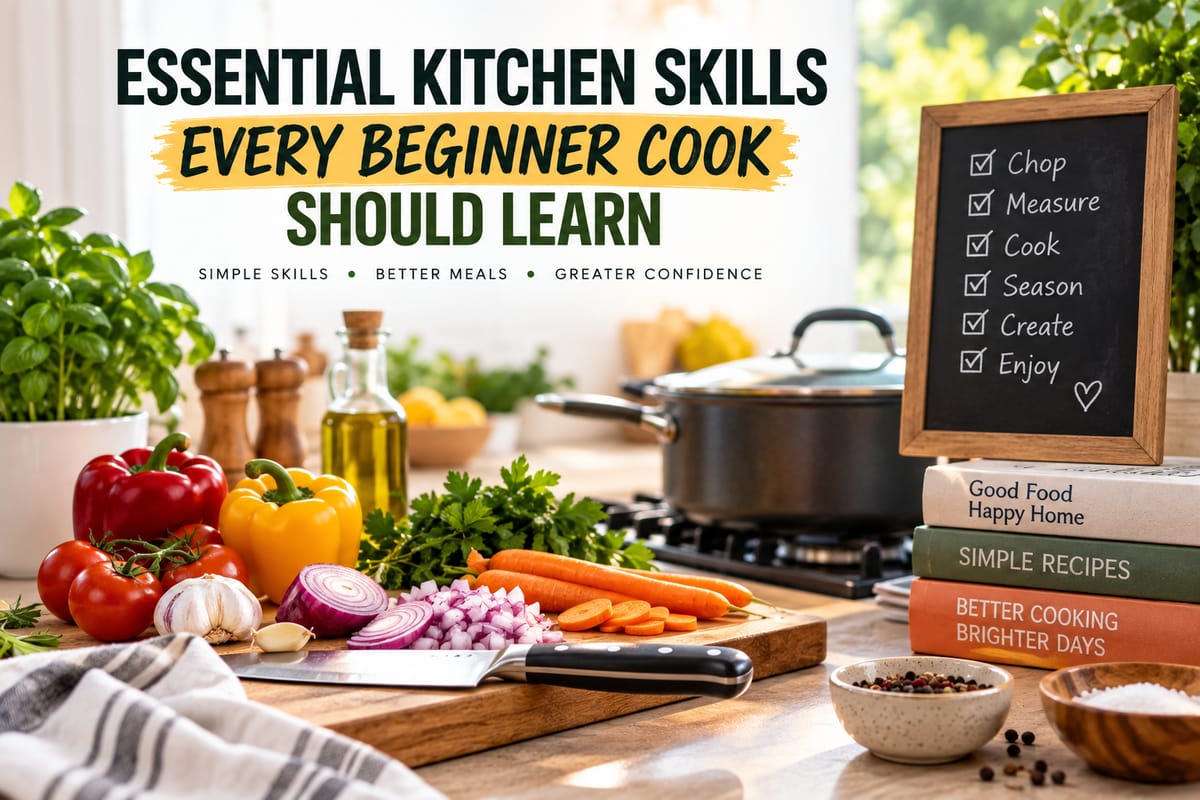
Essential Kitchen Skills Every Beginner Cook Should Learn
Learning to cook does not require mastering complicated recipes or owning a professional kitchen full of specialized equipment. Most successful home cooking starts with a handful of practical skills that make everyday meals easier, safer, and more enjoyable.
A beginner who understands how to handle a knife, control heat, season food, measure ingredients, and recognize when food is properly cooked already has a strong foundation. From there, cooking becomes less about following instructions mechanically and more about understanding what is happening in the pan, oven, or pot.
These essential kitchen skills can help new cooks become more confident while reducing common mistakes and making recipes easier to adapt.
Start With Basic Kitchen Safety
Before learning advanced cooking techniques, beginners should understand how to work safely in the kitchen.
Keep pot handles turned away from the edge of the stove, use appropriate protection when handling hot cookware, and keep towels and other flammable materials away from open flames and heating elements.
Food safety is equally important. Wash your hands before preparing food, keep raw and cooked foods separate, and clean cutting boards and utensils appropriately. Perishable ingredients should also be stored at suitable temperatures rather than being left at room temperature for extended periods.
A safe kitchen allows you to concentrate on learning rather than worrying about avoidable accidents.
Learn How to Use a Chef’s Knife
Knife skills are among the most useful abilities a beginner can develop.
A sharp, properly maintained knife is generally easier to control than a dull one. Beginners should learn how to hold the knife securely and use their other hand to stabilize ingredients while keeping their fingers safely positioned.
Start by practicing simple cuts such as:
- Slicing
- Chopping
- Dicing
- Mincing
- Julienne cutting
Uniform pieces are useful because ingredients of similar size tend to cook at similar rates. This can make everything from vegetables to meat easier to prepare consistently.
There is no need to rush. Good knife technique is primarily about control and consistency.
Understand Basic Cooking Methods
Different foods respond differently to heat, moisture, and cooking time. Learning the major cooking methods gives beginners a better understanding of why recipes call for particular techniques.
Common methods include:
- Boiling
- Simmering
- Steaming
- Sautéing
- Pan-frying
- Roasting
- Baking
- Grilling
- Braising
- Stewing
The complete guide to cooking methods can help beginners understand how these techniques differ and when each method is useful.
Once you understand the basic principles, recipes become easier to follow because you know what the instructions are trying to accomplish.
Learn to Control Heat
One of the biggest differences between inexperienced and confident cooks is often heat management.
A burner set too high can burn the outside of food before the inside has cooked. Heat that is too low may prevent proper browning or cause ingredients to simmer when they should be frying.
Beginners should become familiar with the difference between:
- Low heat
- Medium-low heat
- Medium heat
- Medium-high heat
- High heat
Heat requirements can change during a single recipe. For example, a cook might begin with relatively high heat to brown an ingredient and then lower the temperature to allow it to cook gently.
Understanding how cooking temperature affects food and cooking results makes this process much easier.
Learn How to Season Food
Salt is important, but seasoning involves much more than adding salt at the end.
Herbs, spices, acidity, sweetness, aromatics, and other ingredients can all influence flavor.
Beginners should practice tasting food throughout the cooking process when it is safe and appropriate to do so. This helps them understand how flavors develop.
For example, a dish might taste flat because it needs more salt, while another may benefit from acidity such as lemon juice or vinegar. Fresh herbs can add brightness, while spices can contribute warmth, aroma, or depth.
Learning to taste and adjust is one of the skills that helps cooks move beyond simply following recipes.
Understand When to Add Ingredients
The order in which ingredients enter a pan or pot can affect the final result.
Aromatic ingredients such as onions and garlic may be cooked before other ingredients so they can release their flavors. Vegetables with different cooking times may need to be added at different stages.
Adding everything at once can sometimes produce uneven results.
Recipes often provide an ingredient sequence for a reason. As beginners gain experience, they can begin to understand that sequence rather than treating it as a set of arbitrary instructions.
Master Basic Measuring Skills
Accurate measurements can make a major difference, particularly when baking.
Liquid and dry ingredients are often measured differently, and ingredients such as flour can produce different quantities depending on how they are packed into a measuring cup.
Beginners should become comfortable using:
- Measuring cups
- Measuring spoons
- Kitchen scales
- Liquid measuring containers
The guide to cooking measurements and ingredient conversions for home cooks can be particularly useful when recipes use unfamiliar units or require ingredient conversions.
A kitchen scale can also be valuable because weight measurements can provide greater consistency than volume measurements for many ingredients.
Learn to Read a Recipe Before Cooking
One common beginner mistake is starting to cook immediately after opening a recipe.
Instead, read the entire recipe first.
Look for:
- Total cooking time
- Preparation time
- Required equipment
- Ingredient quantities
- Cooking temperatures
- Steps that need to happen simultaneously
- Ingredients that need preparation beforehand
This prevents situations where an ingredient is suddenly needed but has not been chopped, thawed, measured, or otherwise prepared.
Experienced cooks often prepare ingredients before cooking begins. This practice is sometimes called mise en place, a French term meaning “everything in its place.”
Practice Basic Egg Cooking
Eggs are inexpensive, versatile, and useful for learning temperature control.
Beginners can practice making:
- Scrambled eggs
- Fried eggs
- Boiled eggs
- Poached eggs
- Omelets
Eggs also provide immediate feedback. Excessive heat can make them tough, while gentle heat can produce softer textures.
Because they cook relatively quickly, eggs are an excellent way to practice adjusting heat and timing.
Learn How to Cook Pasta Properly
Pasta is another useful beginner food because it teaches several fundamental techniques.
Start with sufficient water and follow the package instructions for cooking time, while remembering that the desired texture can vary.
Taste pasta near the end of the recommended cooking period rather than relying exclusively on the clock.
It is also useful to understand that pasta water can become part of a sauce. The starchy water can help bring ingredients together and contribute to a smoother texture.
Learn Basic Vegetable Cooking
Vegetables can be prepared in many different ways, and beginners should experiment with several techniques.
Roasting can encourage browning and concentrated flavors. Steaming can preserve a vegetable’s fresh character while keeping it relatively firm. Sautéing can produce quick cooking and attractive surface browning.
Learning these differences helps cooks choose techniques based on the result they want rather than simply using the same method for everything.
Understand Browning
Browning is an important part of cooking because it can add color, aroma, and complex flavors.
When foods such as meats and vegetables develop a browned surface, chemical reactions occur that contribute to their flavor and appearance.
To encourage browning, cooks generally need appropriate heat and should avoid overcrowding the pan. Excess moisture can also interfere with the development of a browned surface.
Beginners do not need to memorize the chemistry behind browning, but recognizing the visual and aromatic cues is useful.
Learn How to Cook Meat Safely
Cooking meat requires both technique and attention to food safety.
The cooking method, thickness, starting temperature, and type of meat all influence how quickly it cooks.
A food thermometer can be one of the most useful tools for beginners because appearance alone is not always a reliable indicator of whether meat has reached a safe internal temperature.
Avoid relying exclusively on color or cooking time when food safety is important. Follow appropriate food-safety guidance for the specific type of meat being prepared.
Learn to Make a Simple Sauce
A basic sauce can transform otherwise simple ingredients into a complete meal.
Beginners can start with straightforward options such as:
- Tomato-based sauces
- Simple pan sauces
- Yogurt-based sauces
- Basic cheese sauces
- Herb and oil sauces
Sauces also teach important concepts such as reducing liquids, balancing seasoning, and combining flavors.
Once these principles are understood, cooks can adapt sauces instead of depending entirely on packaged versions or rigid recipes.
Keep the Kitchen Organized
Cooking becomes easier when the workspace is organized.
Before beginning a recipe, clear unnecessary items from the counter and place frequently used ingredients and utensils where they can be reached easily.
Clean as you go whenever practical. Washing a cutting board or utensil while food is cooking can reduce the amount of cleanup left at the end.
Organization also makes it easier to notice missing ingredients before they become a problem.
Learn How to Adjust Recipes
Recipes should be treated as useful guides rather than unchangeable formulas in every situation.
Once beginners understand the purpose of ingredients and techniques, they can start making sensible substitutions.
For example, a cook might use one vegetable instead of another, adjust seasoning to personal preference, or modify the amount of a sauce.
However, substitutions are more complicated in baking because ingredient ratios can strongly influence the final structure. Beginners should therefore experiment more cautiously with cakes, breads, pastries, and other recipes where chemistry plays a major role.
Understand Cooking Time Versus Cooking Doneness
A recipe might say that something should cook for 20 minutes, but cooking time is not always an exact guarantee.
Ingredients vary in size, cookware varies in material and thickness, and ovens and stovetops can differ in actual performance.
Instead of relying exclusively on the clock, beginners should learn to recognize signs of doneness.
Depending on the food, these might include:
- Desired color
- Texture
- Aroma
- Tenderness
- Internal temperature
- Appearance of juices
- Changes in structure
The more cooks learn to observe food, the less dependent they become on rigid cooking times.
Build a Small Collection of Reliable Recipes
Beginners do not need hundreds of recipes.
A small collection of dependable meals can provide repeated opportunities to practice essential skills.
A useful starting collection might include:
- A simple breakfast
- A vegetable dish
- A pasta meal
- A rice-based meal
- A basic soup
- A roasted dish
- A simple protein
- A versatile sauce
Repeating familiar recipes allows cooks to notice how changes in heat, seasoning, timing, and technique affect the result.
The complete guide to cooking for beginners can provide additional foundations for developing this confidence.
Learn From Mistakes
Mistakes are an unavoidable part of learning to cook.
Food may become too salty, vegetables may be overcooked, a sauce may become too thick, or something may burn because the heat was too high.
Instead of treating these experiences as failures, beginners can use them as feedback.
Ask what happened and why.
If vegetables burned, perhaps the heat was too high or the pieces were too small. If pasta became mushy, perhaps it cooked for too long. If a dish tasted bland, it may have needed more seasoning or acidity.
This habit of analyzing mistakes gradually develops cooking intuition.
Confidence Comes From Understanding
The most valuable kitchen skills are not necessarily complicated techniques. They are the basic abilities that help cooks understand ingredients, heat, timing, seasoning, safety, and texture.
Once those foundations become familiar, recipes stop feeling like mysterious instructions. A beginner can start recognizing when a pan is hot enough, when vegetables are ready to turn, when a sauce needs adjustment, and when food has reached the desired level of doneness.
That is when cooking becomes more flexible and enjoyable. The goal is not to prepare every dish perfectly. It is to develop enough knowledge and practical experience to prepare good food confidently, learn from mistakes, and keep improving with every meal.