How Cooking Temperature Affects Food and Cooking Results
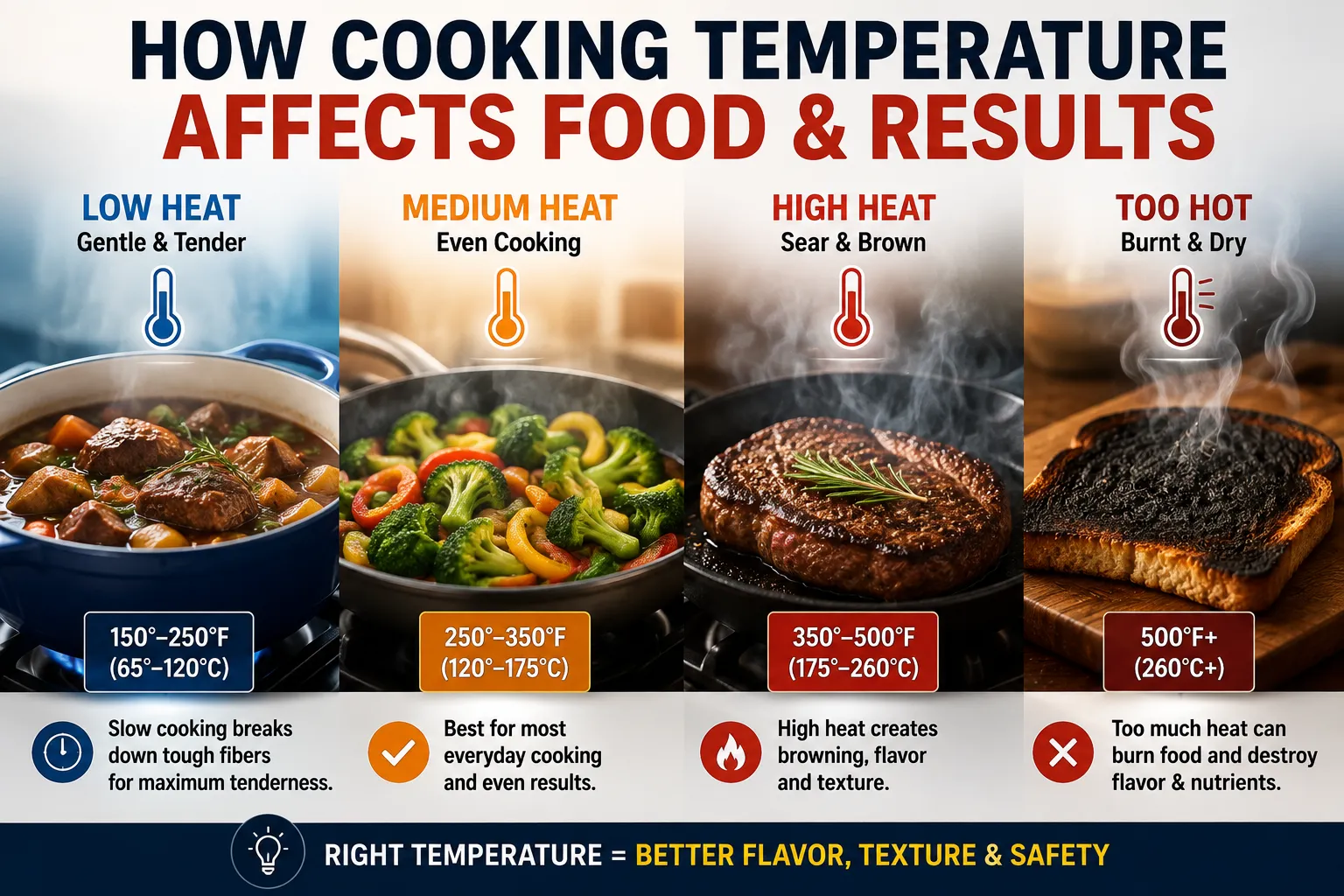
How Cooking Temperature Affects Food and Cooking Results
Cooking temperature can be the difference between a tender roast and a dry one, a crisp vegetable and a soggy one, or a beautifully browned piece of bread and one that burns before the center is finished.
Temperature influences far more than whether food is hot or cold. It affects how proteins change, how fats melt, how starches absorb water, how moisture moves through food and how quickly browning reactions occur.
Understanding these changes can make everyday cooking more predictable. Instead of relying entirely on cooking times, cooks can use temperature as another tool for deciding when food is ready and how it should be prepared.
For a broader introduction to essential cooking skills, techniques and principles, see the Complete Guide to Cooking for Beginners.
Why Cooking Temperature Matters
Food changes when heat is transferred into it.
As temperature rises, different components of food respond in different ways. Proteins can firm up, fats can melt, water can evaporate and starches can swell and gelatinize.
These changes do not all happen at the same temperature or at the same speed.
That is why two foods cooked at the same oven temperature can produce completely different results.
A delicate fish fillet, for example, has different structural and moisture characteristics from a dense loaf of bread or a large piece of beef.
Cooking is therefore a process of managing heat, time and moisture rather than simply setting an appliance to a particular number.
Heat Changes Proteins
Protein is one of the most temperature-sensitive components in many foods.
When meat, poultry, fish or eggs are heated, proteins gradually change their structure. This process, known as denaturation, can make food firmer.
The extent of this change matters.
Cook a protein-containing food gently and carefully, and it may remain tender and moist. Heat it excessively or for too long, and the proteins can contract more strongly, squeezing out moisture and producing a tougher texture.
This is one reason why overcooked meat can become dry even though it has been thoroughly heated.
Different Proteins React Differently
There is no single temperature at which every protein changes in exactly the same way.
Egg proteins, muscle proteins in meat and proteins in dairy products all behave differently.
Eggs provide an especially useful example.
An egg white becomes increasingly firm as its proteins denature and form a network. The yolk behaves differently because it contains more fat and has a different composition.
This is why relatively small changes in cooking temperature and time can make the difference between a runny, creamy or firm egg.
Temperature Affects Meat Texture
Meat presents a particularly interesting relationship between temperature and texture.
At relatively moderate cooking temperatures, proteins gradually firm. But connective tissue also responds to prolonged heating.
Collagen, a connective protein found in connective tissue, can gradually transform into gelatin during appropriate slow cooking.
This explains why a tough cut of meat can become tender after being cooked slowly for a long period.
Simply increasing the heat is not necessarily the best way to make tough meat tender.
A high-temperature approach may cook the muscle proteins rapidly while failing to provide the prolonged conditions needed for connective tissue to break down effectively.
For more guidance on matching cooking techniques to different cuts, see How to Cook Different Cuts of Meat and Poultry Properly.
Why Low-and-Slow Cooking Works
Slow cooking is particularly useful for foods containing substantial amounts of connective tissue.
Cooking at a relatively low temperature for an extended period allows connective tissue to gradually soften while reducing the likelihood of aggressively drying the exterior.
This technique is commonly used for dishes such as:
- Braised beef
- Pulled pork
- Stews
- Slow-roasted meats
- Certain poultry dishes
The precise temperature and cooking time depend on the food and recipe, but the principle remains the same: time and temperature work together.
A lower temperature generally requires more time to produce a comparable level of cooking.
High Heat Can Create Browning
High cooking temperatures can produce another important effect: browning.
When the surface of food becomes hot and sufficiently dry, chemical reactions can create new colors, aromas and flavors.
One of the most important is the Maillard reaction, a group of reactions involving amino compounds and reducing sugars that contribute to the characteristic brown color and complex flavors found in foods such as roasted meat, toasted bread and browned vegetables.
This is one reason a hot pan can produce a very different result from a low-temperature cooking method.
Browning Requires More Than Heat
Temperature alone does not guarantee good browning.
Moisture matters too.
As long as water is evaporating from the surface of food, the surface temperature is constrained by the water’s behavior. Once enough surface moisture has evaporated, the temperature can rise more substantially and browning reactions become more pronounced.
This is why patting meat dry before searing can make a noticeable difference.
It is also why overcrowding a pan can interfere with browning.
Adding too much food at once can release enough moisture to create a steamy environment, slowing the development of the browned surface that cooks often want.
Caramelization Is Another Temperature-Driven Change
Caramelization is different from the Maillard reaction.
It involves the thermal breakdown and transformation of sugars, producing new flavors, aromas and colors.
Caramelization is important when preparing foods such as:
- Caramelized onions
- Caramel
- Roasted vegetables
- Certain baked goods
The exact chemistry depends on the type of sugar and the conditions involved.
The broader lesson is that temperature determines which chemical reactions become possible and how quickly they progress.
Water Changes How Food Cooks
Water is one of the most important ingredients in cooking, even when it is not explicitly added.
Many foods contain substantial amounts of water naturally.
When food is heated, water can move through the food, evaporate from the surface or participate in processes such as starch gelatinization.
The presence of water also affects the maximum temperature reached by moist foods under ordinary cooking conditions.
This is why boiling, steaming and roasting produce very different results.
Boiling and Steaming Are Not the Same as Roasting
When food is cooked in boiling water, the surrounding environment is limited by the behavior of the water.
Steam cooking also transfers heat efficiently while exposing food to a moist environment.
Roasting is different because the food’s surface can become much hotter and drier than it would in boiling water.
That difference strongly influences texture and flavor.
Boiled vegetables may become tender without developing significant surface browning.
Roasted vegetables can become tender inside while developing browned, caramelized edges on the outside.
The ingredients may be identical, but the heat environment produces a very different result.
Understanding how boiling, steaming, roasting, grilling and other techniques differ can help you choose the right approach for each ingredient. See Cooking Methods Explained: The Complete Guide for a broader overview.
Starch Changes With Heat
Starches are another major food component affected by cooking temperature.
Foods such as potatoes, rice, pasta and bread contain significant amounts of starch.
When starch is heated in the presence of water, its structure changes through a process known as gelatinization.
The starch granules absorb water and swell, contributing to changes in texture.
This process helps explain why raw potatoes are hard while cooked potatoes become soft and why uncooked grains have a very different texture from properly cooked rice.
The amount of water and the cooking temperature both influence the outcome.
Temperature Matters When Cooking Rice and Pasta
Rice and pasta demonstrate how temperature, water and time interact.
If rice is not heated sufficiently or does not have enough water available, starch may not undergo the changes needed to produce the desired texture.
Pasta similarly requires sufficient heat and water to hydrate and soften its starch structure.
However, simply cooking for longer does not always improve the result.
Too much cooking can cause starch structures to break down excessively, producing mushier textures.
This is why timing and temperature need to be considered together.
For more specific guidance on achieving consistent rice texture, see How to Cook Rice With Better Texture.
Baking Depends Heavily on Temperature
Temperature control becomes particularly important in baking.
Unlike many stovetop dishes, baked goods often depend on a sequence of physical and chemical changes occurring within a relatively narrow range of conditions.
Heat can cause:
- Fats to melt
- Water to evaporate
- Proteins to set
- Starches to gelatinize
- Sugars to brown
- Leavening gases to expand
- Dough structures to become firm
If the oven temperature is significantly different from what a recipe expects, several of these processes can occur at the wrong rate.
The result may be a cake that rises poorly, cookies that spread excessively or bread that browns before its interior has fully baked.
The Complete Guide to Baking Fundamentals for Beginners provides a broader foundation for understanding how temperature and other variables affect baked goods.
Oven Temperature Is Not Always Exact
The temperature displayed by an oven is not necessarily identical to the temperature experienced by food.
Home ovens can have hot and cool areas, and thermostats cycle the heating elements on and off to maintain an approximate temperature.
The oven may also take time to preheat fully.
For temperature-sensitive baking, an independent oven thermometer can help identify whether the appliance’s displayed temperature corresponds reasonably closely to its actual internal temperature.
This can be particularly useful when recipes repeatedly produce unexpected results.
Internal Temperature Is Often More Important Than Cooking Time
Recipes frequently provide cooking times, but time alone cannot tell you exactly when a food has reached the desired internal condition.
The size and shape of the food, starting temperature, oven performance and cooking method can all affect how quickly heat reaches the center.
A thermometer can provide more useful information.
For foods where safety depends on reaching a specific internal temperature, following reliable food-safety guidance is especially important.
Using a food thermometer to verify the internal temperature of meat and poultry can be more reliable than judging doneness solely by color or cooking time.
Carryover Cooking Can Change the Final Result
Food does not necessarily stop cooking the instant it is removed from a heat source.
A roast, for example, can continue increasing in internal temperature after being removed from the oven because heat from hotter outer areas continues moving toward the center.
This is known as carryover cooking.
The effect depends on the food’s size, shape, temperature and cooking conditions.
For large pieces of meat, understanding carryover cooking can help prevent accidental overcooking.
Removing food from the heat at the appropriate point and allowing it to rest can therefore be part of the cooking process rather than an unnecessary pause.
Resting Helps Meat Retain Moisture
Resting cooked meat is often recommended because it allows internal temperatures to stabilize and gives juices time to redistribute.
Cutting into meat immediately after cooking can release some of the liquid that would otherwise remain within the structure.
Resting does not magically add moisture back to a dry piece of meat, but it can improve the eating experience when used appropriately.
The amount of resting time depends on the type and size of the food.
Oil Temperature Changes Frying Results
Temperature is especially important when frying.
Oil that is too cool can allow food to absorb more oil and may produce a pale, soft exterior.
Oil that is excessively hot can cause the outside to brown or burn before the interior has finished cooking.
Maintaining an appropriate oil temperature helps balance exterior browning with interior cooking.
This is why professional cooks often use thermometers when deep-frying rather than relying entirely on visual cues.
Why Food Becomes Crispy
Crispness is strongly related to moisture.
As water leaves the surface of food during cooking, the structure can become drier and more brittle.
High surface temperatures can accelerate this process and encourage browning.
This combination helps produce the crisp crust of roasted potatoes, fried foods and baked bread.
However, moisture can migrate back into a crisp surface after cooking.
That is why fried foods can become soft when covered tightly while still hot.
Steam from the food becomes trapped and rehydrates the exterior.
Temperature Affects Vegetables Differently
Vegetables can respond to heat in several ways.
Cooking can soften plant cell structures, change pigments, alter flavors and reduce or transform some nutrients.
The method matters.
Boiling, steaming, roasting and stir-frying expose vegetables to different combinations of temperature, water and cooking time.
For example, roasting can create browned edges and concentrated flavors, while steaming can cook vegetables with relatively little direct contact with water.
The best method often depends on the texture and flavor the cook wants.
Very High Heat Is Not Always Better
High heat can be useful for searing, stir-frying and browning, but it is not automatically the best choice.
Some foods benefit from gentle cooking because their structure is delicate.
Fish, custards, eggs and certain sauces can be damaged by excessive heat.
High temperatures can also cause the outside of food to cook much faster than the interior.
The appropriate temperature therefore depends on the ingredient and the desired result.
Low Heat Has Its Own Advantages
Low-temperature cooking can provide greater control.
It can be useful for:
- Gentle simmering
- Slow braising
- Custards
- Delicate sauces
- Slow roasting
- Melting chocolate
- Cooking certain eggs
Gentle heat reduces the risk of sudden overheating and can allow gradual structural changes.
This is particularly useful when precision matters more than speed.
Temperature Also Affects Food Safety
Cooking temperature is not just about flavor and texture.
It is also an important food-safety consideration.
Raw and undercooked foods can contain harmful microorganisms. Proper cooking can reduce the risk of foodborne illness when foods are heated to appropriate internal temperatures.
Using a food thermometer to verify safe internal temperatures for meat, poultry and other applicable foods is an important part of safe cooking.
Food should also be handled and stored properly before and after cooking.
Temperature control therefore matters at every stage—from refrigeration and preparation to cooking and serving.
Why Temperature and Time Cannot Be Separated
One of the biggest misconceptions about cooking is that temperature alone determines the result.
In reality, temperature and time interact constantly.
A food exposed to a relatively low temperature for a long period may undergo changes that would happen much faster at a higher temperature.
Conversely, a very high temperature may produce rapid surface browning while leaving the interior undercooked.
This is why cooking techniques are built around combinations of time, temperature and moisture rather than one universal setting.
Use Temperature to Become a More Consistent Cook
Learning to think in terms of temperature can make cooking more predictable.
Instead of asking only, “How many minutes should this cook?” consider:
- What temperature should the cooking environment reach?
- What internal temperature should the food reach?
- How quickly is heat moving into the center?
- Is the surface dry enough to brown?
- Does the food need gentle or intense heat?
- Will the food continue cooking after it is removed?
- Is the cooking temperature appropriate for food safety?
These questions help explain why recipes sometimes produce different results in different kitchens.
Matching Heat to the Food
The most effective cooks do not simply use high heat or low heat by default.
They match the cooking method to the ingredient and desired result.
For browning: higher surface heat and relatively dry conditions are useful.
For tenderizing tough meat: lower temperatures combined with sufficient time can be more appropriate.
For delicate foods: gentle heat can prevent excessive protein tightening or other unwanted changes.
For baking: accurate oven temperature is essential because multiple physical and chemical processes must happen in sequence.
For food safety: internal temperature matters, and reliable food-safety guidance should take priority over visual appearance.
Better Cooking Starts With Understanding Heat
Temperature is one of the most powerful variables in the kitchen because it affects nearly every stage of cooking.
It changes proteins, transforms starches, melts fats, drives evaporation and creates the chemical reactions responsible for browning and complex flavors. At the same time, it plays an essential role in making food safe to eat.
The best cooking results usually come from matching temperature, time, moisture and technique to the food being prepared.
Once cooks understand what heat is doing inside and outside their ingredients, cooking becomes less about blindly following a timer and more about recognizing the physical changes that signal progress.
That knowledge can turn a thermometer, a pan and an oven from simple kitchen tools into instruments for much greater consistency.