Cooking Measurements and Ingredient Conversions for Home Cooks
Cooking Measurements and Ingredient Conversions for Home Cooks
Cooking is often described as a creative activity, but successful cooking also depends on a little precision. A recipe may call for cups, tablespoons, teaspoons, ounces or grams, and knowing how those measurements relate to one another can make the difference between a dish that works and one that does not.
For experienced cooks, converting measurements may become second nature. For beginners, however, phrases such as “half a cup,” “four ounces,” or “200 grams” can quickly become confusing—especially when a recipe comes from another country or uses a different measurement system.
The good news is that most everyday kitchen conversions are straightforward once you understand the basics.
For a broader introduction to cooking techniques, ingredients, equipment, and other essential skills, see the Complete Guide to Cooking for Beginners.
Why Accurate Measurements Matter in Cooking
Not every recipe requires laboratory-level precision.
If you are making soup, for example, adding slightly more or less of a vegetable usually will not ruin the dish. Baking is different. The balance between flour, liquid, sugar, fat and leavening agents can significantly affect the final texture and structure.
Accurate measurements are especially important when preparing:
- Cakes
- Cookies
- Bread
- Pastries
- Sauces
- Custards
- Candy
- Preserves
- Recipes involving chemical leaveners
Understanding measurements also makes it easier to adjust recipes, replace ingredients and cook dishes from different countries.
The Two Main Measurement Systems
Home cooks commonly encounter two measurement systems.
The U.S. customary system uses units such as cups, tablespoons, teaspoons and fluid ounces.
The metric system primarily uses grams and milliliters.
Recipes from the United States frequently use volume measurements, while many recipes elsewhere rely more heavily on weight.
Neither system is inherently better for every cooking task, but weight measurements are generally more precise, particularly for dry ingredients.
Basic Kitchen Measurement Conversions
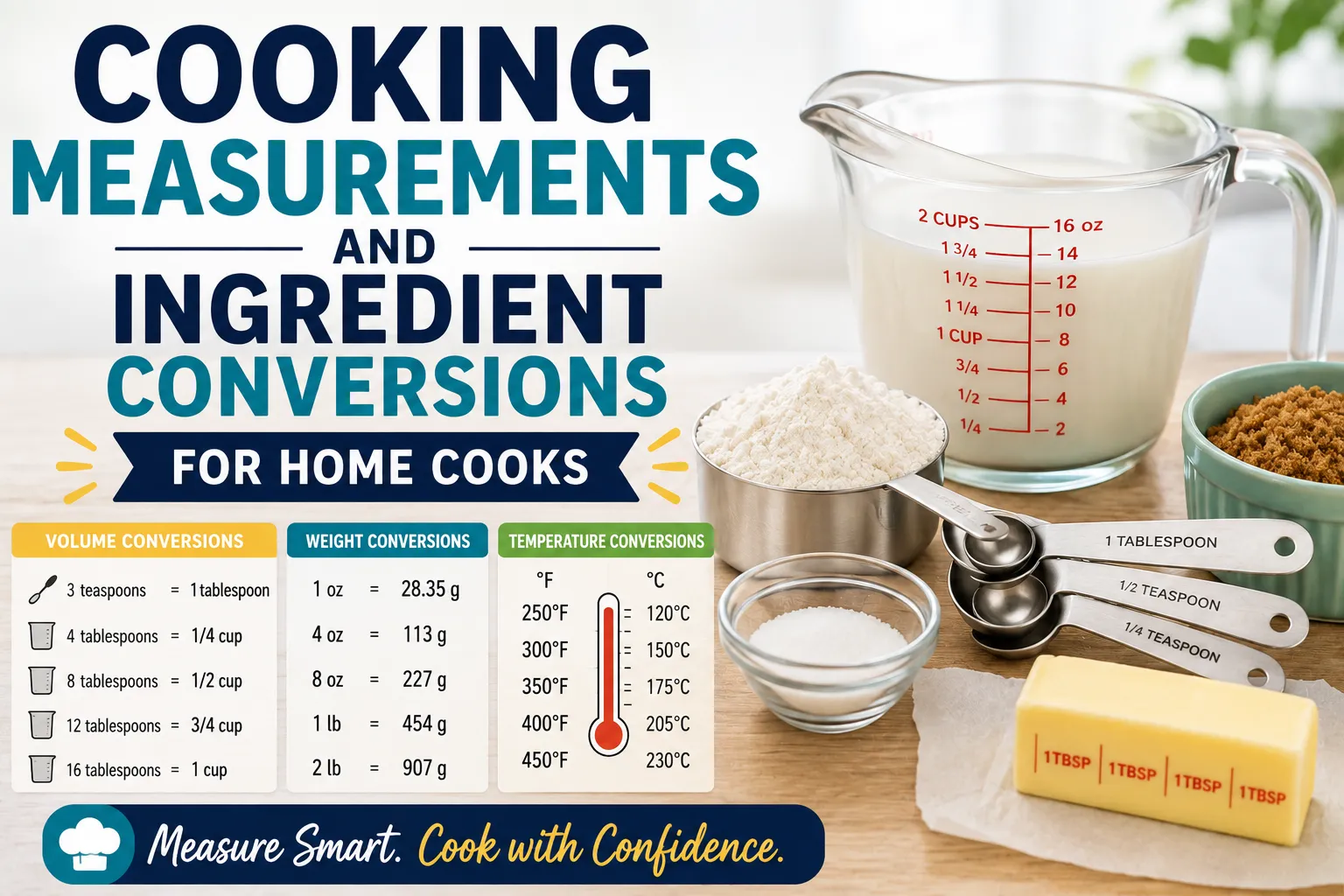
Here are some of the most useful volume conversions for everyday cooking:
| Measurement | Equivalent |
|---|---|
| 3 teaspoons | 1 tablespoon |
| 4 tablespoons | 1/4 cup |
| 5 tablespoons + 1 teaspoon | 1/3 cup |
| 8 tablespoons | 1/2 cup |
| 12 tablespoons | 3/4 cup |
| 16 tablespoons | 1 cup |
| 2 cups | 1 pint |
| 4 cups | 1 quart |
| 16 cups | 1 gallon |
These relationships are particularly useful when scaling recipes or when you do not have a particular measuring cup available.
Teaspoons and Tablespoons
Small measurements can have a surprisingly large effect on a recipe.
The basic relationship is:
3 teaspoons = 1 tablespoon
That means:
- 1 teaspoon = 1/3 tablespoon
- 2 teaspoons = 2/3 tablespoon
- 3 teaspoons = 1 tablespoon
- 6 teaspoons = 2 tablespoons
When measuring ingredients such as baking powder, baking soda, salt or spices, using the correct amount is important because these ingredients can strongly influence flavor and texture.
Understanding Cups
A standard U.S. recipe cup is a volume measurement, not a measurement of weight.
This distinction is extremely important.
One cup of flour does not weigh the same as one cup of sugar. One cup of chopped nuts will have a different weight again.
So you cannot reliably convert cups into grams without knowing the specific ingredient.
For example, a cup of flour and a cup of water occupy the same volume but have very different weights.
Volume vs. Weight
This is one of the most important concepts for home cooks to understand.
Volume tells you how much space an ingredient occupies.
Weight tells you how heavy the ingredient is.
A measuring cup measures volume.
A kitchen scale measures weight.
For ingredients that can vary significantly in density, weight is usually the more reliable measurement.
This is one reason professional bakers often use grams instead of cups.
Why Flour Can Cause Measurement Problems
Flour is a good example of why volume measurements can be inconsistent.
If flour is scooped directly from a container, it can become compacted. The same measuring cup can therefore contain significantly more flour than it would if the flour were gently spooned into the cup and leveled.
That means two people can both measure “one cup of flour” and end up using different amounts.
Using a kitchen scale eliminates much of this variation.
If a recipe provides a weight measurement, using it is usually preferable.
The Spoon-and-Level Method
When a recipe calls for a dry ingredient by volume, the spoon-and-level technique can improve consistency.
Instead of dipping the measuring cup directly into a container:
- Fluff the ingredient slightly if it has settled.
- Spoon it into the measuring cup.
- Fill the cup without packing the ingredient down unless the recipe specifically says to do so.
- Level the top with the straight edge of a knife or other flat utensil.
This method is particularly useful for flour.
Measuring Liquids Correctly
Liquid ingredients should generally be measured using a liquid measuring cup.
These cups are often transparent and have markings along the side, allowing you to check the amount at eye level.
Place the cup on a flat surface and look at the measurement from the side rather than trying to judge it from above.
This can improve accuracy.
Common liquid ingredients include:
- Water
- Milk
- Oil
- Broth
- Vinegar
- Juice
- Cream
Dry and Liquid Measuring Cups Are Not Always Interchangeable
Dry measuring cups are designed to be filled and leveled.
Liquid measuring cups are designed to leave room at the top and provide a clear way to read the liquid level.
Although the actual volume represented by the measurements may be equivalent within a given system, the tools are designed for different purposes.
Using the appropriate measuring tool makes the process easier and reduces spills.
Common Metric Conversions
Metric measurements are especially useful when following international recipes.
Some common kitchen relationships include:
| Measurement | Equivalent |
|---|---|
| 1 kilogram | 1,000 grams |
| 1 gram | 1,000 milligrams |
| 1 liter | 1,000 milliliters |
| 1 liter | 1,000 cubic centimeters |
| 1 tablespoon | Approximately 15 milliliters |
| 1 teaspoon | Approximately 5 milliliters |
For precise cooking, however, always check which measurement standard a recipe is using.
A tablespoon is not identical in size everywhere. For example, the Australian tablespoon is traditionally larger than the tablespoon used in many other countries.
Grams Make Recipe Scaling Easier
One advantage of weight-based recipes is how easy they are to scale.
Suppose a recipe calls for:
- 300 grams flour
- 200 grams water
- 100 grams sugar
If you want to make half the recipe, simply divide each measurement by two:
- 150 grams flour
- 100 grams water
- 50 grams sugar
If you want to make twice as much, double everything.
This is much easier than dealing with fractions of cups for many ingredients.
How to Convert a Recipe From Cups to Grams
There is no universal conversion from cups to grams.
The correct conversion depends on the ingredient.
For example, one cup of:
- Flour
- Sugar
- Butter
- Rice
- Oats
- Chopped nuts
will have different weights.
Therefore, avoid generic statements such as “one cup always equals 240 grams.”
The volume of a standard U.S. cup is approximately 237 milliliters, commonly rounded to 240 milliliters in cooking, but the weight of the ingredient occupying that volume depends on its density.
Approximate Ingredient Conversions
The following are useful approximate values, but recipes can vary depending on how ingredients are measured and packed:
| Ingredient | Approximate weight per U.S. cup |
|---|---|
| All-purpose flour | 120–125 g |
| Granulated sugar | 195–200 g |
| Brown sugar, packed | About 200 g |
| Butter | About 227 g |
| Rolled oats | About 80–90 g |
| Water | About 237–240 g |
| Milk | About 240–245 g |
These numbers should be treated as practical estimates rather than universal rules.
For baking, follow the recipe’s specified weight whenever one is provided.
Packed vs. Unpacked Ingredients
Some recipes specifically instruct you to pack an ingredient.
Brown sugar is a common example.
Packing means pressing the ingredient firmly into the measuring cup so that there are fewer air pockets.
When the recipe says “1 cup packed brown sugar,” it does not mean simply filling the cup loosely.
Other ingredients, such as flour, are generally not supposed to be packed unless the recipe explicitly says so.
Butter Measurements Can Be Confusing
Butter is particularly interesting because recipes can express it in several ways.
You may see:
- Grams
- Ounces
- Tablespoons
- Cups
- Sticks
In recipes using U.S. measurements, one standard stick of butter is commonly:
1/2 cup = 8 tablespoons = about 113 grams
Two sticks equal:
1 cup = 16 tablespoons = about 227 grams
If you are following a recipe from another country, however, the packaging and measurement conventions may be different.
When in doubt, weigh the butter if the recipe provides a gram measurement.
Understanding Ounces
The word “ounce” can refer to either weight or fluid volume, depending on the context.
This is a common source of confusion.
A weight ounce measures mass.
A fluid ounce measures volume.
They are not interchangeable.
For example, an ounce of flour by weight is not the same physical quantity as a fluid ounce of water.
When reading a recipe, determine whether the author means oz as a weight measurement or fl oz as a volume measurement.
Converting Ounces to Grams
For weight measurements:
1 ounce ≈ 28.35 grams
Useful approximations include:
- 1 oz ≈ 28 g
- 2 oz ≈ 57 g
- 4 oz ≈ 113 g
- 8 oz ≈ 227 g
- 16 oz ≈ 454 g
- 32 oz ≈ 907 g
For everyday cooking, rounding to the nearest gram is usually sufficient.
Converting Pounds to Kilograms
For larger quantities:
1 pound ≈ 0.454 kilograms
So:
- 2 lb ≈ 0.91 kg
- 5 lb ≈ 2.27 kg
- 10 lb ≈ 4.54 kg
For most home cooking, these conversions do not need to be exact to several decimal places.
Temperature Conversions Matter Too
Ingredient measurements are not the only conversions cooks encounter.
Cooking temperatures can also be expressed differently.
The most common scales are:
- Fahrenheit
- Celsius
- Gas Mark
The basic Fahrenheit-to-Celsius formula is:
°C = (°F − 32) × 5/9
For Celsius to Fahrenheit:
°F = (°C × 9/5) + 32
Some useful approximate conversions are:
| Fahrenheit | Celsius |
|---|---|
| 250°F | 120°C |
| 300°F | 150°C |
| 325°F | 165°C |
| 350°F | 175°C |
| 375°F | 190°C |
| 400°F | 205°C |
| 425°F | 220°C |
| 450°F | 230°C |
Because oven temperatures can vary considerably between appliances, an oven thermometer can sometimes be more useful than relying solely on the dial.
Understanding temperature alongside measurement is also important when choosing a cooking technique. The Cooking Methods Explained: The Complete Guide provides a broader look at how different methods affect food.
Recipe Scaling Requires More Than Simple Multiplication
Doubling a recipe is usually straightforward, but some ingredients may need adjustment when making very large batches.
For example, doubling the amount of flour and liquid may not always mean doubling every seasoning exactly.
Salt, spices and strongly flavored ingredients sometimes need to be adjusted gradually.
Leavening agents can also require special attention in baking.
For a normal home batch, however, multiplying the ingredients by two is usually a reasonable starting point.
Halving Recipes
Halving a recipe can create awkward measurements.
Suppose a recipe calls for:
- 1 tablespoon
- 1/2 cup
- 3/4 cup
- 2 eggs
Half would be:
- 1 1/2 teaspoons
- 1/4 cup
- 3/8 cup
- 1 egg
The first three are manageable, but 3/8 cup is less convenient.
In that situation, converting the measurement into tablespoons may help.
Since 1 cup equals 16 tablespoons:
3/8 cup = 6 tablespoons
That can be much easier to measure.
What to Do With Half an Egg
Eggs can create a problem when reducing recipes.
If you need half an egg, crack the egg into a bowl and beat it until the yolk and white are combined.
Then weigh the beaten egg and use approximately half.
Alternatively, use a portion based on the recipe and the size of the egg.
This method is especially useful for baking, where precision matters.
For more information about how ingredients behave in baked recipes, see the Complete Guide to Baking Fundamentals for Beginners.
Recipe Conversions Should Preserve Ratios
When adjusting a recipe, the relationship between ingredients is often more important than the individual numbers.
If a bread recipe uses a specific ratio of flour to water, dramatically changing one ingredient without adjusting the others can alter the dough’s texture.
The same principle applies to:
- Pancakes
- Cakes
- Cookies
- Sauces
- Dressings
- Marinades
Think about the recipe as a system rather than a collection of independent measurements.
A Kitchen Scale Is One of the Most Useful Tools
A digital kitchen scale can make cooking significantly easier.
It can:
- Improve baking consistency
- Simplify recipe scaling
- Reduce measuring cups and spoons
- Make international recipes easier to follow
- Reduce washing up
- Help portion ingredients
Many modern recipes provide measurements in both grams and volume.
When both are available, weight is generally the more reproducible option for dry ingredients.
When Precision Matters Most
Not every ingredient needs to be measured with the same level of precision.
Precision is particularly important for:
Baking
The ratio of flour, liquid, fat, sugar and leavening agents affects the final structure.
Fermentation
Bread, yogurt and fermented foods can depend on carefully controlled proportions and conditions.
Candy Making
Sugar concentration and temperature can determine whether a candy becomes soft, chewy, brittle or hard.
Sauces
Too much liquid or thickener can dramatically change consistency.
Spice Blends
Small changes can noticeably alter the balance of flavors.
When You Can Cook by Eye
Experienced cooks often measure some ingredients less precisely.
For example, when making a soup, stew or stir-fry, you may be able to adjust:
- Herbs
- Vegetables
- Broth
- Spices
- Aromatics
according to taste.
This flexibility is one of the enjoyable parts of cooking.
A good approach is to become precise where precision matters and flexible where it does not.
Taste as You Go
Measurements provide a starting point, but taste provides feedback.
A recipe may call for a specific amount of salt, lemon juice or herbs, but the final dish can be affected by the ingredients themselves.
Tomatoes can vary in acidity.
Broths can contain different amounts of salt.
Herbs can vary in intensity.
Taste throughout the cooking process when it is safe and appropriate to do so.
You can then make small adjustments rather than relying entirely on the written measurement.
For additional guidance on balancing salt, herbs, spices, and other flavor components, see How to Season Food With Herbs, Spices, Salt and Other Flavors.
Keep a Conversion Chart in the Kitchen
A small conversion chart can save time.
It can include:
- Teaspoons to tablespoons
- Cups to tablespoons
- Cups to milliliters
- Ounces to grams
- Pounds to kilograms
- Fahrenheit to Celsius
Keeping these references near your cooking area can be particularly helpful when working with recipes from different countries.
Don’t Rely on Memory for Every Conversion
Even experienced cooks occasionally forget a conversion.
There is little value in trying to memorize dozens of numbers when a reliable kitchen scale, measuring set or conversion reference can do the job.
What matters more is understanding the basic relationships:
3 teaspoons = 1 tablespoon
16 tablespoons = 1 cup
1 ounce ≈ 28.35 grams
1 kilogram = 1,000 grams
1 liter = 1,000 milliliters
Once these fundamentals become familiar, most other conversions become easier.
Common Measurement Mistakes to Avoid
Several simple mistakes can lead to inconsistent results.
Confusing Weight and Volume
An ounce of weight is not the same as a fluid ounce.
Packing Ingredients That Should Be Loose
Flour is a common example.
Failing to Level Dry Ingredients
A heaped measuring cup can contain substantially more than a level one.
Using the Wrong Measuring Tool
Use dry measuring cups for dry volume measurements and liquid measuring cups for liquids.
Assuming Every Cup Is the Same
Recipe conventions vary between countries.
Converting Without Considering the Ingredient
A cup of flour cannot be converted to grams using the same number as a cup of sugar.
The International Recipe Problem
Modern home cooks regularly encounter recipes from around the world.
A recipe might use:
- Grams and milliliters
- Cups and tablespoons
- Ounces and pounds
- Celsius
- Fahrenheit
- Gas Mark
Before beginning, identify the measurement system being used.
Do not mix systems unnecessarily.
If a recipe gives precise metric measurements, using a digital scale is usually the easiest option.
A More Confident Approach to Recipe Conversions
Cooking measurements become much less intimidating once you understand what each number actually represents.
Volume measurements tell you how much space an ingredient occupies.
Weight measurements tell you how much it weighs.
Temperature measurements tell you how much heat is being applied.
And recipe ratios describe how ingredients interact with one another.
Once those principles are clear, converting recipes becomes a practical skill rather than a mathematical obstacle.
Better Measurements, Better Cooking
Accurate measurements can make recipes more reliable, but they should not take the creativity out of cooking.
Use a scale when precision matters. Learn the basic cup, tablespoon and teaspoon relationships. Understand the difference between weight and volume. Pay attention to the measurement system used by the recipe, and be particularly careful when converting ingredients such as flour, sugar and liquids.
For everyday cooking, a combination of basic measurement knowledge, sensible conversions and your own judgment is usually enough.
The goal is not to measure everything perfectly. It is to understand when precision matters—and when you can put the measuring spoons down, taste the food and make the recipe your own.