How to Organize Clothes and Closet Storage for Easier Everyday Use
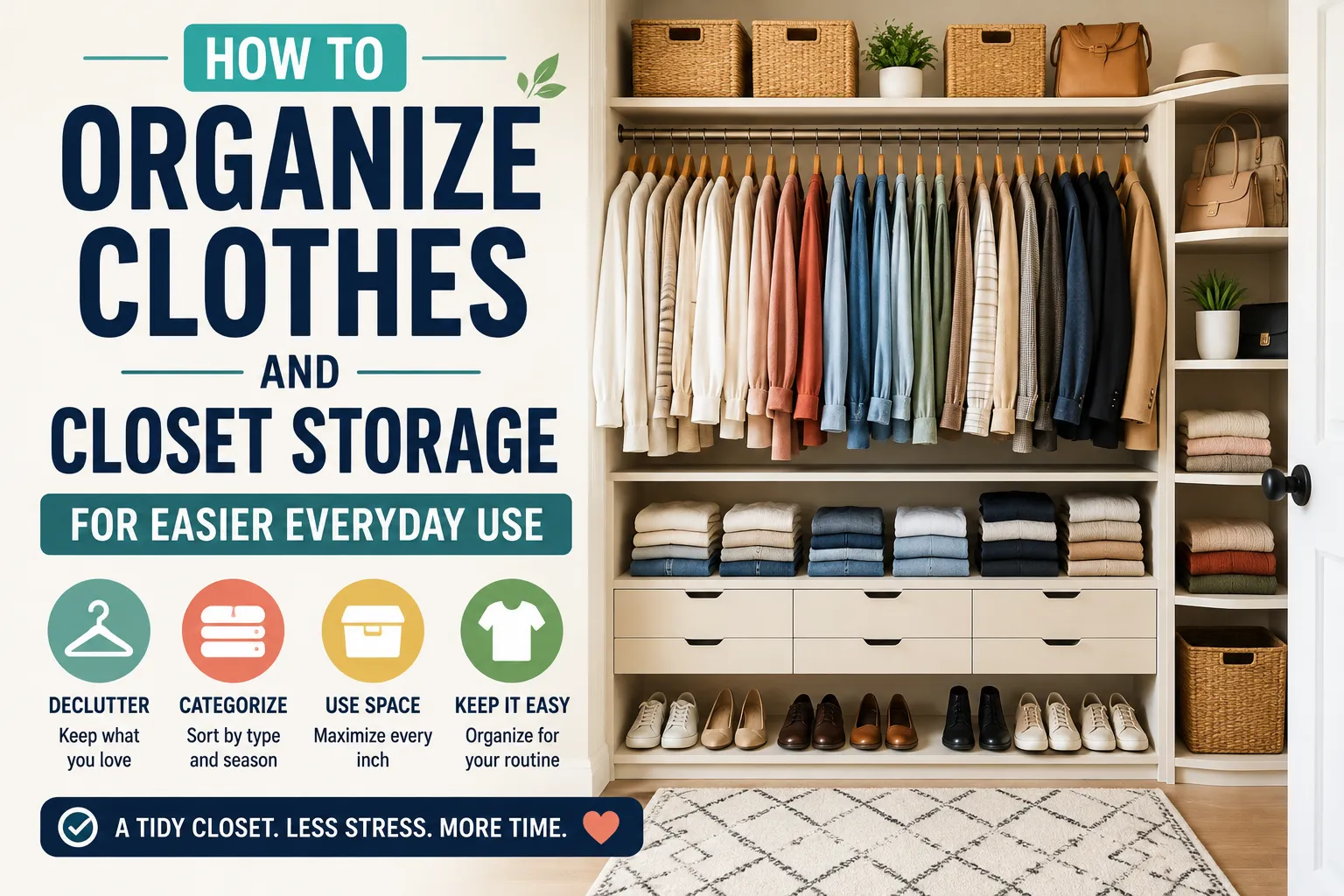
How to Organize Clothes and Closet Storage for Easier Everyday Use
A well-organized closet can make everyday life noticeably easier.
When clothes are packed into overcrowded drawers, shoes are scattered across the floor, and frequently worn items are buried behind things you rarely use, getting dressed can become an unnecessarily frustrating task. A good clothing organization system does more than make a closet look tidy—it makes the things you use most accessible while helping you see what you actually own.
The key is not to create a picture-perfect closet that requires constant maintenance. Instead, the goal is to build a practical storage system that matches your daily habits, available space, and wardrobe. This approach works especially well when closet organization is treated as part of a broader decluttering process rather than simply an exercise in adding more storage.
Why Closet Organization Matters
Closet organization is often treated as a purely visual exercise, but an effective system can provide several practical benefits.
A well-organized wardrobe can help you:
- Find clothes more quickly
- Reduce unnecessary clutter
- Make better use of limited storage space
- Keep clothing in better condition
- Identify items you no longer wear
- Simplify laundry and putting clothes away
- Create outfits more easily
- Avoid buying duplicates of things you already own
- Keep frequently used clothing within easy reach
The best system is one that makes everyday decisions easier.
If you have to move ten items to reach a shirt you wear several times a week, the closet is technically storing your clothes but not serving you particularly well.
Start by Taking Everything Out
Before reorganizing a closet, it helps to understand what you are working with.
Remove the clothing from the section you want to organize and place it somewhere you have enough room to sort comfortably.
Depending on the size of the closet, you can work on everything at once or tackle one section at a time.
Emptying the space allows you to see:
- How much clothing you actually have
- Which areas are being wasted
- What types of storage you need
- Which items are damaged
- What you rarely wear
- Whether certain categories are taking up too much space
It also gives you an opportunity to clean shelves, drawers, floors, and other surfaces before putting everything back.
Sort Clothes Into Useful Categories
Once the closet is empty, start sorting clothing into categories.
Possible categories include:
- T-shirts
- Shirts and blouses
- Trousers
- Jeans
- Dresses
- Skirts
- Sweaters
- Jackets
- Sportswear
- Sleepwear
- Underwear
- Work clothing
- Occasion clothing
- Accessories
The categories do not need to be identical for everyone.
A person who wears mostly casual clothing may have little use for a separate formalwear section, while someone with a business wardrobe may benefit from keeping work clothes together.
The objective is to create categories that reflect how you actually use your clothes.
For a broader approach to organizing different areas of the home, a room-by-room home organization guide can help you apply the same principle beyond the closet.
Separate Frequently Worn Clothes From Rarely Used Items
Not every item deserves the same amount of closet space.
Think about how often you use each category.
Everyday clothes should generally be the easiest to reach. Clothing that you wear occasionally can occupy less accessible areas.
For example, you might place:
Easy access:
- Everyday shirts
- Regular trousers
- Work clothes
- Frequently worn shoes
Secondary storage:
- Formalwear
- Seasonal clothing
- Special-occasion outfits
- Rarely used accessories
This simple distinction can dramatically improve the functionality of a closet.
Decide What Should Stay
Closet organization is much easier when you are not trying to find storage space for clothing you no longer want.
As you sort, ask yourself:
- Do I wear this?
- Does it fit comfortably?
- Is it in usable condition?
- Would I choose to buy it again today?
- Does it suit my current lifestyle?
- Do I own several similar items?
- Am I keeping it because I actually use it or because I feel guilty getting rid of it?
You do not need to throw something away simply because you have not worn it recently.
Some items have sentimental or practical value.
However, if a closet contains large quantities of clothing that no longer fit, are damaged beyond reasonable repair, or have not been worn for years without a meaningful reason, reducing the collection can make organization considerably easier.
Create a Keep, Repair, Donate and Discard System
Instead of making every clothing decision immediately, create four broad groups:
Keep
Items you regularly wear or genuinely need.
Repair
Items that are useful but need alterations, buttons, stitching, zipper repairs, or other attention.
Donate or Give Away
Good-condition clothing that you no longer need and that could be useful to someone else.
Discard
Items that are excessively worn, damaged, stained, or otherwise unsuitable for continued use or donation.
Try not to leave the repair pile indefinitely.
A large collection of clothes waiting for repairs can become another form of clutter.
Arrange Clothes by Type
Once you have decided what stays, arrange clothing according to type.
For hanging clothes, you might group:
- Shirts
- Blouses
- Dresses
- Jackets
- Trousers
- Formalwear
For folded clothing, separate categories such as:
- T-shirts
- Jeans
- Sweaters
- Shorts
- Sportswear
- Sleepwear
This arrangement makes it easier to find a specific type of garment without searching through the entire closet.
Consider Organizing by Color
Color organization can be useful after clothing has already been divided into categories.
For example, within your shirt section, you might arrange garments from lighter to darker shades.
However, color should generally be a secondary organizing principle.
Sorting every garment by color without first separating categories can make it harder to find specific types of clothing.
A practical system might therefore look like:
Shirts → white → beige → blue → green → black
rather than simply:
Everything blue → everything black → everything white
The best approach depends on how you choose outfits.
Use the Right Storage Method for Each Clothing Type
Not every item should be stored in the same way.
Some clothes are best hung, while others are better folded.
Hanging works well for:
- Dresses
- Blouses
- Button-up shirts
- Jackets
- Suits
- Clothing that wrinkles easily
Folding works well for:
- T-shirts
- Jeans
- Sweaters
- Sweatshirts
- Casual trousers
- Many types of knitwear
Heavy sweaters, in particular, may benefit from being folded rather than hung because prolonged hanging can distort their shape.
Choosing appropriate storage methods is also important when managing household belongings more broadly. Home storage systems can help determine how different types of possessions should be stored according to their size, frequency of use, and available space.
Use Vertical Closet Space
One of the most commonly wasted areas in a closet is vertical space.
If your closet has a large amount of unused space above hanging clothes, consider whether that area can accommodate additional shelving or storage.
Possible options include:
- Stackable shelves
- Fabric storage boxes
- Bins
- Additional hanging rods
- Shelf dividers
Vertical storage can be especially useful in small closets because it increases capacity without requiring additional floor space.
Make Use of Closet Doors
Closet doors can provide additional storage opportunities.
Depending on the design of the door, you may be able to use an over-the-door organizer for:
- Belts
- Scarves
- Small bags
- Accessories
- Shoes
- Hair accessories
However, avoid adding so much weight that the door becomes difficult to open or close.
The goal is to add useful storage without creating another cluttered surface.
Organize Drawers by Category
Drawers work best when each one has a clear purpose.
For example:
Drawer 1: Underwear
Drawer 2: Socks
Drawer 3: T-shirts
Drawer 4: Sleepwear
If everything is thrown into one large drawer, finding a particular item can become difficult.
Drawer dividers can help separate smaller categories and prevent items from becoming mixed together.
Try Vertical Folding for Folded Clothes
Traditional stacks of clothing can create a common problem.
You pull something from the bottom and the entire pile collapses.
An alternative is to fold clothes and store them vertically when the drawer or container allows it.
This arrangement makes individual items easier to see.
Instead of looking at the top of a pile, you can see more of the contents at once.
This can work particularly well for:
- T-shirts
- Shorts
- Workout clothing
- Children’s clothes
- Pajamas
The technique is less important than the principle: store clothing in a way that lets you see what you own.
Use Shelf Dividers for Stacked Clothing
If vertical folding is not practical, shelf dividers can help keep stacks separated.
For example, one shelf could contain:
- Jeans on one side
- Casual trousers in the middle
- Shorts on the other side
Dividers prevent piles from spreading into neighboring categories.
They are particularly useful for deep shelves where clothing tends to shift around.
Use Matching Hangers When Practical
Matching hangers are not essential, but they can make a closet easier to manage.
Uniform hangers create consistent spacing and make it easier to slide garments along a hanging rail.
Slim hangers can also reduce the amount of horizontal space each garment occupies.
However, do not replace perfectly usable hangers simply for appearance if doing so is unnecessary.
Organization should improve functionality rather than create unnecessary expense.
Keep Hangers Facing the Same Direction
A simple habit can make a surprisingly noticeable difference.
Place hanging garments in the same direction and keep hangers consistently oriented.
This makes the closet look more orderly and makes it easier to identify gaps and overcrowded sections.
You can also use a simple rule:
One garment, one hanger.
Avoid placing multiple unrelated garments on a single hanger simply to save space. While this may technically increase capacity, it can make clothing much harder to access.
Store Shoes Where You Can See Them
Shoes can quickly turn into closet clutter.
If possible, organize them by type:
- Everyday shoes
- Sneakers
- Sandals
- Boots
- Formal shoes
- Sports shoes
Frequently worn pairs should be easy to reach.
Less frequently used footwear can be stored higher or farther back.
If floor space is limited, consider vertical shoe storage or shelving rather than creating large piles.
Keeping shoes visible can also help prevent forgotten pairs from sitting unused for years.
Give Accessories Their Own Storage
Small accessories can be difficult to organize because they do not always fit naturally into conventional drawers.
Consider separate storage for:
- Belts
- Scarves
- Hats
- Watches
- Jewelry
- Handbags
- Sunglasses
Hooks, small compartments, drawer dividers, and dedicated boxes can prevent accessories from becoming tangled together.
The goal is to make each item easy to find and easy to put away.
Organize Bags Without Crushing Them
Handbags, backpacks, briefcases, and other bags can take up considerable space.
If possible, store them upright rather than throwing them into a pile.
For structured bags, keeping them filled lightly with clean paper or another suitable material can help them retain their shape during long-term storage.
Frequently used bags should remain accessible.
Occasional-use bags can be placed in higher storage areas.
Store Seasonal Clothes Strategically
If your climate changes significantly throughout the year, seasonal rotation can make a closet easier to use.
Clothing that is not currently needed can be stored in:
- Under-bed containers
- Labeled storage boxes
- Vacuum storage bags where appropriate
- High closet shelves
- Dedicated wardrobe storage
Clearly label containers so you know what is inside without opening every box.
In climates where seasons are less distinct, a full seasonal rotation may not be necessary.
Instead, simply move rarely worn items into less accessible storage.
Label Storage Containers
Labels are particularly useful when clothing is stored outside the main closet.
Instead of writing something vague such as “Clothes,” use specific labels:
- Winter sweaters
- Formalwear
- Children’s clothing
- Sportswear
- Extra bedding
- Accessories
Good labeling reduces the amount of time spent searching for stored items.
Transparent containers can also make contents easier to identify.
Make Everyday Clothes the Easiest to Reach
This is perhaps the most important rule in a practical closet.
The frequency with which you use something should determine how accessible it is.
If you wear a particular pair of trousers several times a week, they should not be hidden at the back of a storage box.
If you wear formal clothing twice a year, it does not need prime closet real estate.
Think of the closet as a hierarchy:
Zone 1: Daily use
Items you reach for constantly.
Zone 2: Regular use
Items worn weekly or periodically.
Zone 3: Occasional use
Formalwear, special outfits, and rarely used accessories.
Zone 4: Long-term storage
Sentimental pieces and genuinely seasonal items.
This approach makes the closet work around your lifestyle.
Keep Laundry From Recreating the Mess
A perfectly organized closet can quickly become disorganized if clean laundry is not put away efficiently.
Create a simple routine:
- Wash clothes.
- Dry them properly.
- Fold or hang them promptly.
- Return them to their designated categories.
- Put damaged items into the repair area.
- Keep dirty clothes separate from clean clothes.
The less time clean laundry spends in random piles, the easier it is to maintain the system.
Create a Small Repair Area
A missing button or loose seam does not necessarily mean a garment needs to be discarded.
Create a small repair container for items that need attention.
However, establish a deadline.
For example, if something remains in the repair box for several months, ask whether you are realistically going to repair it.
This prevents the repair category from becoming a permanent holding area for unwanted clothing.
Avoid Overfilling the Closet
A closet that is filled to maximum capacity is difficult to maintain.
Clothes become difficult to remove, hangers become tightly packed, and shelves become harder to access.
Leave enough space to move items comfortably.
A little empty space is not wasted space.
It provides flexibility for future purchases, laundry, seasonal changes, and rearranging categories.
Use the One-In, One-Out Rule Carefully
If your wardrobe is consistently becoming overcrowded, consider a simple rule:
When a new item comes in, an old item goes out.
For example, buying a new pair of jeans could prompt you to evaluate whether you still need your least-used pair.
This does not mean you must immediately discard something every time you buy clothing.
The purpose is to encourage awareness of how much you own and prevent gradual accumulation.
Keep a Donation Bag Ready
If you regularly find clothing that you no longer need, maintain a designated donation bag or box.
When it becomes full, take the items to an appropriate local charity, community organization, or textile-recycling program where available.
Before donating, make sure items meet the organization’s requirements.
Clothing that is heavily damaged or contaminated may not be suitable for donation.
Do Not Organize Clothes You Do Not Need
One of the biggest mistakes in closet organization is trying to create better storage for an excessive amount of clothing.
Adding more boxes, shelves, hooks, and organizers can sometimes hide the real problem.
If the closet contains far more clothing than you use, additional storage may only postpone the problem.
Decluttering first makes organization much easier.
A smaller wardrobe that is well organized can be more useful than a larger wardrobe that is difficult to navigate.
Make the System Easy to Maintain
A complicated closet system may look impressive immediately after installation but fail after a few weeks.
The best system should require little effort.
For example:
- Shirts always return to the shirt section.
- Shoes return to the same shelf.
- Laundry goes directly into its category.
- Accessories have designated containers.
- Seasonal items have labeled storage.
When everything has an obvious home, tidying becomes much faster.
Developing consistent personal organization habits can make this process easier. Improving personal organization skills can help turn these individual storage decisions into routines that are easier to maintain.
Organize Children’s Clothes Differently
Children’s wardrobes require a slightly different approach because sizes and needs change quickly.
Consider keeping:
- Everyday clothing at child-accessible heights
- School clothes together
- Sportswear together
- Sleepwear in a dedicated drawer
- Special-occasion clothing separately
As children grow, regularly check whether clothing still fits.
Clothes that are too small can be donated, stored for younger siblings, or passed to someone else when appropriate.
This prevents drawers and closets from becoming crowded with clothing that cannot be worn.
Make Shared Closets Easier to Use
If two or more people share a closet, clearly defined sections can reduce confusion.
Each person can have dedicated:
- Hanging space
- Shelves
- Drawers
- Shoe storage
- Accessory storage
Shared categories such as towels or household linens can occupy a separate area.
The exact division does not need to be equal in size if one person owns significantly more clothing.
The goal is to create a system that everyone can understand.
Consider Accessibility When Organizing
Storage should be designed around the people who use it.
Frequently used items should not require stretching, climbing, or excessive bending.
For older adults or people with mobility limitations, consider keeping everyday clothing at comfortable heights and reducing the need to use high shelves.
Accessibility is not just about convenience.
It can make everyday routines safer and more independent.
Clean the Closet Before Putting Everything Back
Once sorting is complete, take advantage of the empty space.
Clean:
- Shelves
- Drawers
- Closet floors
- Corners
- Hanging rods
- Storage containers
Dust and dirt can accumulate in areas that are rarely exposed.
Allow surfaces to dry completely before returning clothing.
This is also a good opportunity to check for moisture, unusual odors, insects, or signs of damage that may need attention.
A Simple Closet Organization Layout
A practical closet could be structured like this:
| Storage Area | Best Use |
|---|---|
| Eye-level hanging space | Everyday shirts, dresses and frequently worn clothing |
| Lower shelves | Jeans, trousers and folded clothing |
| Drawers | Underwear, socks and smaller garments |
| Upper shelves | Seasonal and occasional clothing |
| Floor shelving | Shoes and boots |
| Door storage | Belts, scarves and small accessories |
| Separate containers | Long-term or sentimental clothing |
You can adjust this arrangement according to your closet’s size and design.
Common Closet Organization Mistakes
Even well-intentioned organization efforts can create new problems.
Keeping everything
If you never remove unused clothing, the closet will eventually become overcrowded again.
Using too many organizers
Storage products should solve specific problems. Buying organizers without a plan can create additional clutter.
Ignoring daily habits
A system that looks good but does not match how you dress will probably not last.
Storing everything by color
Color can be useful, but organizing only by color may make categories harder to locate.
Overpacking drawers
A drawer that barely closes is not efficiently organized.
Hiding frequently used items
Daily essentials should be among the easiest things to reach.
Creating complicated rules
If putting a shirt away requires several steps, people are less likely to follow the system consistently.
How to Keep Your Closet Organized Long Term
Once your closet is organized, maintenance should be relatively simple.
Set aside a few minutes periodically to:
- Return misplaced clothing
- Remove damaged items
- Reassess clothes that are no longer worn
- Put seasonal items away when appropriate
- Check shoe storage
- Clean shelves and floors
- Empty the donation bag
- Review overcrowded categories
A short reset is much easier than waiting until the entire closet becomes overwhelming.
The Goal Is a Closet That Works for You
A successful closet does not have to look like a showroom.
It does not need expensive storage systems, dozens of matching containers, or a perfectly color-coded wardrobe.
What matters is whether you can find what you need, put things away easily, and maintain the system without excessive effort.
Start by reducing unnecessary clutter. Then divide clothing into useful categories, place frequently worn items within easy reach, use vertical space wisely, and give every remaining item a logical home.
Most importantly, organize around your real life rather than an idealized version of it.
A More Useful Closet Starts With Better Decisions
The most effective clothing organization system is one that quietly removes friction from everyday routines.
When work clothes are easy to find, shoes have a designated place, clean laundry has somewhere to go, and rarely used items are stored out of the way, getting dressed becomes simpler and maintaining the room becomes less demanding.
You do not need to organize everything perfectly in one day. Start with the clothing you use most, create clear categories, remove what no longer serves a purpose, and gradually improve the storage system as you learn what works.
A well-organized closet is ultimately less about having more storage and more about making better use of the space—and the clothes—you already have.