How to Organize and Store Household Cleaning Supplies Efficiently
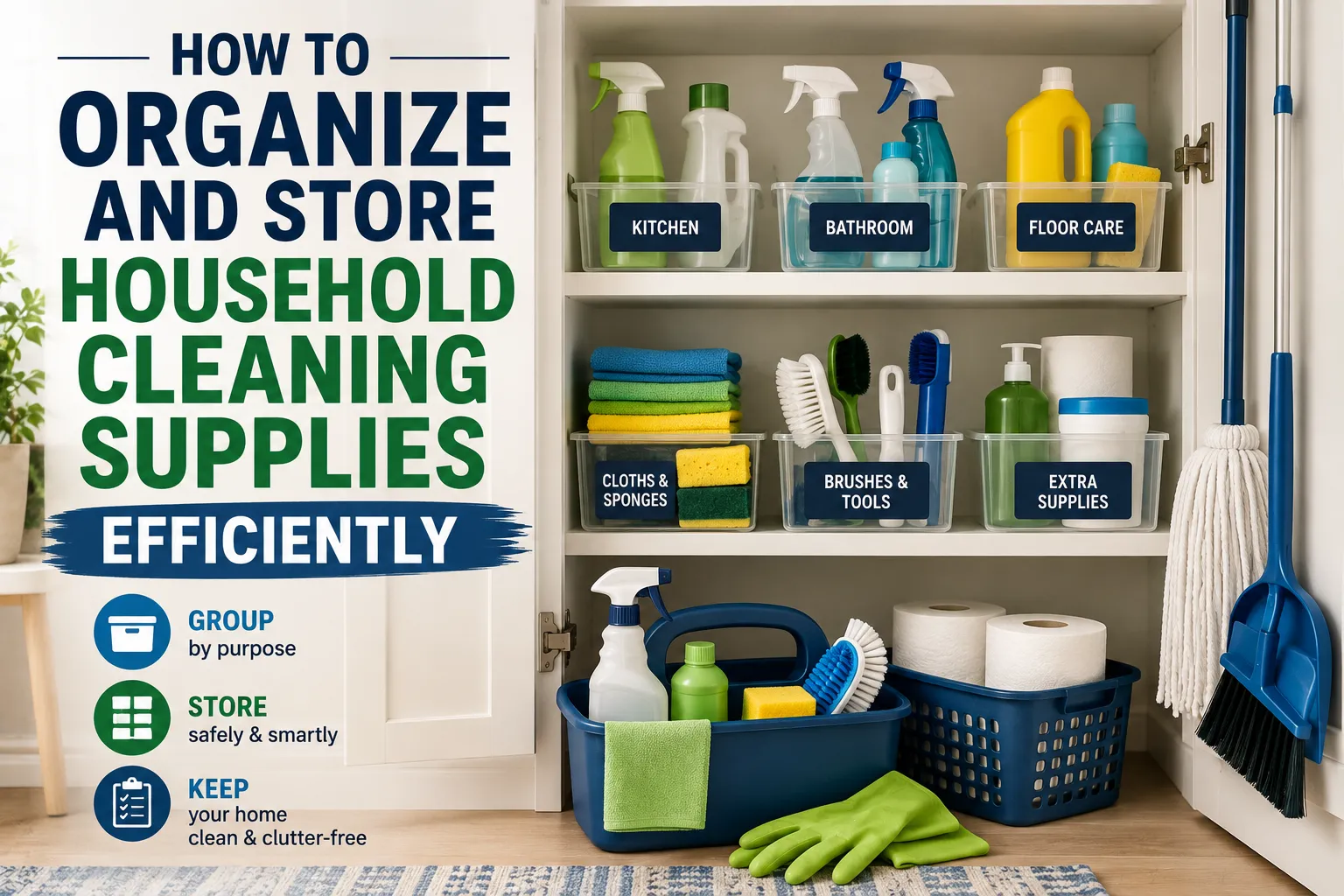
How to Organize and Store Household Cleaning Supplies Efficiently
Cleaning supplies are useful only when they are easy to find, safely stored and kept in good condition. Yet many homes end up with bottles scattered beneath sinks, half-used products pushed into crowded cabinets and cleaning tools that seem to disappear whenever they are needed.
A better system does not require a large utility room or expensive storage equipment. With a little planning, households can organize cleaning products according to how often they are used, where they are needed and how safely they need to be stored.
The result is a cleaning area that is easier to maintain, quicker to use and less likely to become cluttered.
For a broader guide to household cleaning routines, products, tools and maintenance, see The Ultimate Guide to Cleaning Your Home.
Start by Taking Everything Out
The easiest way to organize cleaning supplies is to begin with a complete inventory.
Instead of rearranging a crowded cabinet one bottle at a time, remove everything and place the products where you can see them.
Group similar items together, such as:
-
All-purpose cleaners
-
Disinfectants
-
Bathroom cleaners
-
Glass cleaners
-
Kitchen cleaners
-
Laundry products
-
Dishwashing supplies
-
Floor-care products
-
Sponges and scrubbers
-
Microfiber cloths
-
Brushes
-
Brooms and dustpans
-
Mops
-
Buckets
-
Cleaning gloves
This immediately reveals how much you actually have.
It may also uncover duplicate products that were purchased because an existing bottle was difficult to find.
Get Rid of Products You No Longer Need
Once everything is visible, identify products that should not remain in the storage area.
Look for empty containers, damaged packaging and products that are no longer needed.
Do not simply pour unwanted chemicals down a drain or combine them with other household products. Disposal instructions can vary depending on the product and local regulations.
Keep products in their original containers whenever possible. Original labels provide important information about ingredients, usage instructions and safety precautions.
Group Supplies by Purpose
One of the most efficient organizational systems is to group products according to the job they perform.
For example, create separate categories for:
Kitchen cleaning: Countertop cleaner, dishwashing supplies, degreaser, sponges and cloths.
Bathroom cleaning: Toilet cleaner, bathroom spray, scrubbers, brushes and gloves.
Glass cleaning: Glass cleaner and appropriate microfiber cloths.
Floor care: Floor cleaner, mop, bucket and replacement mop heads.
Laundry: Detergent, stain remover and other laundry-related products.
Understanding what different cleaners are designed to do can make it easier to decide which products deserve storage space. Cleaning Products Explained provides a useful overview of common household cleaning products and their purposes.
This approach makes it easier to grab everything required for a particular task without searching through unrelated supplies.
Store Frequently Used Items Where They Are Needed
Not every cleaning product needs to live in one central location.
If a bathroom is cleaned regularly, keeping a small collection of appropriate supplies nearby can save time.
Similarly, dishwashing supplies belong close to the kitchen sink, while laundry products should be stored near the washing area when practical.
The key is to avoid creating so many storage locations that you forget where things are.
A useful approach is to maintain small task-based collections while keeping backup supplies in a central storage area.
Create a Central Cleaning Supply Zone
A central storage area is useful for products that are used throughout the house.
This could be a utility cabinet, laundry-room shelf, closet or another dedicated space.
Use the central area for:
-
Backup cleaning products
-
Extra microfiber cloths
-
Replacement mop heads
-
Spare sponges
-
Larger containers
-
Less frequently used specialty cleaners
The central zone becomes the household’s cleaning supply station.
When a frequently used product runs out, the replacement can be retrieved from this location.
Use Bins to Create Categories
Open shelves and cabinets can quickly become difficult to manage when small cleaning products are mixed together.
Storage bins provide a simple solution.
Instead of placing individual bottles randomly on a shelf, use separate containers for categories such as:
-
Bathroom supplies
-
Kitchen supplies
-
Floor care
-
Dusting supplies
-
Cleaning cloths
-
Brushes and scrubbers
Choose containers that are easy to remove from the shelf.
A bin that can be pulled out as one unit is often more practical than reaching behind several bottles.
Label Storage Containers
Labels can make an organization system much easier for everyone in the household to follow.
A simple label such as Bathroom, Kitchen, Floors or Cloths & Sponges can make it obvious where an item belongs.
Labels are particularly helpful when multiple people share cleaning responsibilities.
The objective is to make the correct storage location obvious rather than relying on memory.
Keep Cleaning Cloths Separate
Reusable cleaning cloths can become messy when they are stored with chemical bottles.
A dedicated basket or container can keep cloths together.
You can organize them by type or intended use.
For example:
-
Glass-cleaning cloths
-
General-purpose microfiber cloths
-
Kitchen cloths
-
Bathroom cloths
-
Floor-cleaning cloths
Separate storage can also reduce the risk of accidentally using a cloth for one area after it has been used for another.
After laundering, return clean cloths to their designated storage container.
Organize Brushes and Scrubbers Vertically
Cleaning brushes can take up surprisingly little space when stored vertically.
A narrow container can hold scrub brushes, bottle brushes and other long-handled tools.
Wall-mounted hooks can also be useful for brushes or dusters when the storage area permits.
The main goal is to prevent tools from forming a pile at the bottom of a cabinet.
When every tool has a visible position, it becomes easier to find and return.
For more ideas on selecting and organizing the equipment used for different cleaning jobs, see Cleaning Tools: Complete Guide to Household Tools & Uses.
Make Better Use of Cabinet Doors
The inside of a cabinet door can provide valuable storage space.
Depending on the cabinet’s construction and the products being stored, door-mounted organizers can hold lightweight items such as:
-
Cleaning cloths
-
Small brushes
-
Sponges
-
Gloves
-
Dusting tools
Before installing an organizer, make sure it does not interfere with shelves or prevent the door from closing properly.
Use Hooks for Long-Handled Tools
Mops, brooms and dustpans are awkward to store when they are simply leaned against a wall.
A row of sturdy hooks or a purpose-built tool organizer can keep them upright and accessible.
Store long-handled tools in a location where they will not fall into walkways or block doors.
Allowing wet mop heads to dry properly before storage is also important.
Let Wet Tools Dry Before Storing Them
Putting damp cleaning tools into a closed cabinet can create unpleasant odors and encourage microbial growth.
Mop heads, reusable cloths, brushes and sponges should be allowed to dry appropriately before being placed into enclosed storage.
Where possible, provide ventilation around items that regularly become wet.
A storage system should not merely hide cleaning equipment. It should also allow the equipment to dry properly between uses.
Store Chemicals Safely
Safety should take priority over convenience when organizing cleaning chemicals.
Keep products in their original containers and follow the manufacturer’s storage instructions.
Household chemicals should be kept away from children and pets.
Where possible, use secure storage that prevents young children from accessing potentially dangerous products.
Do not transfer chemicals into food or drink containers. A bottle that looks like a beverage container can create a serious poisoning risk.
Never Mix Cleaning Chemicals
Different cleaning products can contain chemicals that react dangerously when combined.
A particularly important example is bleach. It should never be mixed with ammonia, acids or other incompatible cleaning products.
The safest approach is simple:
Use one cleaning product according to its label instructions and never experiment by combining products.
If you are switching between cleaning products, follow the manufacturer’s directions about rinsing or preparing the surface first.
Keep Products Away From Food
Cleaning products should not be stored alongside food, cooking ingredients or food containers.
This is especially important in kitchens, where cabinet space may be limited.
A dedicated cleaning-products cabinet or clearly separated storage area can help prevent accidental contamination.
Keep chemical products securely closed and follow their label instructions regarding storage conditions.
Consider Temperature and Moisture
Some cleaning products can be affected by extreme temperatures or excessive moisture.
A storage area should therefore be appropriate for the specific products being stored.
Avoid placing products in locations where they are exposed to conditions that contradict their labels.
A damp cabinet under a sink may be convenient, but it is not always ideal for every type of product.
Check labels for special storage requirements.
Use the “Everyday” and “Backup” System
One of the simplest ways to prevent clutter is to separate products currently in use from replacements.
For example, keep one bottle of a commonly used cleaner in the kitchen and store unopened replacements elsewhere.
This prevents a cabinet from becoming packed with several bottles of the same product.
It also makes it easier to see when backup supplies are running low.
Avoid Buying Too Many Similar Products
Cleaning aisles offer a huge range of specialized products.
However, many households can accomplish most routine cleaning with a relatively small selection of appropriate products.
Before purchasing another cleaner, ask whether an existing product already serves the same purpose.
Reducing duplicates saves storage space and can make the entire system easier to manage.
Specialized products can still have a place when they are genuinely useful, but they should earn their space.
Create a Simple Inventory
For households with many supplies, a basic inventory can prevent unnecessary purchases.
You do not need a complicated spreadsheet.
A short list of important supplies can be enough:
| Category | Item | Status |
|---|---|---|
| Laundry | Detergent | Available |
| Kitchen | Dish soap | Low |
| Bathroom | Toilet cleaner | Available |
| Floors | Floor cleaner | Backup needed |
| General | Microfiber cloths | Available |
The list can be kept on a phone, printed inside the cleaning cabinet or incorporated into a household shopping list.
Store Heavy Items Lower
Large containers and heavy cleaning equipment are generally easier and safer to handle when stored on lower shelves.
Place lighter products and frequently used small items higher up where appropriate.
This can also reduce the risk of a heavy container falling when someone reaches into a cabinet.
Always consider the stability and weight limits of shelves and storage systems.
Make the Most Frequently Used Items Easiest to Reach
Organization works best when it reflects actual habits.
If a product is used every day, it should not be buried behind items used once a year.
Place everyday supplies toward the front or at convenient heights.
Less frequently used products can occupy harder-to-reach areas, provided they remain safely accessible to the appropriate adults.
This simple change can make a major difference in how quickly cleaning tasks can begin.
Use Clear Containers for Small Accessories
Small cleaning accessories can disappear easily in deep drawers and cabinets.
Clear or open containers can help keep items such as:
-
Sponges
-
Replacement scrub pads
-
Gloves
-
Small brushes
-
Cloths
-
Cleaning attachments
visible and easy to access.
The objective is not to create a perfectly styled cabinet. It is to eliminate unnecessary searching.
Keep a Small Cleaning Caddy
A portable cleaning caddy can be particularly useful in larger homes.
Instead of carrying individual bottles and tools from room to room, place commonly used supplies in one container.
A basic caddy might include:
-
General-purpose cleaner
-
Appropriate cloths
-
Scrub brush
-
Sponges
-
Gloves
-
Small trash bags
The caddy can be carried to the area being cleaned and returned to its storage location afterward.
Don’t Overfill Storage Areas
A storage system becomes difficult to maintain when every available space is packed.
Leave enough room to remove bottles without knocking over everything around them.
Overcrowded cabinets also make it harder to identify products that are leaking, expired or running low.
A little empty space is not wasted space. It makes the entire system easier to use.
Check Supplies Regularly
Organization is not a one-time project.
Every few weeks or months, depending on how much your household uses, check the cleaning area.
Look for:
-
Empty containers
-
Products running low
-
Damaged packaging
-
Leaks
-
Duplicate products
-
Supplies that are no longer needed
-
Tools that need cleaning or replacement
A quick review prevents clutter from rebuilding.
Clean the Storage Area Itself
Cleaning supplies can leave behind residue, dust and spills.
Once or twice in a while, remove the products and wipe down shelves and storage containers.
Pay particular attention to the bottom of cabinets where leaking bottles can leave residue unnoticed.
If a product has leaked, follow its label instructions for safe cleanup.
Create a Restocking Routine
A simple restocking system can prevent the household from suddenly running out of essential supplies.
When a product reaches a predetermined level, add it to the shopping list.
For frequently used products, maintaining one backup may be enough.
There is usually no need to stockpile large quantities unless a particular household has a specific reason to do so.
Organize According to Your Home
There is no universal cleaning-supply organization system.
A small apartment may need only one cabinet and a compact cleaning caddy.
A larger home may benefit from a central utility closet plus small storage areas near bathrooms, the kitchen and laundry room.
The best system is the one that fits the way the household actually cleans.
An elaborate organization method that nobody follows is less effective than a simple system everyone understands.
Keep the System Easy to Maintain
One of the biggest mistakes in home organization is creating a system that looks perfect on the first day but requires too much effort to maintain.
A practical system should make putting things away almost automatic.
Every product needs an obvious home.
Every storage category should be easy to understand.
Frequently used items should be convenient.
Unnecessary products should have a clear disposal or replacement process.
When those principles are in place, maintaining the organization becomes much easier.
A Cleaner Cabinet Can Make Cleaning Easier
Organizing household cleaning supplies is ultimately about reducing friction.
When products are scattered, cleaning takes longer because people spend time searching, moving bottles and figuring out what they need.
When supplies are grouped logically, stored safely and placed close to where they are used, the entire process becomes more efficient.
The most effective system does not require expensive organizers or a dedicated utility room. It starts with removing unnecessary products, grouping the rest by purpose, separating everyday supplies from backups and giving every item a clear place.
A well-organized cleaning station turns a collection of bottles, brushes and cloths into a simple system—and when that system is easy to use, keeping the rest of the home organized becomes a little easier too.