How to Make Compost and Use It Effectively in a Garden
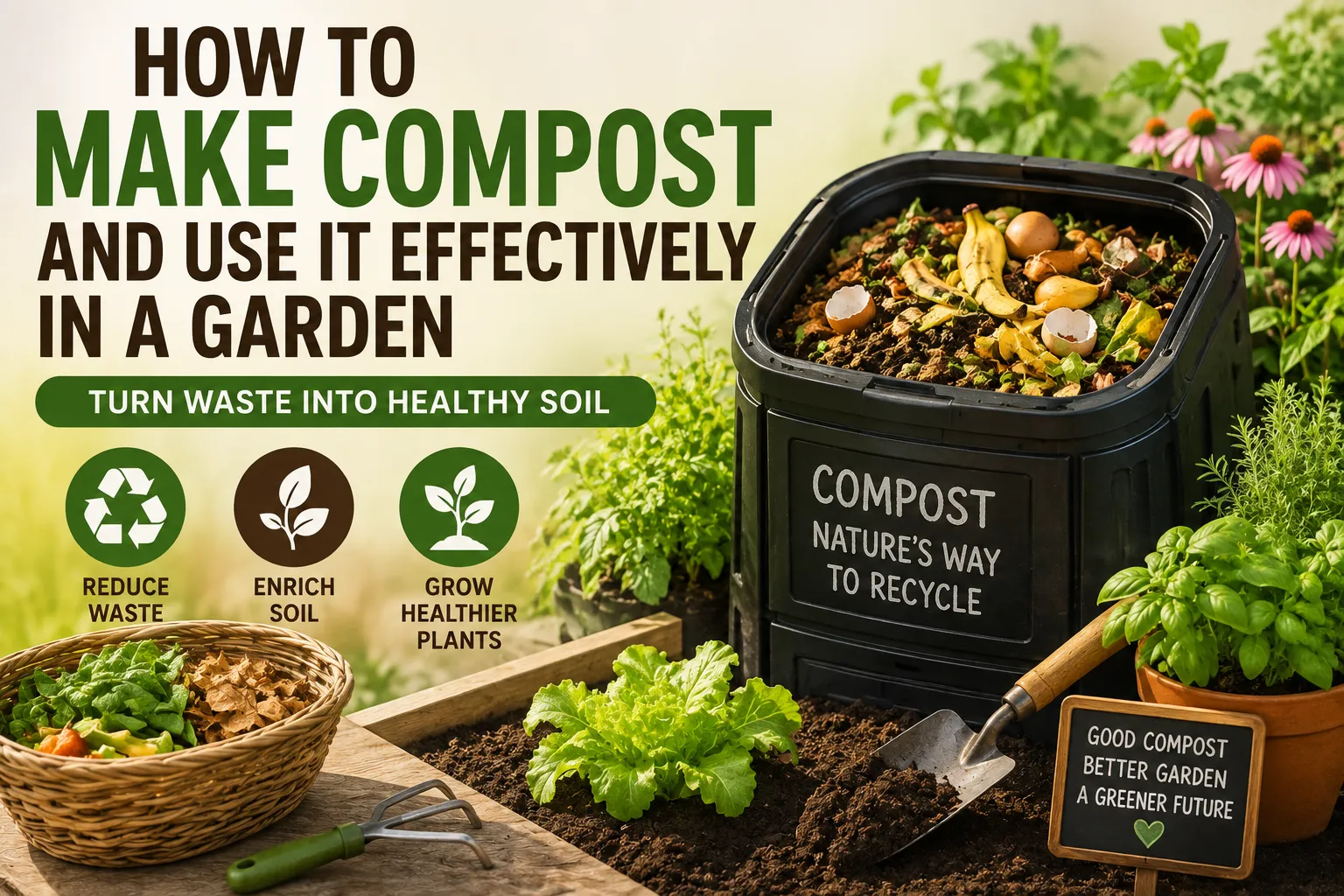
How to Make Compost and Use It Effectively in a Garden
Compost is one of the simplest ways to turn everyday organic waste into something useful for the garden. Instead of sending food scraps, leaves and grass clippings to the trash, gardeners can allow these materials to break down naturally and become a dark, nutrient-rich material that improves soil.
Making compost does not require expensive equipment or a large garden. A basic compost pile can work in a backyard, while bins and enclosed systems can make composting practical for smaller spaces.
The key is understanding what materials to add, how to maintain the pile and how to use finished compost without overwhelming the soil or plants.
What Is Compost?
Compost is decomposed organic material produced through a natural biological process.
Microorganisms such as bacteria and fungi break down plant and other organic materials. Larger organisms, including insects and worms, can also contribute to decomposition.
As the materials break down, the original ingredients gradually become a dark, crumbly substance with an earthy smell.
Finished compost can add organic matter to soil, improve its structure and support the organisms that contribute to healthy soil ecosystems.
Why Compost Matters in the Garden
Compost is valuable because it improves more than just the appearance of garden soil.
Adding organic matter can help soil:
- Hold moisture
- Drain excess water
- Resist compaction
- Support beneficial soil organisms
- Improve structure
- Release nutrients gradually
- Support healthier root growth
The benefits can be especially noticeable in soils that are very sandy, heavy with clay or low in organic matter.
Compost is not a replacement for every fertilizer or soil amendment, but it can become an important part of a broader soil-management strategy.
For a broader overview of how different gardening practices work together to support healthy plants, see the Complete Guide to Flower Gardening.
You Don’t Need a Large Garden to Make Compost
A common misconception is that composting requires a large backyard.
In reality, composting systems range from large outdoor piles to compact containers.
Gardeners can choose among options such as:
- Open compost piles
- Enclosed compost bins
- Compost tumblers
- Worm composting systems
- Small kitchen composting containers
- Community composting programs
The best option depends on available space, the amount of organic material produced and how much time you want to spend managing the compost.
Choose a Suitable Composting Location
For outdoor composting, choose a location that is convenient but does not interfere with normal household activities.
A good location should generally have:
- Reasonable drainage
- Access to water
- Enough space for the composting system
- Some protection from extreme weather
- Easy access for adding materials and removing finished compost
A compost pile placed too far from the kitchen may become inconvenient, while one placed immediately beside a living area may create problems if it is poorly managed.
The Basic Ingredients of Compost
Successful composting depends on a balance of different types of organic material.
Gardeners often describe these materials as greens and browns.
Greens
Green materials are generally relatively rich in nitrogen.
Examples include:
- Fresh grass clippings
- Vegetable scraps
- Fruit scraps
- Coffee grounds
- Fresh plant material
- Fresh weeds before they develop mature seeds
These materials tend to be moist and decompose relatively quickly.
Browns
Brown materials generally provide more carbon.
Examples include:
- Dry leaves
- Small pieces of untreated cardboard
- Shredded paper
- Dry grass
- Small twigs
- Straw
- Dead plant material
These materials help provide the carbon structure microorganisms need during decomposition.
Why the Carbon-to-Nitrogen Balance Matters
Composting microorganisms need both carbon and nitrogen.
Too much nitrogen-rich material can produce a wet, unpleasant-smelling pile.
Too much carbon-rich material can cause decomposition to proceed slowly.
You do not need to calculate the exact carbon-to-nitrogen ratio every time you add a handful of scraps. A practical approach is to combine a mixture of moist green materials with plenty of dry brown material.
If the pile becomes wet and smells bad, add more dry brown material.
If it remains dry and decomposes very slowly, adding some moist green material and water may help.
Chop Materials Into Smaller Pieces
Large pieces of organic material generally take longer to break down.
Cutting kitchen scraps into smaller pieces and shredding leaves can increase the surface area available to microorganisms.
Small pieces also make it easier to create a reasonably balanced pile.
You don’t need to pulverize everything. Simply cutting large pieces into smaller sections is usually enough to make a difference.
Keep the Compost Moist
Moisture is essential for decomposition.
A compost pile that is extremely dry can slow down or stop biological activity.
At the same time, a pile saturated with water can develop poor airflow and unpleasant odors.
A useful target is a moisture level similar to a damp, wrung-out sponge.
If the pile becomes too dry, add a small amount of water while mixing it.
If it becomes too wet, add dry leaves, shredded cardboard or another suitable brown material.
Compost Needs Oxygen
Aerobic microorganisms need oxygen to break down organic material efficiently.
Without enough airflow, the composting process can become slower and may produce unpleasant odors.
Turning the pile periodically helps introduce oxygen.
A compost fork, garden fork or suitable tool can be used to mix the outer and inner materials.
How often the pile needs turning depends on the composting method. A frequently turned pile can decompose faster, while a low-maintenance pile may take considerably longer.
How to Build a Compost Pile
A simple compost pile can be built gradually.
Start with a layer of coarse brown material, such as small twigs or dry plant material.
Add alternating or mixed layers of brown and green materials.
Continue adding organic material as it becomes available.
If the pile appears too wet, add more brown material. If it becomes very dry, add some water and moist organic material.
There is no need to build a perfectly layered pile. The goal is to maintain a reasonable balance of materials, moisture and airflow.
What You Can Put in Compost
Many common plant-based materials can become compost.
Suitable materials can include:
- Vegetable peelings
- Fruit scraps
- Coffee grounds
- Tea leaves
- Eggshells
- Grass clippings
- Dry leaves
- Garden trimmings
- Untreated paper
- Shredded cardboard
- Small amounts of untreated wood material
When in doubt, check the requirements of your particular composting system.
What You Should Generally Keep Out
Some materials can create problems in a typical backyard compost pile.
Avoid adding:
- Meat
- Fish
- Dairy products
- Oils and greasy foods
- Pet waste
- Diseased plants
- Weeds containing mature seeds
- Chemically treated materials
- Plastics
- Synthetic fabrics
- Glossy or heavily coated paper
Specialized composting systems may be designed to handle some materials that should not go into a conventional garden compost pile.
For example, certain commercial or municipal systems can process food waste under controlled conditions.
Be Careful With Diseased Plants
Composting diseased plant material can be risky if the compost pile does not reach conditions capable of destroying the relevant pathogens.
A typical backyard pile may not consistently reach high enough temperatures to eliminate every plant disease.
If a plant has a serious disease, it may be safer to dispose of the material through an appropriate waste-management system rather than adding it to home compost.
Watch Out for Weed Seeds
Weeds can be another problem.
If weeds have already produced mature seeds, adding them to a cool compost pile may allow those seeds to survive.
The result can be a batch of compost that spreads weeds when applied to the garden.
Young weeds without mature seed heads are generally easier to compost safely, provided they are otherwise suitable for your system.
How Long Does Compost Take?
There is no single timetable for finished compost.
Under favorable conditions, an actively managed pile can produce usable compost in a few months.
A cooler or less frequently turned pile may take considerably longer.
Factors that influence the speed include:
- Temperature
- Moisture
- Material size
- Carbon-to-nitrogen balance
- Oxygen availability
- Amount of organic material
- Frequency of turning
Trying to rush the process by adding excessive amounts of nitrogen-rich material can create an imbalanced pile rather than better compost.
How to Know When Compost Is Finished
Finished compost should look and smell different from the original materials.
Good finished compost is generally:
- Dark brown to nearly black
- Crumbly
- Relatively uniform
- Earthy-smelling
- Difficult to identify by its original ingredients
You should not be able to recognize most of the individual food scraps or plant materials.
Some larger pieces may remain. These can be returned to the compost pile for additional decomposition.
Don’t Use Immature Compost Everywhere
Partially decomposed organic material is not necessarily ready for use around plants.
Immature compost can continue decomposing after it is added to soil, potentially competing with plants for available nitrogen or causing other problems.
Allow compost to mature until most of the original materials have broken down.
If you are uncertain whether compost is finished, giving it additional time is usually safer than applying it immediately.
How to Use Compost in Garden Beds
Finished compost can be incorporated into existing garden soil before planting.
Spread a layer over the soil surface and mix it into the upper portion of the soil when appropriate.
The exact amount depends on the condition of the soil and the plants being grown.
There is generally no need to create an extremely thick layer of compost. Compost works best as part of a balanced soil-management approach.
Gardeners working with raised beds can also combine compost with other soil-management practices. The guide to building and managing healthy raised garden beds covers how growing conditions, soil and bed preparation work together.
Use Compost as a Soil Amendment
One of compost’s biggest advantages is its ability to add organic matter.
In sandy soils, organic matter can help improve water and nutrient retention.
In heavy clay soils, it can contribute to better structure and drainage when incorporated appropriately.
However, compost does not instantly transform poor soil into ideal soil.
Repeated, moderate applications combined with other good gardening practices are often more useful than one extremely large application.
For a deeper look at the conditions plants need from their growing medium, see the Ultimate Guide to Soil Health.
Compost Around Established Plants
Compost can also be used around established plants.
Apply a relatively thin layer around the root zone, keeping it away from direct contact with stems and trunks.
Compost should function as a soil amendment or surface organic layer rather than a mound piled against the base of plants.
For trees and shrubs, avoid creating a thick “volcano” of material around the trunk.
Compost as Mulch
Finished compost can serve as part of a surface mulch strategy.
A layer of organic material on the soil can help reduce evaporation and protect soil from temperature fluctuations.
However, pure compost may not always be the most effective long-term mulch because it decomposes relatively quickly.
Materials such as shredded leaves, wood chips or straw may provide longer-lasting surface coverage, depending on the garden.
Compost can still be used beneath or alongside these materials to improve soil quality.
Compost for Vegetable Gardens
Vegetable gardens can benefit from compost because crops often grow quickly and remove nutrients from the soil.
Incorporating mature compost before planting can improve soil structure and provide a gradual source of nutrients.
Compost can also be added between growing seasons to replenish organic matter.
However, the needs of individual vegetables vary, and excessive nutrient application can create problems.
Gardeners growing food at home can combine composting with other practices covered in the Ultimate Guide to Growing Vegetables at Home.
Compost for Flower Gardens
Flower beds can also benefit from compost.
Adding organic matter can improve soil structure and support root development.
Before planting annual flowers or preparing perennial beds, gardeners can incorporate a moderate amount of mature compost into the soil.
Avoid assuming that more compost will always produce more flowers.
Plant nutrition depends on multiple factors, including soil pH, available nutrients, moisture and sunlight.
Compost for Container Plants
Compost can be useful in container gardening, but it should not necessarily make up the entire potting medium.
Garden containers require a growing medium that provides adequate drainage, aeration and water retention.
A heavy, compost-dominated mixture can become compacted or hold too much moisture.
Use mature compost as one component of an appropriate container-growing mix rather than treating it as a complete substitute for potting soil.
Compost and Seed Starting
Seeds and young seedlings can be sensitive to excessive nutrients and poorly decomposed organic matter.
For starting seeds, use a suitable seed-starting medium rather than assuming ordinary garden compost is appropriate.
Once plants become established, compost can become more useful as part of the broader growing environment.
Compost and Lawn Care
Compost can also be useful for lawns.
A thin layer of finely screened compost can be applied as a topdressing to improve soil organic matter.
However, heavy applications can smother grass or create an uneven surface.
For lawns with serious drainage, compaction or nutrient problems, soil testing and appropriate lawn-care practices may be more useful than simply adding large amounts of compost.
Compost Can Support Soil Life
Healthy soil is home to a complex community of microorganisms and larger organisms.
Compost provides organic matter that can support this biological activity.
Earthworms, fungi, bacteria and other organisms contribute to decomposition and nutrient cycling.
A healthy soil ecosystem is not simply about adding as many nutrients as possible. It is about maintaining a functioning environment where plants, microorganisms, water and minerals interact.
Don’t Assume Compost Is a Complete Fertilizer
Compost contains nutrients, but its nutrient composition varies depending on what went into it.
Two compost piles can have very different nutrient profiles.
Compost is therefore better viewed as a valuable source of organic matter and a relatively slow source of nutrients rather than a precisely formulated fertilizer.
If plants show signs of nutrient deficiency, soil testing can help identify what is actually missing.
Compost and Soil pH
Compost can influence soil properties, but it should not be treated as a universal solution for correcting soil pH.
If your garden has a serious pH problem, test the soil first.
Different plants prefer different pH ranges, and changing soil chemistry without knowing the starting conditions can create additional problems.
Use targeted amendments when a soil test indicates they are necessary.
Avoid Adding Too Much Compost
More compost is not always better.
Repeatedly adding large quantities can cause excessive accumulation of certain nutrients and potentially contribute to environmental problems.
It can also alter soil structure in undesirable ways.
A moderate, consistent approach is generally more sustainable than treating compost as something that should be added in unlimited quantities.
Compost Can Reduce Household Organic Waste
One of composting’s broader benefits is waste reduction.
Kitchen and garden materials that would otherwise enter the household waste stream can become useful soil organic matter.
This can reduce the volume of organic waste sent to disposal facilities while returning some nutrients and carbon-containing material to the garden.
The environmental benefit depends on how the composting system is managed, what happens to the finished compost and what waste-management alternatives are available locally.
Composting Requires Some Patience
Composting is a biological process, not an instant transformation.
A new pile may take time to heat up and begin breaking down efficiently.
You may encounter periods when the pile seems inactive.
Instead of abandoning the process, check the basics:
Is it too dry?
Add some moisture.
Is it too wet?
Add dry brown material.
Does it smell unpleasant?
Improve airflow and add carbon-rich material.
Is decomposition very slow?
Check the material size, moisture level and balance between green and brown materials.
Small adjustments can often restore the process.
A Simple Composting Routine
A manageable routine can make composting easier.
Every Few Days
Add suitable kitchen scraps and cover them with brown material.
Weekly
Check the moisture level.
Mix or turn the pile if you are using an active composting method.
Monthly
Inspect the overall condition of the pile.
Add dry leaves, shredded cardboard or other brown materials if it is too wet.
When the Compost Looks Finished
Move finished compost aside and allow it to mature if necessary.
Screen out large pieces and return them to the active pile.
Then use the finished compost in garden beds, around established plants or in suitable growing mixes.
Composting Is About Building Better Soil
Making compost is less about creating a perfect pile and more about creating a healthy cycle for organic materials.
A successful system needs the right combination of carbon-rich and nitrogen-rich materials, adequate moisture and enough oxygen for decomposition. Once the material has fully broken down, the resulting compost can be used to improve garden soil, support plant growth and return organic matter to the land.
The most effective gardeners also recognize that compost has limits. It is not a substitute for every fertilizer, it should not be applied excessively, and immature or contaminated material can create problems.
Start small, pay attention to what your compost pile is telling you and use finished compost in moderation. With consistent care, yesterday’s leaves and kitchen scraps can become part of the soil that supports tomorrow’s garden.