How Personal Development Works and How People Build Meaningful Skills
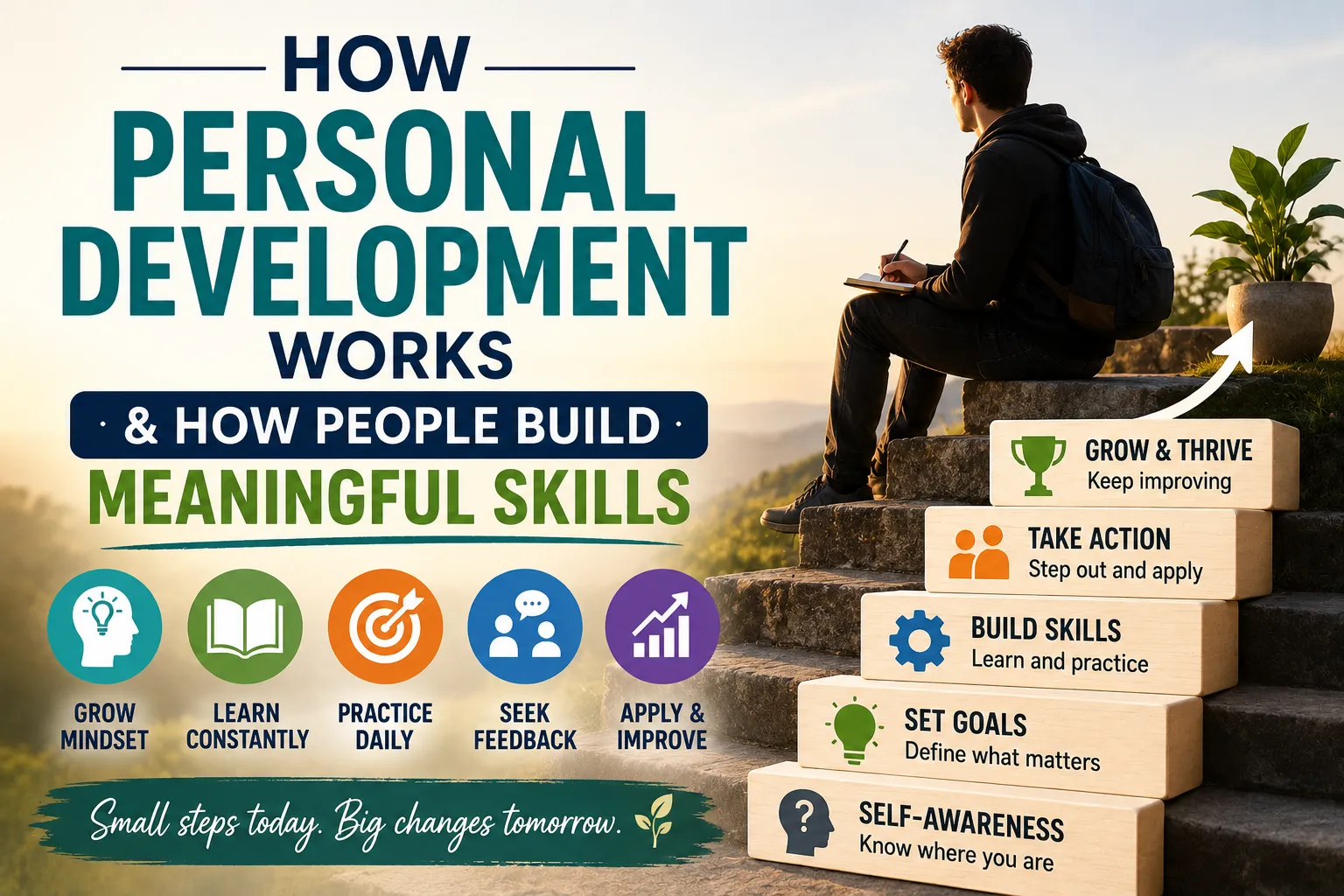
How Personal Development Works and How People Build Meaningful Skills
Personal development is often presented as a simple formula: set ambitious goals, work harder, stay motivated, and eventually become a better version of yourself.
Real growth is usually more complicated.
People develop through a combination of learning, practice, reflection, experience, feedback, relationships, and gradual changes in behavior. Some improvements happen deliberately, such as learning a new language or developing public-speaking skills. Others emerge through everyday experiences, including solving problems, managing setbacks, communicating with people, and taking on unfamiliar responsibilities.
The most meaningful personal development is not about constantly trying to become more productive. It is about building capabilities that make life more manageable, purposeful, and fulfilling.
What Is Personal Development?
Personal development is the ongoing process of improving knowledge, abilities, behaviors, habits, self-awareness, and other qualities that influence how a person lives and works.
It can involve many areas, including:
- Communication
- Emotional awareness
- Time management
- Leadership
- Problem-solving
- Financial skills
- Creativity
- Physical well-being
- Relationships
- Career development
- Decision-making
- Confidence
- Adaptability
Personal development looks different for everyone because people begin with different strengths, experiences, responsibilities, and goals.
For one person, growth might mean becoming a better manager. For another, it could mean learning how to manage money, communicate more confidently, cook independently, or develop a creative hobby.
Personal development is one part of creating a broader, sustainable approach to everyday life, which is why it fits naturally within a balanced lifestyle that supports meaningful growth.
Why Personal Development Matters
The world around people changes constantly.
Technology changes how work is performed. Industries evolve. Relationships develop. Responsibilities change. New opportunities appear while old assumptions become less useful.
Personal development helps people adapt.
Developing useful skills can make it easier to:
- Solve problems
- Make informed decisions
- Communicate clearly
- Handle change
- Build relationships
- Pursue career opportunities
- Manage responsibilities
- Understand personal strengths and weaknesses
The objective is not to become exceptionally good at everything.
It is to become more capable in areas that matter.
Personal Development Starts With Self-Awareness
Before deciding what to improve, it helps to understand where you currently stand.
Self-awareness involves recognizing your:
- Strengths
- Weaknesses
- Values
- Interests
- Habits
- Emotional patterns
- Motivations
- Priorities
- Limitations
Without self-awareness, people can spend considerable time pursuing goals that do not actually matter to them.
For example, someone might pursue a particular career because it appears impressive rather than because it fits their interests or values.
Self-awareness helps distinguish what you genuinely want to develop from what you feel pressured to pursue.
For a deeper look at this process, identifying personal values and using them to make better life decisions can help connect development choices with what actually matters to you.
Define What “Better” Means
Personal development becomes easier when the desired outcome is specific.
“Become better at communication” is vague.
“Give clearer presentations at work” is more concrete.
“Improve my health” is broad.
“Build a consistent exercise routine three times a week” provides a clearer direction.
Specific goals make it easier to determine whether progress is actually occurring.
Skills Are Built Through Practice
One of the most important principles of personal development is that meaningful skills rarely appear simply because someone understands the theory.
Reading about public speaking does not automatically make someone a strong speaker.
Watching cooking videos does not create cooking expertise.
Studying a programming language does not automatically create programming ability.
Knowledge provides a foundation, but practice converts knowledge into capability.
This is why people who consistently practice a skill often improve even when they do not feel particularly talented at the beginning.
Break Large Skills Into Smaller Components
Many skills appear intimidating because they are actually collections of smaller abilities.
Consider communication.
Being an effective communicator can involve:
- Listening
- Asking questions
- Explaining ideas
- Reading social cues
- Organizing thoughts
- Managing tone
- Writing clearly
- Giving feedback
- Handling disagreements
Instead of trying to “become a great communicator,” a person can work on one component at a time.
Breaking a large skill into smaller pieces makes progress easier to see.
Start With the Fundamentals
People sometimes rush toward advanced techniques before mastering basic principles.
A strong foundation usually matters more.
For example, someone learning photography may initially benefit more from understanding:
- Exposure
- Composition
- Focus
- Light
than from immediately purchasing expensive equipment.
Someone learning personal finance may benefit more from understanding:
- Income
- Expenses
- Saving
- Debt
- Interest
- Budgeting
before exploring complicated investment strategies.
Fundamentals create the platform on which advanced skills can be built.
Deliberate Practice Is Different From Repetition
Simply repeating an activity does not guarantee improvement.
Someone can drive for ten years without becoming dramatically better at driving because ordinary repetition may not challenge weak areas.
Deliberate practice is more purposeful.
It involves identifying a specific aspect of performance, practicing it intentionally, receiving feedback, and adjusting accordingly.
For example, someone trying to improve presentation skills might record a presentation, review their pacing and clarity, identify weaknesses, and deliberately practice those areas.
The process is more demanding than simply repeating the activity.
Feedback Accelerates Learning
It can be difficult to identify your own weaknesses.
Feedback provides another perspective.
Useful feedback can come from:
- Teachers
- Coaches
- Managers
- Mentors
- Colleagues
- Friends
- Customers
- Peers
Good feedback should ideally be specific.
“There is something wrong with your presentation” provides little direction.
“Your main argument becomes difficult to follow when you introduce three examples at once” gives the person something concrete to improve.
Learn to Receive Criticism Productively
Feedback can feel uncomfortable because it challenges how people see themselves.
A useful response is to separate criticism of a behavior from criticism of personal worth.
Someone can be poor at a particular skill today without being incapable of learning it.
Instead of asking, “Does this criticism mean I’m not good enough?” ask:
“Is there something useful here that I can improve?”
Not every criticism is accurate, but useful criticism should not automatically be rejected simply because it feels uncomfortable.
Use Mistakes as Information
Mistakes are an unavoidable part of skill development.
A failed presentation, incorrect calculation, unsuccessful project, or awkward conversation can provide information about what needs to change.
The important question becomes:
- What happened?
- Why did it happen?
- What could I do differently?
- What should I practice?
- What can I prevent next time?
This turns failure from a final judgment into feedback.
Build Skills Through Small Challenges
People generally learn by operating slightly beyond what they can already do comfortably.
If a task is completely effortless, it may provide little opportunity for growth.
If it is overwhelmingly difficult, frustration can prevent useful practice.
A productive challenge sits somewhere between the two.
For example:
- A beginner writer might start with short articles.
- A new speaker might begin with small meetings.
- A beginner runner might gradually increase distance.
- A new manager might initially lead smaller projects.
Progressive difficulty allows capability to expand without requiring a dramatic leap.
Consistency Usually Beats Intensity
A person who practices a skill for a manageable amount of time consistently can often make more sustainable progress than someone who works intensely for a few days and then stops.
This applies to many areas:
- Learning
- Exercise
- Writing
- Reading
- Financial planning
- Creative work
- Language acquisition
- Professional development
Consistency creates repeated exposure.
Repeated exposure creates opportunities for correction.
Correction creates improvement.
Build Habits Around Desired Behaviors
Motivation can be unpredictable.
Habits reduce the need to rely on motivation every time.
Instead of saying:
“I will study whenever I feel motivated.”
a person might establish:
“I will study for 30 minutes after dinner on weekdays.”
The second approach creates a predictable opportunity for action.
The goal is not to eliminate motivation but to make progress less dependent on it.
Make the First Step Easy
A habit becomes easier to maintain when the initial barrier is low.
If you want to write regularly, keep your writing tools ready.
If you want to exercise, prepare your clothes beforehand.
If you want to read more, keep a book accessible.
If you want to learn a language, place the learning application or materials somewhere visible.
Small environmental changes can reduce the effort required to begin.
Environment Influences Behavior
People often think personal development is entirely about willpower.
Environment matters too.
A person surrounded by distractions may struggle to concentrate even with strong intentions.
Someone whose social environment encourages learning may find it easier to maintain educational habits.
Someone who wants to reduce unnecessary spending may find the process easier after removing shopping apps and reducing exposure to marketing.
Changing the environment can sometimes be more effective than constantly trying to fight against it.
Learn From Other People
Personal development does not have to happen alone.
Other people can provide knowledge that would otherwise take years to acquire.
Useful sources can include:
- Books
- Courses
- Teachers
- Mentors
- Workshops
- Professional communities
- Colleagues
- Experienced friends
- Practical demonstrations
A mentor, in particular, can help identify blind spots and provide guidance based on experience.
Build a Personal Learning System
Rather than collecting random information, create a system for learning.
A simple process might look like this:
Choose → Study → Practice → Apply → Review → Adjust
For example, someone learning project management might:
- Learn basic project-management concepts.
- Study examples of successful projects.
- Practice creating project plans.
- Apply those plans to a real project.
- Review what worked and what failed.
- Adjust the approach for the next project.
This turns learning into an ongoing cycle rather than a one-time activity.
Reading Is Useful, but Application Matters
Reading can dramatically expand knowledge.
Books and articles can introduce new ideas, perspectives, and frameworks.
But information remains theoretical until it is applied.
After learning something useful, ask:
“Where can I use this?”
That question transforms passive learning into practical development.
A person who reads about negotiation, for example, can practice the principles during an everyday discussion about responsibilities, deadlines, or purchases.
Take Notes That You Can Actually Use
Effective notes do not need to contain everything a person reads.
Instead, focus on:
- Important ideas
- Useful examples
- Questions
- Practical applications
- Mistakes to avoid
- Actions to try
The purpose of notes is not to create another archive that will never be opened.
It is to make learning easier to retrieve and apply.
Teach Someone Else
Explaining an idea to another person can reveal whether you genuinely understand it.
If you cannot explain a concept clearly, you may have memorized information without understanding its underlying structure.
Teaching also forces you to:
- Organize information
- Identify important points
- Answer questions
- Recognize gaps
- Adapt explanations
You do not have to be an expert to benefit from explaining what you have learned.
Develop Transferable Skills
Some skills are useful across many areas of life.
These are often called transferable skills.
Examples include:
- Communication
- Writing
- Critical thinking
- Problem-solving
- Time management
- Collaboration
- Adaptability
- Research
- Decision-making
- Emotional regulation
Developing transferable skills can provide benefits across multiple careers and personal situations.
Communication Is One of the Most Valuable Skills
Almost every area of life involves communication.
Strong communication can help people:
- Explain ideas
- Resolve misunderstandings
- Negotiate
- Build relationships
- Lead teams
- Give instructions
- Ask for help
- Express boundaries
Improving communication does not necessarily mean becoming more talkative.
It often means becoming clearer, more attentive, and better at understanding others.
Listening Is Part of Communication
People often focus on speaking while overlooking listening.
Active listening involves paying attention to what another person is saying rather than simply waiting for an opportunity to respond.
Useful listening behaviors include:
- Asking clarifying questions
- Summarizing what you heard
- Avoiding unnecessary interruptions
- Paying attention to tone
- Not immediately assuming intent
- Allowing the other person to finish
Better listening can improve both professional and personal relationships.
Critical Thinking Helps With Everyday Decisions
Critical thinking involves evaluating information carefully rather than accepting claims automatically.
It can help with:
- News
- Advertising
- Financial decisions
- Workplace proposals
- Health information
- Online content
- Personal beliefs
Useful questions include:
- What evidence supports this?
- What assumptions are being made?
- Is there another explanation?
- Who benefits from this claim?
- How reliable is the source?
- What information might be missing?
Critical thinking is especially valuable in an environment where people encounter enormous amounts of information every day.
Emotional Skills Matter Too
Personal development is not limited to intellectual or professional abilities.
Emotional skills can influence relationships, decision-making, and resilience.
They can include:
- Recognizing emotions
- Managing reactions
- Understanding other people’s perspectives
- Communicating needs
- Handling disagreements
- Coping with disappointment
- Practicing empathy
Emotional development does not mean suppressing difficult feelings.
It means becoming better at recognizing and responding to them.
Learn to Manage Your Attention
Attention is a limited resource.
Constant notifications, social media, email, entertainment, and other distractions can make sustained concentration difficult.
Developing attention-management skills can include:
- Turning off unnecessary notifications
- Working in focused blocks
- Keeping distracting applications closed
- Establishing periods without interruptions
- Completing one important task before starting another
Being able to concentrate deeply is increasingly valuable in both creative and professional work.
Time Management Is Really Priority Management
People sometimes think time management means filling every hour with tasks.
It is more useful to think of it as deciding where limited time should go.
A useful priority system might distinguish between:
- Important and urgent
- Important but not urgent
- Urgent but less important
- Neither important nor urgent
This can prevent less meaningful tasks from consuming all available time.
Learn to Make Decisions
Decision-making is a skill that improves with experience and reflection.
For significant decisions, consider:
- What outcome do I want?
- What information do I have?
- What am I assuming?
- What are the risks?
- What are the likely benefits?
- What happens if I do nothing?
- Is the decision reversible?
- What matters most in the long term?
Not every decision requires extensive analysis.
Learning when to think deeply and when to make a straightforward choice is itself a useful skill.
Develop Financial Skills
Personal development also includes practical abilities that affect everyday life.
Financial literacy can help people understand:
- Budgeting
- Saving
- Debt
- Interest
- Insurance
- Investing
- Taxes
- Financial risk
A person does not need to become a financial expert to benefit from basic financial knowledge.
Understanding how money works can make many life decisions easier.
Develop Digital Skills
Digital literacy has become a fundamental part of modern life.
Useful digital skills can include:
- Basic cybersecurity
- Online research
- File organization
- Productivity software
- Digital communication
- Data management
- Privacy awareness
- Understanding artificial intelligence tools
The specific technologies will change, but the ability to learn and adapt to new tools is likely to remain valuable.
Creativity Can Be Developed
Creativity is sometimes treated as a personality trait that people either possess or lack.
In practice, creative ability can be strengthened through experimentation.
Creative development might involve:
- Writing
- Drawing
- Photography
- Music
- Cooking
- Design
- Problem-solving
- Building projects
- Exploring unfamiliar ideas
Creativity improves when people are willing to experiment without expecting every attempt to succeed.
For a broader exploration of this area, developing creativity, learning independently, and pursuing meaningful personal interests can complement a personal development plan.
Build Physical Skills Too
Personal development is not purely mental.
Physical capabilities can influence independence, energy, confidence, and quality of life.
Useful physical skills might include:
- Strength
- Balance
- Coordination
- Mobility
- Cooking
- Basic home maintenance
- Gardening
- Swimming
- Cycling
Practical physical abilities can make everyday life easier and reduce dependence on others for routine tasks.
Don’t Confuse Productivity With Development
Productivity is useful, but doing more tasks does not necessarily mean becoming a better person.
Someone can become extremely efficient at activities that do not contribute meaningfully to their goals.
Personal development asks a different question:
“Am I becoming more capable in ways that actually matter?”
That distinction can prevent productivity techniques from becoming another source of pressure.
Avoid Chasing Every New Skill
There is always another skill to learn.
Another language.
Another certification.
Another software application.
Another productivity system.
Another course.
Trying to learn everything can lead to shallow progress and exhaustion.
Choose skills based on relevance.
Ask:
- Will this improve my life?
- Does it support my goals?
- Will I use it regularly?
- Does it complement skills I already have?
- Is this something I genuinely care about?
Depth can be more valuable than collecting credentials.
Build Skills That Reinforce Each Other
Some skills become more powerful when combined.
For example:
Writing + research + digital skills can create strong content-production capabilities.
Communication + leadership + emotional intelligence can strengthen management ability.
Financial knowledge + critical thinking + discipline can improve personal financial decision-making.
Rather than viewing skills as isolated categories, look for combinations that create useful capabilities.
Practice in Real Situations
Real-world application is where many skills become meaningful.
A person learning negotiation can practice it in actual conversations.
Someone learning photography can create real projects.
A person studying leadership can volunteer to coordinate a small team.
Someone learning public speaking can present at a community event.
Real situations introduce uncertainty that practice exercises cannot always reproduce.
Build Projects, Not Just Knowledge
Projects provide a practical structure for learning.
Instead of saying:
“I want to learn web design.”
create a small website.
Instead of:
“I want to learn photography.”
create a photo series.
Instead of:
“I want to improve writing.”
publish a collection of articles.
Projects create deadlines, problems, decisions, and feedback.
That makes learning more concrete.
Keep Track of Progress
Progress is easier to recognize when it is documented.
You can track:
- Practice sessions
- Completed projects
- New skills
- Mistakes
- Feedback
- Milestones
- Lessons learned
A simple journal or digital document can be enough.
Looking back after several months can reveal progress that is difficult to notice day by day.
Reflect Regularly
Reflection turns experience into learning.
At the end of a project or challenging period, ask:
What worked?
What did not?
What surprised me?
What would I do differently?
What should I continue doing?
What skill needs more attention?
Without reflection, people can repeat the same mistakes without understanding why they keep occurring.
Learn to Be Patient With Progress
Skill development is rarely linear.
There may be periods of rapid improvement followed by periods where progress appears to stop.
This does not necessarily mean that learning has ended.
Some improvements are difficult to notice because they occur gradually.
A person may eventually realize that something that once required intense concentration has become automatic.
That is often a sign that the skill has become integrated.
Avoid Comparing Your Beginning With Someone Else’s Middle
Social media can make other people’s achievements highly visible while hiding the years of practice behind them.
Comparing your first attempt with someone else’s tenth year can create unrealistic expectations.
A more useful comparison is:
“Am I more capable than I was before?”
Personal development is fundamentally personal.
Confidence Often Follows Competence
People frequently try to build confidence directly.
Sometimes confidence becomes stronger naturally as competence develops.
When you repeatedly practice a skill, solve problems, survive mistakes, and see improvement, you accumulate evidence that you can handle similar challenges.
That evidence can create more durable confidence than simply repeating positive statements.
Failure Can Strengthen Resilience
Resilience does not mean never experiencing disappointment.
It means developing the ability to respond to setbacks and continue moving forward.
A resilient approach might involve:
- Acknowledge what happened.
- Allow yourself to experience the disappointment.
- Identify what can be learned.
- Decide what can be changed.
- Try again when appropriate.
The goal is not to pretend that failure does not hurt.
It is to avoid allowing one failure to define the entire future.
Know When Rest Is Part of Growth
Personal development can become counterproductive if every free moment is treated as an opportunity for self-improvement.
People need rest.
Sleep, leisure, relationships, and unstructured time are not necessarily obstacles to growth.
Recovery allows people to return to challenging activities with greater energy and attention.
A sustainable development plan must leave room for being off duty.
Develop a Long-Term Mindset
Meaningful skills rarely develop in a weekend.
Think in months and years rather than days.
A person who practices a skill consistently for several years can become dramatically more capable than someone who repeatedly starts and stops.
Long-term development is less exciting than instant transformation, but it is often more realistic.
Create a Personal Development Plan
A simple development plan can include five elements:
1. Choose a Priority
Select one or two areas that matter most.
2. Define the Desired Outcome
Describe what being better would actually look like.
3. Choose a Practice Method
Decide how you will develop the skill.
4. Establish a Routine
Choose when and how often you will practice.
5. Review Progress
Evaluate what is working and adjust the plan.
This keeps personal development practical rather than abstract.
For people who need help turning broader aspirations into specific actions, setting meaningful personal goals provides a useful companion framework.
An Example of Skill Development
Imagine someone who wants to become a better public speaker.
They could begin by identifying specific weaknesses.
Perhaps they speak too quickly and organize presentations poorly.
Instead of simply trying to “become confident,” they could:
- Study basic presentation structure.
- Practice speaking more slowly.
- Record short presentations.
- Review the recordings.
- Ask a colleague for feedback.
- Present in small meetings.
- Gradually take on larger presentations.
- Review each performance.
- Continue refining specific weaknesses.
Over time, the combination of knowledge, practice, feedback, and real experience can create meaningful improvement.
Personal Development Should Support Your Values
Growth is most useful when it aligns with what you consider important.
Someone who values family might prioritize communication and time management.
Someone who values creativity might prioritize writing, design, or music.
Someone focused on career development might prioritize leadership or technical skills.
There is no universal list of skills that everyone needs to master.
The right skills depend on the life you are trying to build.
Build a Life That Makes the Skills Worth Having
Personal development is ultimately less about collecting achievements and more about increasing your ability to live intentionally.
Meaningful skills are built through a combination of practice, feedback, real-world experience, reflection, patience, and consistent effort. The process is usually gradual. There is no single course, book, habit, or productivity system that can replace repeated application.
The most useful approach is to identify the capabilities that genuinely matter to your life, break them into manageable components, practice them regularly, and give yourself opportunities to use them in real situations.
Over time, small improvements compound.
A person who learns to communicate more clearly may build stronger relationships. Someone who improves financial skills may make more informed decisions. Someone who develops problem-solving abilities may become more adaptable at work and in everyday life. Someone who learns to manage attention may have more time for the things that matter.
Personal development works best when growth is connected to purpose. The objective is not simply to become more skilled—it is to use those skills to create a life that is more capable, meaningful, adaptable, and genuinely your own.