How to Develop Creativity, Learn Independently and Pursue Meaningful Personal Interests
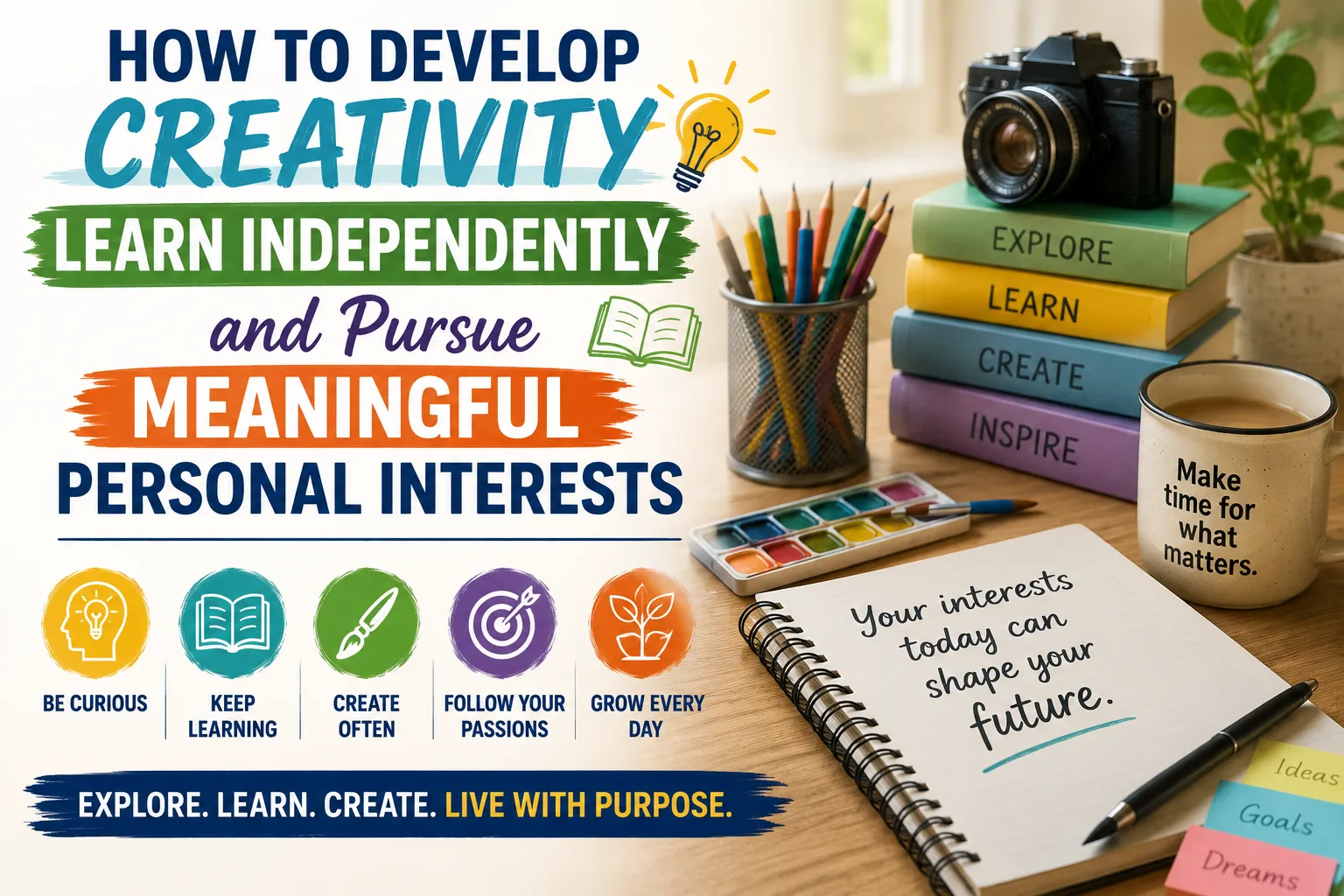
How to Develop Creativity, Learn Independently and Pursue Meaningful Personal Interests
Creativity is often treated as something people either have or do not have. Learning is frequently associated with classrooms, degrees and formal qualifications. Personal interests, meanwhile, can be pushed aside when work, family responsibilities and everyday obligations take priority.
But creativity, independent learning and meaningful hobbies are not limited to naturally talented people or those with unlimited free time.
They are skills and habits that can be developed gradually.
Whether you want to become better at writing, learn a language, explore photography, understand a new subject, develop practical skills or simply make more time for things you enjoy, the process begins with curiosity and becomes stronger through consistent practice.
The challenge is not necessarily finding more things to do. It is learning how to explore ideas, teach yourself effectively, create without excessive fear of failure and make space for interests that genuinely matter to you.
These activities also form an important part of building a balanced lifestyle around meaningful interests and personal growth.
What Does Creativity Really Mean?
Creativity is often associated with artistic activities such as painting, music, writing or design.
In reality, creativity is much broader.
It involves producing new ideas, making connections between existing ideas and finding different ways to approach problems.
Creativity can appear in:
- Writing a story
- Designing a room
- Developing a business idea
- Solving a technical problem
- Cooking a new meal
- Planning a trip
- Learning an instrument
- Building something
- Finding a better way to complete a routine task
You do not have to consider yourself an artist to be creative.
Everyday problem-solving can involve creativity too.
Creativity Can Be Developed
Some people may naturally be more curious, imaginative or comfortable experimenting, but creativity is not a fixed ability.
It can improve through practice.
One of the most effective ways to develop creativity is to create regularly without making every attempt responsible for proving your talent.
Write even when the writing is imperfect.
Sketch even when the drawing looks awkward.
Take photographs even when some images fail.
Experiment with recipes even when the first version is not great.
The more opportunities you give yourself to experiment, the more comfortable you become with generating and testing ideas.
Curiosity Is the Starting Point
Creativity often begins with a simple question:
What if?
What if you approached a familiar problem differently?
What if two unrelated ideas were combined?
What if you learned how something works instead of simply using it?
What if you tried something you have never done before?
Curiosity creates opportunities for exploration.
Instead of immediately looking for the correct answer, allow yourself to investigate the question.
That habit can lead to ideas that would not emerge from following familiar patterns.
Give Yourself Permission to Experiment
Fear of failure can suppress creativity.
When every attempt has to be impressive, experimentation becomes uncomfortable.
A healthier approach is to treat early attempts as experiments.
A first draft does not have to be excellent.
A beginner’s photograph does not need to look professional.
A first attempt at coding may contain errors.
A new recipe may not work.
These outcomes are part of learning.
The purpose of experimentation is to discover what works.
Make Time for Creative Activities
Creativity needs time.
That does not necessarily mean spending several hours every day on a hobby.
Even short, consistent sessions can help.
You might dedicate:
- 15 minutes to sketching
- 20 minutes to writing
- 30 minutes to learning an instrument
- A few evenings each week to a personal project
- One weekend morning to photography or woodworking
The important thing is to protect some time from being automatically consumed by routine obligations.
Reduce the Pressure to Be Productive
Not everything you do needs to produce money, credentials or measurable achievements.
A hobby can simply be enjoyable.
Reading fiction does not have to make you more employable.
Playing music does not need to become a career.
Gardening does not need to generate income.
Painting does not need to be exhibited.
Personal interests can provide value through enjoyment, curiosity, relaxation and self-expression.
When every activity becomes a productivity project, leisure can begin to feel like another job.
For a broader look at why these activities matter beyond productivity, the role of hobbies and leisure in everyday life provides useful context.
Learn to Notice What Holds Your Attention
Your natural interests can provide clues about what you genuinely enjoy.
Pay attention to activities that make you lose track of time or leave you wanting to learn more.
You might repeatedly find yourself watching videos about architecture, reading about history, experimenting with technology, researching travel destinations or taking photographs.
These recurring interests are worth exploring.
You do not need to turn every curiosity into a serious pursuit.
But noticing patterns can help you identify subjects that deserve more of your attention.
How to Learn Independently
Independent learning means taking responsibility for your own education.
You identify something you want to understand, find useful resources, practice the skill and evaluate your progress.
This does not mean learning without guidance.
Books, courses, teachers, mentors, communities and educational platforms can all support independent learning.
The difference is that you take an active role in deciding what, why and how you learn.
Start With a Specific Goal
“Learn photography” is a broad goal.
“Learn how to take better indoor photographs using manual camera settings” is much more specific.
“Learn programming” is broad.
“Build a simple website using HTML, CSS and JavaScript” gives you a clearer destination.
Specific goals make it easier to choose resources and measure progress.
Instead of asking:
What should I learn?
Ask:
What would I like to be able to do that I cannot do yet?
That question turns learning into an actionable process.
Break Large Subjects Into Smaller Questions
Complex subjects can feel overwhelming because there is too much information available.
Break the subject into smaller areas.
For example, someone learning photography might study:
- Exposure
- Shutter speed
- Aperture
- ISO
- Composition
- Lighting
- Focusing
- Editing
- Portrait photography
- Landscape photography
Each topic creates a manageable learning objective.
This approach prevents you from trying to understand everything simultaneously.
Use Multiple Learning Resources
No single resource is perfect for every learner.
You might combine:
- Books
- Online courses
- Tutorials
- Podcasts
- Documentaries
- Academic papers
- Practical exercises
- Expert interviews
- Community discussions
- Reference materials
Different formats can provide different perspectives.
A video might make a complex concept easier to visualize, while a book may provide greater depth.
The goal is not to consume the maximum amount of content.
It is to find resources that help you understand and apply the subject.
Do Not Confuse Information With Learning
One of the easiest traps in independent learning is consuming enormous amounts of information without actually practicing.
Watching ten tutorials about photography does not necessarily make you a better photographer.
Reading about programming does not necessarily teach you how to build software.
Listening to language lessons does not automatically make you fluent.
Learning becomes stronger when information is followed by action.
After learning a concept, ask:
How can I use this?
That question turns passive consumption into active learning.
Practice Retrieval
Simply rereading information can create the feeling that you understand something better than you actually do.
Try recalling information without looking at your notes.
After studying a subject, close the book and explain the concept in your own words.
Ask yourself:
- What did I just learn?
- Why does it matter?
- How does it work?
- Can I explain it simply?
- Can I give an example?
- Where could I apply it?
This reveals gaps in your understanding.
Teach What You Learn
Explaining something to another person can be an effective way to discover whether you actually understand it.
You do not need to become a professional teacher.
Try explaining the concept aloud as though you were teaching a beginner.
If you struggle to explain a particular part, that may indicate an area that requires further study.
Writing explanations can serve the same purpose.
Build Projects Instead of Only Studying
Projects are powerful because they force different pieces of knowledge to work together.
If you are learning photography, create a small photo series.
If you are learning writing, publish a short article or create a collection of essays.
If you are learning programming, build a simple application.
If you are learning cooking, plan and prepare a meal around a particular cuisine.
Projects transform abstract knowledge into practical experience.
They also create something tangible that you can evaluate.
Expect the Beginner Stage to Feel Difficult
Beginners often expect progress to be linear.
It rarely is.
At first, you may improve quickly because basic concepts produce noticeable changes.
Later, progress can slow.
You may reach a stage where your work does not look as good as you imagined it would.
This is normal.
The gap between what you can currently create and what you want to create can actually be evidence that your standards are developing faster than your skills.
Keep practicing.
Learn From Mistakes
Mistakes contain useful information.
Instead of simply thinking:
I failed.
Ask:
What specifically went wrong?
Maybe the instructions were misunderstood.
Maybe the technique was incorrect.
Maybe you lacked a particular skill.
Maybe the goal was unrealistic.
Maybe you need better equipment.
Turning failure into analysis makes it easier to improve.
Find Feedback
Independent learning does not have to mean learning in isolation.
Feedback can reveal problems you cannot see yourself.
You can ask:
- A teacher
- A mentor
- An experienced friend
- A professional
- A relevant community
- A study group
The most useful feedback is specific.
“That’s bad” does not tell you much.
“The composition feels crowded because there are too many competing elements” gives you something you can work on.
Be Selective About Online Information
The internet has made independent learning easier than ever, but it has also made misinformation easier to encounter.
When learning an important subject, consider:
- Who created the information?
- What evidence supports the claim?
- Is the source qualified?
- Are multiple reputable sources saying the same thing?
- Is the information current?
- Does the author distinguish facts from opinions?
This is particularly important when learning about health, finance, science, law or other subjects where inaccurate information can have serious consequences.
Avoid Endless Resource Hunting
There is always another course.
Another book.
Another tutorial.
Another expert.
Another productivity system.
You can spend so much time searching for the perfect learning resource that you never actually begin.
Choose a reasonably good resource and start.
You can change resources later if you discover that the approach does not suit you.
Progress usually comes from practice, not from finding the perfect tutorial.
How to Develop Meaningful Personal Interests
A meaningful personal interest is something that matters to you beyond external recognition.
It might challenge you, relax you, help you connect with other people or simply make your life more interesting.
Meaningful interests can include:
- Reading
- Gardening
- Photography
- Cooking
- Writing
- Music
- Art
- Hiking
- History
- Languages
- Astronomy
- Woodworking
- Technology
- Volunteering
- Sports
- Travel
- Collecting
- Crafts
There is no universal definition.
What matters is whether the activity has personal value.
Explore Before You Commit
You do not need to choose one lifelong hobby immediately.
Experiment.
Try a beginner’s photography course.
Attend a cooking class.
Borrow a book about a subject you have never studied.
Visit a museum.
Learn a few phrases in another language.
Try drawing.
Join a recreational sports group.
Build something.
You may discover an interest you never expected.
You may also discover that something you thought you would love is not actually enjoyable.
Both outcomes are useful.
Follow Curiosity Rather Than Trends
Popular hobbies can be a good starting point, but you do not need to pursue something simply because everyone else is doing it.
Ask yourself:
Would I still enjoy this if nobody knew I was doing it?
That question can separate genuine interest from activities chosen primarily for status or social approval.
A hobby does not need to be impressive.
It needs to be meaningful to you.
Choose Interests That Match Your Personality
Different activities provide different forms of satisfaction.
Some people enjoy creating.
Others enjoy collecting information.
Some prefer physical activities.
Others like quiet intellectual pursuits.
Some people thrive in groups, while others prefer solitary activities.
You may find that your best hobbies reflect how you naturally like to spend your time.
There is nothing wrong with trying different types.
Combine Interests
Creative possibilities often emerge when different interests overlap.
Someone interested in:
Cooking + photography
might create a food photography project.
Someone interested in:
History + writing
might start a historical blog.
Someone interested in:
Technology + education
might create tutorials.
Someone interested in:
Gardening + sustainability
might document a home-growing project.
Combining interests can create something more personally meaningful than pursuing either one independently.
Turn Consumption Into Participation
Many hobbies can exist at two levels.
You can consume or participate.
For example:
- Read about photography or take photographs.
- Watch music performances or learn an instrument.
- Watch cooking videos or cook a meal.
- Read about gardening or grow something.
- Watch sports or play a sport.
Consumption can provide inspiration.
Participation creates experience.
Try moving from one to the other.
Make Hobbies Social When You Want To
Personal interests can also become a way to develop relationships.
You might join:
- A book club
- A running group
- A photography community
- A gardening club
- A language exchange
- A cooking group
- A maker community
- A recreational sports team
Shared interests provide natural conversation and collaboration.
Social hobbies can also make it easier to maintain motivation.
But Solitary Interests Are Valuable Too
Not every hobby needs a community.
Reading alone, writing in a journal, drawing, playing an instrument or exploring a subject independently can provide valuable personal time.
Solitary activities can create space away from constant communication and digital stimulation.
The ideal balance depends on the individual.
How to Make Time for Personal Growth
One of the biggest obstacles to creativity and independent learning is not a lack of interest.
It is a lack of time.
Work, family responsibilities, household tasks and unexpected events can consume most of the day.
The solution is not necessarily to find several additional hours.
Start small.
Use Small Blocks of Time
Fifteen or twenty minutes can be enough to make progress.
You could use a short session to:
- Read a few pages
- Practice vocabulary
- Sketch
- Write a paragraph
- Practice scales on an instrument
- Watch a focused tutorial
- Review notes
- Plan a personal project
Small sessions become significant when repeated.
Schedule Important Interests
If you leave a hobby for “when I have time,” it may never happen.
Instead, give it a specific place in your routine.
For example:
Tuesday evening: language practice
Thursday evening: writing
Saturday morning: photography
The exact schedule does not matter.
The principle is to treat personally meaningful activities as legitimate uses of your time.
Reduce Low-Value Distractions
Time often disappears through small, repeated activities.
Scrolling social media for a few minutes can become an hour.
Watching one video can become several.
Checking notifications repeatedly can fragment attention.
You do not have to eliminate entertainment.
Instead, consider whether some of your screen time could be redirected toward activities that leave you feeling more fulfilled.
Protect Your Attention
Creativity and learning require concentration.
Constant interruptions make both more difficult.
During a creative or learning session, consider:
- Turning off unnecessary notifications
- Putting your phone away
- Closing unrelated browser tabs
- Using headphones if appropriate
- Working in a quiet environment
- Setting a short timer
- Focusing on one task
Even a 25-minute period of uninterrupted attention can be surprisingly productive.
How to Stay Motivated
Motivation naturally fluctuates.
You will not feel enthusiastic every day.
That is why relying entirely on motivation can make hobbies difficult to maintain.
Instead, build simple systems that make participation easier.
Keep your guitar accessible.
Leave your sketchbook on your desk.
Keep your reading book somewhere visible.
Prepare your learning materials before the next session.
Make the first step easy.
Track Progress Without Becoming Obsessed With It
Tracking can provide encouragement.
You might keep a simple record of:
- Practice sessions
- Books completed
- Projects finished
- New skills learned
- Articles written
- Miles walked
- Language lessons completed
The purpose is to see progress, not create another source of pressure.
Avoid turning a hobby into a competition with yourself if that removes the enjoyment.
Celebrate Small Improvements
Improvement can be difficult to notice from day to day.
Compare your current work with something you created several months ago.
You may discover that your skills have improved considerably.
Recognizing progress reinforces the value of consistent practice.
Accept Periods of Reduced Activity
Life changes.
There may be periods when work, family responsibilities, travel or other circumstances leave little time for personal interests.
You do not need to abandon a hobby permanently because you stopped for a few weeks or months.
Return when circumstances allow.
A meaningful interest can survive interruptions.
The Role of Creativity in Everyday Life
Creativity does not need to become a career.
It can make ordinary life more interesting.
You might experiment with a new meal, rearrange a room, create a personal garden, write a story for your children or find a new way to organize your workspace.
These small acts encourage curiosity and active participation.
Instead of simply consuming what other people have created, you begin creating things yourself.
That shift can be deeply satisfying.
Independent Learning Can Change How You See the World
Learning independently does more than add information to your memory.
It can change the questions you ask.
Learning astronomy can make the night sky more interesting.
Learning architecture can change how you see buildings.
Learning photography can make you notice light.
Learning history can provide context for current events.
Learning about plants can make an ordinary walk feel different.
Knowledge changes perception.
The more you learn, the more connections you may begin to notice between subjects.
Avoid Turning Every Interest Into a Career
Modern culture often encourages people to monetize everything they enjoy.
A hobby becomes a business.
A skill becomes a side hustle.
A passion becomes a personal brand.
There can be genuine benefits to turning an interest into income, but it is not necessary.
Some interests are valuable precisely because they exist outside commercial pressure.
You are allowed to learn something simply because it fascinates you.
You are allowed to create without selling.
You are allowed to play without becoming an expert.
Build a Personal Learning Ecosystem
Independent learning becomes easier when you have a simple system.
You might maintain:
A list of questions you want to answer.
A reading list of useful books and articles.
A project list containing things you want to create.
A notebook for ideas and observations.
A folder containing useful resources.
A schedule for regular practice.
The system does not need to be complicated.
Its purpose is simply to prevent interesting ideas from disappearing.
Keep an Idea Journal
Ideas often appear at inconvenient times.
Keep a notebook or digital document where you can record them.
Write down:
- Questions
- Observations
- Project ideas
- Interesting quotes
- Things you want to investigate
- Creative concepts
- Problems you might solve
Do not worry about whether every idea is good.
The purpose is to create a place where ideas can accumulate.
Some will eventually develop into projects.
Learn to Connect Unrelated Ideas
One of the most powerful creative exercises is combining concepts that do not normally appear together.
Ask:
What could these two things teach each other?
For example:
Cooking + chemistry
could lead to an exploration of fermentation.
History + technology
could lead to research about how inventions changed societies.
Photography + psychology
could lead to an exploration of how images influence perception.
Connections create opportunities for original thinking.
A Practical Routine for Creativity and Independent Learning
You do not need an elaborate personal-development system.
A simple weekly routine might look like this:
Daily
Spend 15–30 minutes reading, practicing or creating.
Several times a week
Work on one specific skill.
Once a week
Explore something completely new.
Every few weeks
Review what you have learned and identify gaps.
Every month
Complete a small project.
Every few months
Evaluate which interests still excite you and which ones you have naturally moved away from.
This creates a balance between consistency and exploration.
What to Do When You Lose Interest
Not every interest lasts forever.
That is normal.
You may become fascinated with something for six months and then discover that another subject captures your attention.
You do not necessarily need to force yourself to continue.
Ask:
- Am I genuinely finished with this?
- Or have I simply reached a difficult stage?
- Is the activity still enjoyable?
- Would changing the way I practice make it interesting again?
- Is there another related area I want to explore?
Sometimes an interest needs a new challenge.
Other times, it has simply served its purpose.
Moving on is not necessarily failure.
Creativity, Learning and Meaningful Interests Work Together
These three areas reinforce each other.
Creativity encourages you to explore possibilities.
Independent learning gives you knowledge and skills.
Personal interests give you reasons to keep exploring.
Learning photography can inspire creative projects.
A creative project can reveal something you need to learn.
A personal interest can introduce you to an entirely new field.
This creates a cycle:
Curiosity → Learning → Experimentation → Creation → Reflection → More Curiosity
The cycle can continue throughout life.
Making Curiosity a Lifelong Habit
Developing creativity, learning independently and pursuing meaningful interests are not activities that need to be completed.
They are ways of approaching life.
You can remain curious at any age.
You can learn new skills after leaving formal education.
You can discover interests you never had time to explore before.
You can return to hobbies you abandoned years ago.
You can create things without needing to become an expert.
The most important step is often the simplest one: start before you feel completely ready.
Choose one subject that interests you. Set aside a small amount of time. Find a reliable resource. Practice something. Make something. Ask another question.
Over time, those small decisions can develop into skills, friendships, creative projects and interests that give your everyday life greater depth.
You do not need to become a different person to live more creatively or learn more independently. You simply need to make a little more room for curiosity, experimentation and the things that genuinely make you want to keep discovering what is possible.