Complete Guide to Smart Home Climate Control
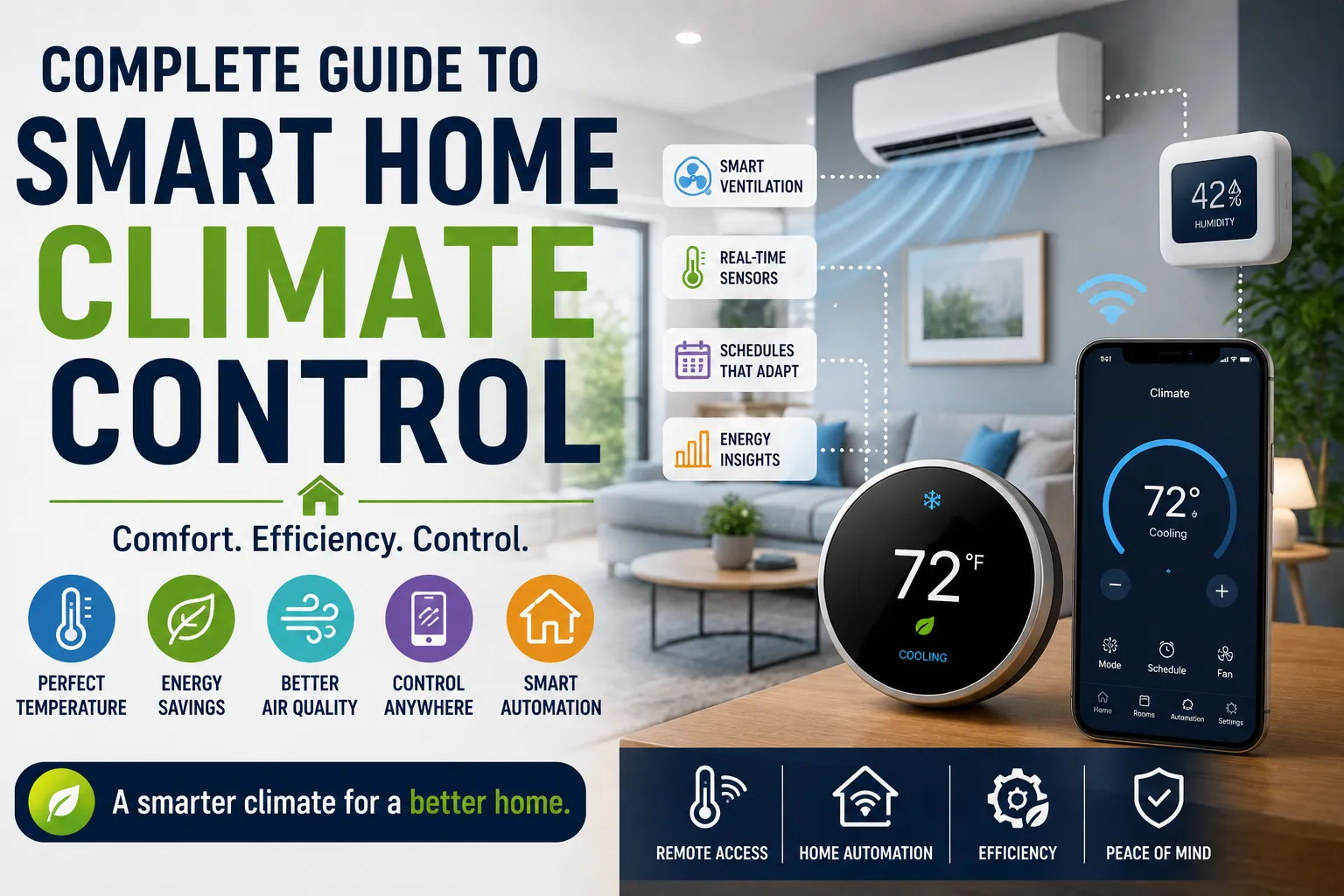
Complete Guide to Smart Home Climate Control
Smart home climate control has evolved far beyond simply adjusting the thermostat from a wall-mounted control panel.
Today’s systems can automatically adjust heating, cooling, ventilation and air quality based on factors such as temperature, humidity, occupancy, schedules and even the habits of people living in the home. When properly configured, smart climate control can make a home more comfortable while potentially reducing unnecessary energy use.
The technology can range from a simple smart thermostat to a fully integrated system connecting HVAC equipment, temperature sensors, smart vents, ceiling fans, air purifiers and home automation platforms.
This guide explains how smart home climate control works, what components you need, the benefits and limitations, and how to build a system that makes sense for your home. For a broader overview of connected-home technologies and how the different systems fit together, see the Complete Guide to Smart Homes.
What Is Smart Home Climate Control?
Smart home climate control refers to connected technologies that monitor and manage indoor environmental conditions automatically or remotely.
A conventional thermostat generally follows a temperature setting chosen by the homeowner. A smart climate-control system can use additional information to decide when and how the HVAC system should operate.
Depending on the system, it may respond to:
- Indoor temperature
- Outdoor temperature
- Humidity
- Occupancy
- Time of day
- User schedules
- Room-by-room temperature differences
- Air-quality measurements
- Energy-use patterns
- Remote commands
- Connected smart-home routines
The objective is to create a home that maintains comfortable conditions without unnecessarily running heating or cooling equipment.
How Smart Climate Control Works
A smart climate system generally consists of three basic elements:
- Sensors
- A control system
- Heating, cooling or ventilation equipment
Sensors collect information about the environment.
The control system processes that information and determines whether an adjustment is necessary.
The HVAC equipment then responds.
For example, imagine a home where the thermostat is set to maintain a particular temperature.
A temperature sensor detects that the living room has become warmer than the desired setting. The smart thermostat can communicate with compatible HVAC equipment and activate cooling.
If another sensor indicates that the bedroom is already comfortable, a zoned system may avoid cooling that room unnecessarily.
This creates a more responsive system than simply operating the entire house from one temperature measurement.
Smart Thermostats Explained
The smart thermostat is often the foundation of a smart climate-control system.
Unlike a basic programmable thermostat, a smart thermostat can connect to a home network and provide additional controls and automation.
Common features include:
- Smartphone control
- Scheduling
- Remote temperature adjustment
- Multiple temperature sensors
- Occupancy detection
- Energy-use information
- Heating and cooling modes
- Humidity monitoring
- Smart-home integration
- Automated routines
Some systems can also learn patterns over time and adjust their operation based on established preferences.
However, not every smart thermostat supports every HVAC system.
Before purchasing one, check compatibility with your heating and cooling equipment.
What Is a Smart Thermostat Sensor?
A thermostat’s built-in sensor measures conditions where the thermostat itself is installed.
That can create a problem in larger homes.
For example, a thermostat located near a frequently used hallway may measure a different temperature from a bedroom at the opposite end of the house.
Additional wireless sensors can provide temperature readings from other rooms.
The system can then use those readings to make more informed decisions.
This is particularly useful when:
- Bedrooms become warmer than living areas.
- Certain rooms receive more sunlight.
- Different floors have different temperatures.
- One room is rarely occupied.
- A home office needs a different comfort level.
Room-by-Room Climate Control
One of the biggest advantages of smart-home technology is the ability to move beyond whole-house temperature control.
Zoned climate control divides a home into separate areas that can be managed independently.
For example:
- Upstairs bedrooms
- Downstairs living spaces
- Home office
- Guest rooms
- Kitchen
- Basement
Each zone can have its own temperature target or schedule.
This can improve comfort because people do not necessarily want every room maintained at exactly the same temperature.
Smart Vents and Airflow Management
Smart vents can be used in some HVAC systems to control airflow through individual ducts.
Depending on the system, a smart vent can open or close according to schedules, temperature requirements or occupancy.
For example, an unused guest room may not need the same airflow as an occupied bedroom.
However, homeowners should be careful about closing too many vents in a conventional forced-air system.
HVAC systems are designed around specific airflow requirements. Excessive restriction can create pressure problems and reduce system performance.
Smart vents should therefore be used as part of a properly designed HVAC strategy rather than simply closing as many vents as possible.
Smart Climate Control and Humidity
Temperature is only one part of indoor comfort.
Humidity can significantly affect how a room feels.
A home that is too humid may feel warmer and can create conditions favorable to mold and other moisture-related problems.
Very dry indoor air can cause discomfort such as:
- Dry skin
- Irritated eyes
- Dry throat
- Static electricity
Smart climate systems can monitor humidity and, when compatible equipment is available, coordinate humidifiers, dehumidifiers and HVAC equipment.
This can provide a more balanced indoor environment than temperature control alone.
Smart Air Quality Monitoring
Some smart climate systems also monitor indoor air quality.
Depending on the device, sensors may measure indicators such as:
- Carbon dioxide
- Particulate matter
- Volatile organic compounds
- Humidity
- Temperature
Air-quality information can be used to trigger ventilation, purification or alerts.
For example, a smart system could notify a homeowner when indoor air quality changes significantly.
However, it is important to understand what a particular sensor actually measures. A device marketed as an “air-quality monitor” does not necessarily detect every possible indoor pollutant.
For a closer look at connected sensors and how they can monitor conditions throughout a home, see the Smart Home Monitoring Guide: Sensors and Alerts.
Smart Air Purifiers
Smart air purifiers can complement HVAC systems.
Many include:
- Air-quality sensors
- Automatic operating modes
- Smartphone controls
- Scheduling
- Filter reminders
- Fan-speed adjustment
Some can automatically increase fan speed when their sensors detect a change in indoor air conditions.
An air purifier is not a replacement for adequate ventilation or fixing the source of indoor pollution, but it can be a useful additional layer of indoor-air management.
Smart Ceiling Fans
Ceiling fans can also become part of a smart climate strategy.
A connected fan can be scheduled or controlled remotely and, in some systems, integrated into broader home routines.
Fans do not generally cool the air itself in the same way an air conditioner does. Instead, moving air can improve how comfortable people feel by increasing evaporation from the skin.
This means a fan can sometimes allow occupants to feel comfortable at a somewhat higher thermostat setting.
That can reduce the amount of time an air conditioner needs to operate.
Smart Climate Schedules
Scheduling is one of the simplest ways to make climate control more efficient.
Instead of maintaining the same temperature around the clock, a schedule can reflect how the household actually uses the home.
For example:
Morning
Comfortable temperature while people prepare for the day.
Daytime
A different setting when the home is largely empty.
Evening
Comfort-focused settings when residents return.
Night
A temperature appropriate for sleeping.
The exact settings should reflect the home’s climate, HVAC equipment and personal comfort.
Geofencing and Location-Based Control
Some smart-home systems can use smartphone location to determine whether residents are nearby.
A system might recognize that everyone has left and adjust the home’s climate settings.
When someone returns, it can restore a preferred comfort setting.
This is known as geofencing.
The advantage is convenience.
Instead of relying entirely on a fixed schedule, the system can respond to actual household movements.
However, geofencing is not always perfect. Shared devices, guests, forgotten phones and inaccurate location information can produce unexpected behavior.
Occupancy-Based Climate Control
Occupancy sensors provide another way to automate climate settings.
A sensor can detect whether a room appears to be occupied and potentially adjust the system accordingly.
This can be especially useful in:
- Home offices
- Guest bedrooms
- Meeting rooms
- Large living areas
- Holiday homes
Occupancy-based control should be configured carefully.
A person sitting quietly or sleeping may not always be detected correctly by every sensor.
Smart Climate Control With Voice Assistants
Many connected climate systems can integrate with voice-controlled smart-home platforms.
This can allow users to perform actions such as:
- Change the temperature
- Turn heating on
- Turn cooling off
- Ask for the current temperature
- Adjust a specific zone
Voice control is convenient, but it should be viewed as an additional interface rather than the main reason to buy a smart thermostat.
The more important features are reliable temperature management, compatibility, automation and appropriate controls.
Smart Home Climate Scenes and Routines
Smart-home routines can combine climate control with other devices.
For example, a “Good Night” routine could:
- Adjust the thermostat
- Turn off selected lights
- Close compatible blinds
- Adjust bedroom temperature
- Lock smart doors
A “Leaving Home” routine could:
- Adjust HVAC settings
- Turn off unnecessary devices
- Switch lights off
- Activate security features
These automations can make climate control largely invisible.
The system simply follows the household’s routine.
Smart Blinds and Temperature Control
Windows have a major influence on indoor temperatures.
Smart blinds and shades can therefore become part of climate management.
During hot periods, automated shades can reduce direct sunlight entering rooms.
During colder periods, appropriate window coverings can help reduce heat loss.
The effectiveness depends on the type of window, orientation, climate and quality of the window covering.
This is an important reminder that smart climate control is not only about HVAC equipment.
Sometimes the most effective intervention is to reduce the amount of heating or cooling the home needs in the first place.
Smart Climate Control and Energy Efficiency
One of the biggest reasons homeowners consider smart climate technology is the potential to reduce unnecessary energy consumption.
A smart system can help by:
- Reducing heating or cooling when the home is empty
- Following customized schedules
- Identifying unusual energy patterns
- Coordinating multiple devices
- Avoiding unnecessary operation
- Providing reminders for maintenance
- Improving temperature control
For a broader look at how connected technologies can be used to reduce household energy consumption, see the Smart Home Energy-Saving Guide.
However, simply installing a smart thermostat does not guarantee lower energy bills.
Savings depend on:
- Local climate
- Existing HVAC efficiency
- Insulation
- Home size
- Household behavior
- Temperature settings
- Equipment condition
- How the smart system is configured
Automation is a tool. The outcome depends on how it is used.
Smart Climate Control for Different Home Types
Not every home needs the same system.
Apartments
A smart thermostat may be enough if the HVAC system is individually controlled and compatible.
Small Houses
A smart thermostat plus one or two additional sensors may provide substantial benefits.
Large Houses
Multiple sensors, zoning and integrated HVAC controls may be more valuable.
Multi-Story Homes
Separate zones can help address differences between upper and lower floors.
Older Homes
Smart controls can improve management, but insulation, windows and HVAC condition may need attention first.
New Homes
Smart climate systems can potentially be integrated with HVAC, lighting, shades and other systems from the beginning.
Smart Climate Control in Hot Climates
In warm regions, cooling is often the primary concern.
A smart system can help homeowners manage air conditioning around daily routines.
Useful features may include:
- Temperature scheduling
- Remote control
- Occupancy detection
- Humidity monitoring
- Smart fans
- Automated blinds
- Zone control
However, building design remains critical.
Shade, insulation, ventilation, roof design and window placement can significantly influence how much cooling a home needs.
Technology works best when combined with sound building principles.
Smart Climate Control in Cold Climates
In colder climates, heating management becomes the priority.
Smart controls can adjust heating according to:
- Time of day
- Occupancy
- Indoor temperature
- Outdoor conditions
- Individual room requirements
Homeowners should also ensure that heating systems receive appropriate maintenance.
A smart thermostat cannot compensate for a poorly maintained boiler, furnace, heat pump or other heating equipment.
Heat Pumps and Smart Controls
Heat pumps have become increasingly important in discussions about efficient home heating and cooling.
A heat pump can provide both heating and cooling, depending on the system.
Smart controls can help coordinate operation, but compatibility is especially important.
Heat pumps often operate differently from traditional heating systems, and some thermostats may not support all of their functions.
Always verify compatibility with the exact equipment model.
Smart Climate Control and HVAC Maintenance
Automation does not eliminate the need for maintenance.
A smart thermostat cannot repair:
- A dirty filter
- A refrigerant problem
- A blocked duct
- A failing compressor
- A malfunctioning fan
- A damaged heat exchanger
- Poor insulation
Regular maintenance remains essential.
Depending on the equipment, maintenance may involve:
- Replacing or cleaning filters
- Inspecting equipment
- Cleaning components
- Checking airflow
- Servicing outdoor units
- Inspecting electrical connections
- Professional HVAC servicing
Follow the manufacturer’s recommended maintenance schedule.
For more on maintaining connected home technology alongside the equipment it controls, see the Smart Home Maintenance Guide.
How Often Should HVAC Filters Be Changed?
There is no universal replacement interval that applies to every home.
Filter life depends on:
- Filter type
- HVAC system
- Household size
- Pets
- Indoor air quality
- Dust levels
- Usage
Check the filter regularly and follow the manufacturer’s recommendations.
A clogged filter can restrict airflow and make the HVAC system work harder.
Smart Thermostat Compatibility
One of the most important steps before buying a smart thermostat is determining whether it is compatible with your HVAC system.
Potential compatibility considerations include:
- Heating type
- Cooling type
- Heat pumps
- Multi-stage systems
- Zoning
- Auxiliary heating
- Wiring
- Power requirements
- Existing control systems
Some thermostats require a common wire, often called a C-wire, while others use alternative power arrangements.
Do not assume that because a thermostat is marketed as “universal” it will support every HVAC configuration.
Check the manufacturer’s compatibility guide.
Wi-Fi vs Local Smart Home Control
Many smart climate products depend on cloud services and internet connectivity.
This can provide:
- Remote access
- Software updates
- Integration with online services
- Notifications
- Data synchronization
But it can also introduce dependence on:
- Internet availability
- Manufacturer servers
- Account access
- App support
Some smart-home ecosystems offer local control or additional options that can keep basic functionality available even when the internet is unavailable.
Consider this when choosing equipment.
Privacy and Smart Climate Devices
Connected climate-control devices can collect information about how a home is used.
Depending on the device and platform, this may include:
- Temperature data
- Device activity
- Schedules
- Occupancy information
- Location data
- Account information
Before purchasing a connected device, review:
- Privacy policies
- Data-sharing practices
- Account security
- Available privacy controls
- Whether data can be deleted
- How long information is retained
Use strong passwords and enable multi-factor authentication when available.
Cybersecurity for Smart Thermostats
Smart thermostats are generally less sensitive than devices such as security cameras, but they are still connected devices.
Good practices include:
- Use a unique password.
- Keep firmware updated.
- Secure your home Wi-Fi network.
- Enable multi-factor authentication where supported.
- Remove old user accounts.
- Buy devices from reputable manufacturers.
- Replace unsupported devices when necessary.
A secure smart-home network should be treated as part of overall home technology management.
What Happens When the Internet Goes Down?
This depends entirely on the device.
Some smart thermostats continue to perform basic temperature control without an internet connection.
Others may lose remote-access functionality while retaining local controls.
Before purchasing, determine:
- Whether the thermostat works offline
- Whether schedules continue running
- Whether local controls remain available
- Whether remote access requires cloud connectivity
This is particularly important if reliable climate control is essential in your region.
Smart Home Climate Control Costs
The cost of a smart climate-control system varies widely.
A basic setup may involve:
- One smart thermostat
- Existing HVAC equipment
- A smartphone app
A more advanced system could include:
- Multiple temperature sensors
- Zoning
- Smart vents
- Smart blinds
- Air-quality monitors
- Humidifiers
- Dehumidifiers
- Smart fans
- Air purifiers
- Home automation hubs
The right system is not necessarily the most expensive one.
Start by identifying the actual problem you want to solve.
If the main issue is an upstairs bedroom that is consistently warmer than the rest of the house, buying a dozen connected devices may be unnecessary.
A better approach might be one additional sensor, improved airflow or properly designed zoning.
How to Choose a Smart Climate System
Before purchasing, consider these questions.
1. What HVAC System Do You Have?
Identify the exact heating and cooling equipment.
2. Do You Need Whole-Home or Room-Level Control?
A single thermostat may be enough for a small home.
3. Do You Need Additional Sensors?
Sensors can improve comfort when the thermostat’s location does not represent the entire home.
4. What Smart-Home Platform Do You Use?
Check compatibility with your existing ecosystem.
5. Does It Work Without Internet?
Understand what functionality remains offline.
6. What Data Does It Collect?
Review privacy practices.
7. Will You Actually Use the Automation?
Complexity has little value if you never configure the system properly.
Common Smart Climate-Control Mistakes
Buying Before Checking Compatibility
This can result in an expensive device that cannot properly control your HVAC system.
Installing Too Many Sensors
More sensors do not automatically create better climate control.
The system needs a sensible strategy for using their readings.
Setting Extreme Temperatures
Smart automation does not make extreme settings more efficient.
Reasonable temperature targets are generally more practical.
Ignoring Insulation
If a home loses heat or gains heat rapidly, smart controls cannot completely compensate.
Forgetting Maintenance
A smart HVAC system still needs filters, servicing and repairs.
Overcomplicating Automation
Start with a few useful routines rather than creating dozens of complicated rules.
Smart Climate Control and Home Insulation
One of the best ways to improve climate efficiency is to reduce unwanted heat transfer.
Depending on the home, this may involve:
- Roof insulation
- Wall insulation
- Better windows
- Door seals
- Curtains
- Shading
- Weatherstripping
A smart thermostat can control the HVAC system, but insulation determines how quickly the home gains or loses heat.
Improving the building envelope can therefore make the entire climate-control system more effective.
Smart Home Climate Control and Solar Energy
Homes with solar power can potentially coordinate energy production and climate-control schedules.
For example, a household may choose to operate certain energy-intensive equipment when solar generation is high.
The exact strategy depends on:
- Solar production
- Battery storage
- Electricity tariffs
- HVAC equipment
- Local grid conditions
- Smart-home compatibility
This can become particularly interesting when a home combines solar panels, batteries, smart appliances and an intelligent energy-management system.
The Future of Smart Climate Control
The direction of smart climate technology is moving toward increasingly integrated systems.
Instead of having separate devices for temperature, lighting, blinds and air quality, homeowners may increasingly use systems that coordinate multiple aspects of the indoor environment.
Future-oriented climate systems are likely to focus on:
- More precise room-level control
- Better occupancy detection
- Improved energy optimization
- Integration with heat pumps
- Automated ventilation
- Air-quality monitoring
- Predictive climate management
- Greater interoperability
- More sophisticated energy management
The most useful systems will not necessarily be the ones with the most features.
They will be the ones that can make intelligent adjustments without constantly requiring the homeowner’s attention.
Building a Smarter, More Comfortable Home
Smart home climate control works best when technology is used to solve a real household problem.
For one homeowner, that might mean automatically adjusting the thermostat when everyone leaves for work. For another, it could mean keeping an upstairs bedroom comfortable, managing humidity or coordinating a heat pump with other energy systems.
The strongest setup usually combines good building design, efficient HVAC equipment, sensible temperature settings and intelligent automation.
Start with the basics: understand your home’s heating and cooling needs, improve insulation and airflow where necessary, maintain the HVAC equipment and then add smart controls where they provide a clear benefit.
A smart thermostat alone cannot turn an inefficient house into an efficient one. But when connected technology is paired with a well-maintained HVAC system and a thoughtfully designed home, it can make climate management more convenient, responsive and potentially more energy-conscious.
The smartest climate-control system is ultimately the one that keeps the people in the home comfortable while doing as much of the routine work automatically as possible.