Smart Home Protocols Explained: Matter, Thread, Wi-Fi & More
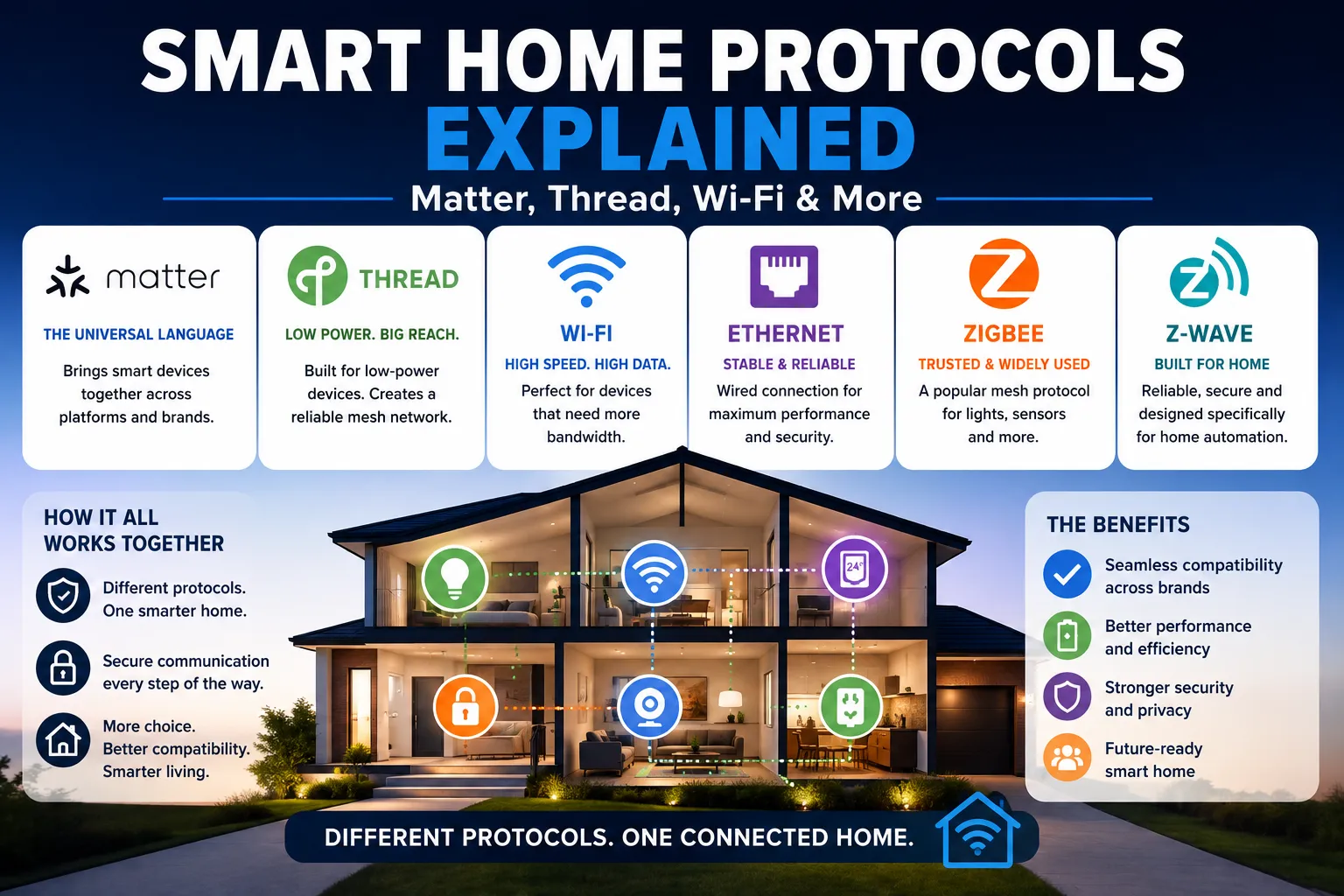
Smart Home Protocols Explained: Matter, Thread, Wi-Fi & More
Smart home technology has become easier to buy, but understanding how smart devices actually communicate can still be surprisingly complicated.
A smart light might advertise Matter support. Another device might use Thread. A camera may rely on Wi-Fi, while an older smart-home product could use Zigbee or Z-Wave.
These terms are often treated as competing technologies, but they do different jobs.
The most important distinction is that Matter is primarily an application-layer standard, while Thread, Wi-Fi, and Ethernet provide network connectivity. Matter can operate over Wi-Fi, Thread, and Ethernet, while Bluetooth Low Energy can be used during setup.
Understanding that difference makes the modern smart home much easier to understand.
For a broader overview of how these technologies fit into a complete connected-home system, see The Complete Guide to Smart Homes.
What Is a Smart Home Protocol?
A smart home protocol is a set of technical rules that determines how connected devices communicate.
Depending on the protocol, those rules may govern different parts of communication, including:
- How devices connect to a network
- How devices exchange information
- How devices are discovered
- How data is secured
- How commands are transmitted
- How different devices interact
The important point is that not every smart home technology operates at the same layer.
Think of a smart home as a communication system with multiple levels.
Wi-Fi and Thread provide ways for devices to connect. Matter provides a common language that compatible smart-home devices can use to communicate.
That distinction explains why Matter and Thread are not direct substitutes.
What Is Matter?
Matter is an open smart-home standard developed to improve interoperability between connected devices from different manufacturers.
The Connectivity Standards Alliance describes Matter as an open smart-home protocol designed to provide reliable and secure connectivity while allowing compatible products to work across major smart-home platforms.
In practical terms, Matter is intended to reduce one of the biggest frustrations in smart-home technology: figuring out whether a device will work with the rest of your system.
Instead of choosing a product solely because it belongs to a particular brand ecosystem, Matter gives compatible devices a standardized way to communicate.
What Does Matter Actually Do?
Matter standardizes communication between compatible smart-home devices.
It can help standardize areas such as:
- Device discovery
- Setup
- Communication
- Device control
- Security
- Interoperability
Matter is designed to work across multiple network technologies rather than replacing them.
A Matter device can use Wi-Fi, Thread, or Ethernet for its network connection. Bluetooth Low Energy can be used during commissioning, or the initial process of setting up a device.
This is why buying a Matter device does not necessarily mean buying a new type of Wi-Fi or replacing your existing home network.
Matter Does Not Replace Alexa, Google Home, Apple Home, or SmartThings
Another common misunderstanding is that Matter is itself a complete smart-home platform.
It is not.
Matter can work with major smart-home platforms, including ecosystems associated with Amazon Alexa, Apple, Google, and Samsung SmartThings.
A simple way to think about the relationship is:
Matter = a common smart-home language
Smart-home platform = the system you use to control and automate your devices
This distinction allows a Matter-compatible product to participate in different supported ecosystems without being locked exclusively to one manufacturer’s platform.
What Is Thread?
Thread is a low-power wireless mesh networking protocol designed specifically for connected devices.
Unlike Matter, Thread is primarily concerned with the networking layer.
Thread Group describes Thread as an IPv6-based, secure, low-power mesh network designed for Internet of Things applications, including smart homes.
Thread is particularly well suited to devices such as:
- Sensors
- Smart buttons
- Door and window sensors
- Thermostats
- Smart locks
- Lighting controls
- Other battery-powered devices
Its low-power design makes it useful for devices that need to operate for long periods without frequent battery replacement.
How Does Thread Work?
Thread creates a mesh network in which compatible devices can participate in the network rather than relying on a single central wireless connection.
This can provide several advantages.
Low Power Consumption
Thread was designed around low-power IoT communication.
That makes it attractive for small devices that operate from batteries.
Mesh Networking
Thread devices can help extend the network’s coverage by communicating through other participating devices.
Self-Healing Architecture
Thread networks are designed to adapt when network paths change or devices become unavailable.
IP-Based Communication
Thread is based on IPv6, allowing Thread devices to fit naturally into IP-based network environments.
What Is a Thread Border Router?
A Thread Border Router connects a Thread network to the rest of the home network.
This is an important concept because Thread devices do not simply connect to your normal Wi-Fi network in the same way a Wi-Fi smart bulb does.
Instead, the Thread Border Router provides a connection between the Thread network and other IP networks.
Thread Group explains that Border Routers can connect Thread devices with Wi-Fi and Ethernet devices while maintaining the IP-based nature of the network.
The good news is that a dedicated standalone box is not necessarily required.
Thread Border Router functionality can be built into products such as smart speakers, displays, televisions, appliances, routers, and other smart-home equipment.
Homeowners building more extensive systems may also want to understand the role of centralized controllers. The Complete Guide to Smart Home Hubs explains how hubs and controllers can fit into a connected-home setup.
What Is Wi-Fi?
Wi-Fi is probably the most familiar connectivity technology in the smart home.
It connects devices wirelessly to a local network, usually through a home router or access point.
Wi-Fi is particularly useful for devices that need more bandwidth, including:
- Security cameras
- Video doorbells
- Smart televisions
- Streaming devices
- Large smart appliances
- Voice assistants
- Other high-data devices
Wi-Fi is generally not designed specifically for tiny battery-powered sensors in the way Thread is.
That does not make Wi-Fi inferior. It simply means the technologies are optimized for different jobs.
Why Smart Cameras Usually Use Wi-Fi
Consider a security camera.
A camera may continuously transmit video, which requires substantially more bandwidth than a temperature sensor sending an occasional reading.
Wi-Fi is well suited to this type of communication.
A small battery-powered door sensor, by contrast, may only need to send a tiny status update when a door opens or closes.
Thread’s low-power design can make more sense for that type of device.
The best smart-home network therefore may contain both Wi-Fi and Thread devices.
For a broader look at the network infrastructure supporting connected devices, see the Complete Guide to Smart Home Networking.
What Is Ethernet?
Ethernet is a wired networking technology.
While smart homes are often associated with wireless devices, wired connections remain extremely valuable.
Ethernet can provide:
- Reliable connectivity
- High bandwidth
- Low latency
- Consistent performance
- Reduced dependence on wireless signals
Smart-home hubs, network equipment, televisions, computers, cameras, and other devices may benefit from wired connections.
Matter supports Ethernet alongside Wi-Fi and Thread.
Matter, Thread, Wi-Fi, and Ethernet Work Together
One of the biggest misconceptions about modern smart homes is that homeowners must choose one protocol.
In many cases, the opposite is true.
A modern smart home might look something like this:
Matter smart sensor → Thread → Thread Border Router → home IP network
While another device could use:
Matter smart camera → Wi-Fi → home router
And another might use:
Matter smart home controller → Ethernet → home network
The Matter layer can provide a common application-level approach while different devices use different network technologies underneath.
This is one of the reasons Matter is significant.
Understanding how these different technologies fit together is also important when considering How to Make Different Smart Home Devices Work Together.
What Is Zigbee?
Zigbee is another wireless technology that has been widely used in smart homes.
Like Thread, Zigbee is associated with low-power wireless mesh networking.
Many older and existing smart-home products use Zigbee, particularly in lighting, sensors, switches, and automation systems.
Zigbee and Thread are not simply different versions of Matter.
They operate at different parts of the technology stack.
Matter can also work with existing ecosystems through bridges, allowing certain devices that use other networking technologies to participate alongside Matter devices.
What Is Z-Wave?
Z-Wave is another established wireless technology used for home automation.
It has historically been popular for products such as:
- Door locks
- Sensors
- Switches
- Thermostats
- Security devices
- Lighting controls
Like Zigbee, Z-Wave has its own ecosystem and technology stack.
For homeowners with existing Z-Wave devices, replacing everything simply because newer Matter products are available is usually unnecessary.
Bridging and ecosystem compatibility can allow older and newer technologies to coexist.
What Is Bluetooth Low Energy?
Bluetooth Low Energy, often abbreviated as BLE, is another technology found in smart homes.
Matter uses Bluetooth Low Energy primarily during device commissioning, or setup.
This is an important distinction.
A product can use Bluetooth during setup without using Bluetooth as its primary method of communicating with the smart-home network afterward.
In other words, Bluetooth may help you get a device onto the network without being the technology that carries its normal smart-home commands.
Matter vs Thread: What Is the Difference?
The simplest explanation is:
| Technology | Primary Role | Typical Strength |
|---|---|---|
| Matter | Smart-home application standard | Interoperability |
| Thread | Low-power wireless networking | Sensors and battery devices |
| Wi-Fi | Wireless networking | Higher-bandwidth devices |
| Ethernet | Wired networking | Reliability and bandwidth |
| Zigbee | Wireless networking/protocol ecosystem | Established smart-home devices |
| Z-Wave | Wireless home-automation ecosystem | Established automation products |
| Bluetooth LE | Short-range wireless/setup | Commissioning and accessories |
The key takeaway is that Matter and Thread are not competing versions of the same thing.
Matter can run over Thread.
Matter can also run over Wi-Fi and Ethernet.
Thread is therefore better understood as one of the networking technologies that can carry Matter communication.
For another look at how different connected-home technologies can coexist and communicate, Understanding Smart Home Integration and Compatibility provides useful context.
Why Matter Over Thread Is Important
Matter over Thread combines two complementary technologies.
Matter provides a standardized smart-home application layer.
Thread provides a low-power mesh network.
This combination can be particularly useful for devices that need long battery life while still participating in a broader interoperable smart-home system.
Thread Group specifically describes Matter as an application-layer protocol that can use Thread, Wi-Fi, or Ethernet underneath it.
That separation allows manufacturers to select the network technology that makes the most sense for a particular device.
Which Devices Should Use Thread?
Thread is particularly attractive for small, low-power smart-home devices.
Examples include:
- Motion sensors
- Temperature sensors
- Contact sensors
- Smart buttons
- Door locks
- Certain switches
- Thermostats
- Lighting controls
The common characteristic is that these devices typically do not need to transmit large amounts of data.
Thread’s low-power mesh architecture is designed for precisely this type of environment.
Which Devices Should Use Wi-Fi?
Wi-Fi makes more sense for devices that need higher bandwidth or are already designed around conventional home networking.
Examples include:
- Cameras
- Smart TVs
- Streaming devices
- Large appliances
- Some speakers
- High-bandwidth displays
A camera sending video requires a very different network profile from a contact sensor that simply reports “open” or “closed.”
Using different technologies for different device categories can therefore be more efficient than forcing everything onto one network technology.
Do Matter Devices Need Wi-Fi?
No.
This is one of the most important points to understand.
Matter supports Wi-Fi, Thread, and Ethernet as underlying network technologies.
Therefore, a Matter device can be designed to operate over Thread instead of Wi-Fi.
This distinction becomes particularly important when shopping for battery-powered devices.
A product labeled “Matter” does not automatically tell you whether it uses Wi-Fi or Thread.
The product specifications should identify the connectivity technology.
Do Thread Devices Need Wi-Fi?
No.
Thread operates as its own low-power wireless mesh network.
However, a Thread network can connect to the home’s broader IP network through a Thread Border Router.
This allows Thread devices to communicate with other network-connected devices and services.
A Thread network and a Wi-Fi network can therefore coexist without being the same wireless network.
Does Thread Replace Wi-Fi?
No.
Thread and Wi-Fi solve different problems.
Wi-Fi is optimized for relatively high-bandwidth wireless communication.
Thread is optimized for low-power, low-bandwidth connected devices.
A smart home can benefit from both.
Trying to replace Wi-Fi with Thread would make little sense for a device such as a high-resolution security camera.
Likewise, using a high-power Wi-Fi connection for every tiny battery-powered sensor may not be the most efficient design.
What Happens When a Matter Device Uses Wi-Fi?
A Wi-Fi Matter device connects to the home’s IP network using Wi-Fi.
The Matter application layer then provides standardized communication between the device and compatible controllers or platforms.
The general architecture looks like:
Matter device → Wi-Fi → home network → Matter controller/platform
The Wi-Fi connection handles network transport, while Matter handles standardized smart-home communication.
What Happens When a Matter Device Uses Thread?
The architecture is slightly different:
Matter device → Thread mesh → Thread Border Router → home IP network → Matter controller/platform
The Thread Border Router provides the connection between the Thread network and the broader IP network.
This allows Thread and Wi-Fi devices to coexist within the same overall home network environment.
What Is a Matter Controller?
A Matter controller is a device or software component that manages Matter devices within a smart-home ecosystem.
Depending on the platform and product, controller functionality can be built into devices such as smart speakers, displays, hubs, or other compatible equipment.
The controller is different from a Thread Border Router, although a single physical device can potentially perform multiple roles.
This is another reason smart-home terminology can become confusing.
One physical product may contain several different networking and smart-home functions.
What Is a Matter Bridge?
A Matter bridge allows devices using another technology or protocol to participate in a Matter environment.
For example, an existing ecosystem may contain Zigbee devices.
Rather than replacing every device, a compatible bridge can expose those devices to a Matter ecosystem.
The bridge effectively handles communication between the different technology environments.
This can make upgrading an existing smart home much more practical.
Why Bridges Matter for Older Smart Homes
The smart-home industry did not start with Matter.
Millions of homes already contain products using proprietary systems, Zigbee, Z-Wave, Wi-Fi, Bluetooth, and other technologies.
Replacing everything whenever a new standard appears would be expensive and wasteful.
Bridging provides a way to preserve some existing equipment while gradually adding newer Matter-compatible products.
For homeowners, that means the transition to newer smart-home standards does not necessarily have to happen all at once.
Are Older Smart Home Devices Obsolete?
Not necessarily.
A device does not become useless simply because it does not support Matter.
If an existing device works reliably and meets your needs, there may be little reason to replace it.
The decision becomes more relevant when:
- The device is no longer supported
- Security updates have stopped
- The manufacturer has discontinued its ecosystem
- The product frequently disconnects
- You want broader platform compatibility
- You are expanding the system significantly
Matter is best viewed as an opportunity to improve interoperability rather than a mandatory replacement program.
Security Matters Regardless of Protocol
Smart-home connectivity introduces security considerations regardless of whether a device uses Wi-Fi, Thread, Zigbee, Z-Wave, or another technology.
A secure smart home should include sensible practices such as:
- Keeping firmware updated
- Using strong account credentials
- Enabling multifactor authentication where available
- Securing the home router
- Replacing unsupported devices
- Reviewing connected devices periodically
- Buying products from manufacturers that provide meaningful security support
Thread includes security mechanisms at the networking layer, while Matter is designed with security and authenticated device communication as core parts of the standard.
No protocol eliminates the need for good security practices.
For practical guidance on protecting connected devices, accounts, and networks, the Smart Home Security Guide covers important security and privacy considerations.
Does Matter Make Smart Homes Simpler?
It can, but Matter does not eliminate every compatibility issue.
A device can support Matter while still having limitations based on the specific features supported by a platform or product.
For example, interoperability depends not only on whether two products carry the Matter logo but also on whether the relevant device type and functionality are supported.
The Matter standard is designed to reduce fragmentation, but consumers should still check the specifications and supported platforms before buying.
How to Choose Smart Home Connectivity
When buying a new smart-home product, start with the device itself.
Ask what kind of data it needs to send.
For Sensors
Thread can be an attractive option because of its low-power design.
For Cameras
Wi-Fi or Ethernet will generally make more sense because cameras require substantially more bandwidth.
For Smart TVs
Wi-Fi or Ethernet are natural choices.
For Battery-Powered Devices
Thread can be particularly appealing.
For Existing Zigbee or Z-Wave Systems
A bridge may allow existing products to coexist with newer Matter equipment.
What Should You Look for on the Box?
Don’t stop at the word Matter.
Look for the complete connectivity information.
A product may say:
Matter over Thread
or:
Matter over Wi-Fi
or indicate Ethernet support.
If it uses Thread, check whether your home has a compatible Thread Border Router.
If you are building a large system, also consider which devices will act as controllers and whether your preferred smart-home platform supports the device category you need.
A Simple Example of a Modern Smart Home
Imagine a home with:
- Five smart lights
- Four door sensors
- Two motion sensors
- A thermostat
- Two security cameras
- A smart television
- A smart speaker
- A smart lock
The cameras might use Wi-Fi.
The television might use Wi-Fi or Ethernet.
The battery-powered sensors could use Thread.
Matter could provide the standardized application layer for compatible products.
A smart speaker or other device could potentially provide Matter controller and Thread Border Router functionality.
The homeowner therefore does not need to force every product onto the same connectivity technology.
The Smart Home Is Becoming a Layered System
The most useful way to understand modern smart-home technology is to stop thinking of protocols as a single list of competing standards.
Instead, think in layers.
Application layer:
Matter defines standardized smart-home interactions.
Network layer:
Thread, Wi-Fi, and Ethernet provide ways for devices to communicate across the network.
Setup:
Bluetooth Low Energy can assist with commissioning.
Bridging:
Bridges can connect compatible devices using other technologies to Matter ecosystems.
This layered approach explains why multiple protocols can exist in the same home without necessarily creating chaos.
The Best Smart Home May Use More Than One Protocol
The future of smart-home connectivity is unlikely to mean that every device uses exactly the same technology.
Instead, different protocols can specialize in different jobs.
Thread is well suited to low-power mesh devices. Wi-Fi handles higher-bandwidth wireless connections. Ethernet provides reliable wired networking. Bluetooth can assist with setup. Matter provides a standardized application layer intended to make compatible devices easier to use across ecosystems.
That division of responsibilities is what makes the modern smart home more flexible.
For consumers, the most useful rule is simple: don’t choose a protocol just because it is popular—choose the connectivity technology that fits the device, while using standards such as Matter to improve interoperability where supported.
Understanding that distinction makes it much easier to build a smart home that is reliable today without unnecessarily locking it into one technology or manufacturer.