Kitchen Knives: Complete Guide for Home Cooks
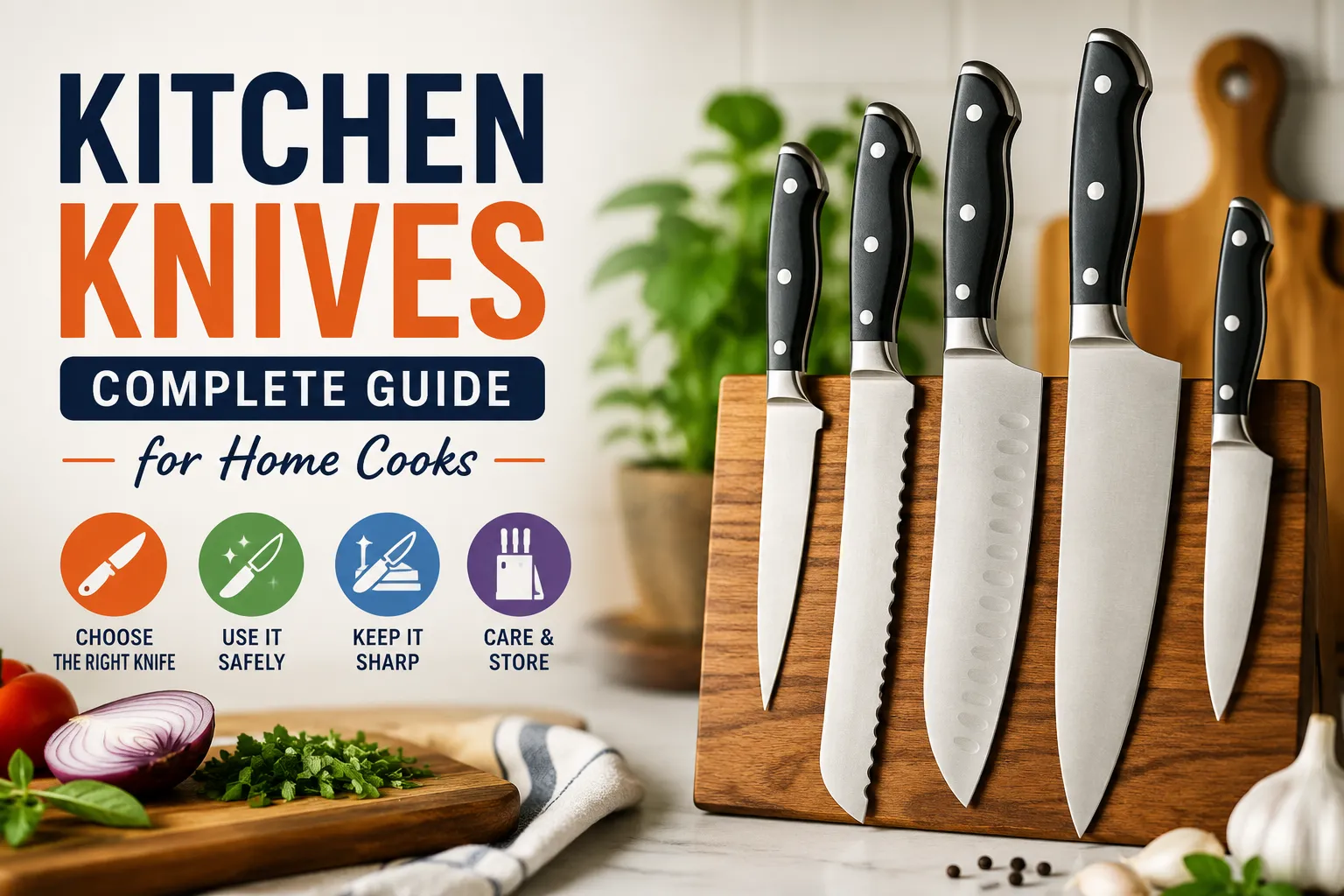
Kitchen Knives: Complete Guide for Home Cooks
A good kitchen knife can change the way you cook.
The right knife makes chopping vegetables faster, slicing meat cleaner, preparing herbs easier, and everyday kitchen work considerably more comfortable. Yet with so many shapes, sizes, materials, and price points available, choosing the right knives can be surprisingly confusing.
Do you really need a different knife for every ingredient? Is an expensive chef’s knife worth it? What’s the difference between a chef’s knife and a santoku? How often should you sharpen your blades? And perhaps most importantly, how can you use and care for kitchen knives safely?
This complete guide breaks down the essential kitchen knives every home cook should understand, what each one is designed to do, how to choose a quality blade, and how to keep your knives performing well for years.
Why Kitchen Knives Matter
Knives are among the most frequently used tools in a kitchen.
A sharp, appropriately sized knife gives you better control over your ingredients and allows you to make consistent cuts. This isn’t just about presentation. Uniform pieces tend to cook more evenly, which can make a noticeable difference in the finished dish.
A good knife can also reduce the effort required for routine preparation.
A dull or poorly balanced knife, on the other hand, may require excessive pressure and can slip more easily. That’s one reason proper knife maintenance and safe cutting technique are just as important as the knife itself.
The Essential Kitchen Knife Set
You don’t need a huge collection to cook well.
For most home kitchens, a few versatile knives can handle the majority of everyday tasks.
A practical collection might include:
- Chef’s knife
- Paring knife
- Serrated bread knife
- Utility knife
- Boning or specialty knife, depending on what you cook
Of these, the chef’s knife is usually the most important investment.
Rather than buying a large block filled with knives you rarely use, it often makes more sense to buy a smaller number of quality knives that match your cooking habits.
The Chef’s Knife
The chef’s knife is the workhorse of the kitchen.
Typically featuring a broad blade that tapers toward the tip, it can be used for a wide range of tasks, including:
- Chopping vegetables
- Slicing meat
- Dicing onions
- Mincing herbs
- Cutting fruit
- Preparing garlic
- Breaking down larger ingredients
A traditional Western chef’s knife often has a curved cutting edge that allows a rocking motion when chopping.
For many home cooks, an approximately 20-centimeter blade is a versatile starting point, although smaller or larger knives may be more comfortable depending on hand size, cutting style, and kitchen tasks.
What Makes a Good Chef’s Knife?
Look for:
- Comfortable grip
- Good balance
- Strong blade construction
- Comfortable weight
- Reliable edge retention
- Appropriate blade length
- Handle that feels secure in your hand
The most expensive knife isn’t automatically the best knife for you.
A moderately priced knife that feels comfortable and is easy to maintain can be more useful than an expensive blade that feels awkward.
The Santoku Knife
The santoku is a Japanese-style knife that has become popular in home kitchens around the world.
The name is commonly associated with three types of kitchen tasks: slicing, dicing, and mincing.
Santoku knives typically have a shorter, lighter blade than many Western chef’s knives, with a relatively flat cutting edge and a taller blade profile.
They can be particularly comfortable for cooks who prefer a more controlled up-and-down cutting motion rather than a pronounced rocking motion.
Some santoku blades feature hollowed-out indentations along the edge. These can reduce food sticking to the blade during certain cutting tasks, although their effectiveness varies.
Chef’s Knife vs. Santoku
Neither is universally better.
Choose a chef’s knife if you prefer:
- A curved cutting edge
- Rocking cuts
- A longer blade
- A traditional Western knife profile
A santoku may be preferable if you like:
- A lighter knife
- A shorter blade
- A flatter cutting edge
- Push-cutting or straight chopping
The best choice ultimately comes down to how the knife feels in your hand.
The Paring Knife
A paring knife is a small, highly maneuverable knife designed for precision work.
It is useful for:
- Peeling fruits and vegetables
- Removing seeds
- Trimming vegetables
- Cutting small fruits
- Removing blemishes
- Creating small decorative cuts
- Preparing garlic and small ingredients
A paring knife isn’t a replacement for a chef’s knife. Its strength is control.
When you’re working with a small ingredient that requires careful trimming, a large chef’s knife can feel unnecessarily cumbersome.
The Serrated Bread Knife
A bread knife has a long blade with a serrated edge.
The teeth allow it to cut through crusty bread without crushing the soft interior.
It can also be useful for other foods with firm exteriors and soft interiors, including some cakes and certain ripe fruits.
A serrated knife works differently from a smooth-edged knife. Instead of relying primarily on a sharp continuous edge, its teeth engage with the food as you use a gentle sawing motion.
Because sharpening serrated blades requires specialized equipment or techniques, proper care is particularly important.
The Utility Knife
A utility knife generally falls between a chef’s knife and a paring knife in size.
It can be useful for:
- Slicing smaller vegetables
- Cutting sandwiches
- Preparing fruit
- Trimming meat
- Handling ingredients that are too large for a paring knife but too small for a chef’s knife
It’s not essential for every cook, but it can be a convenient addition if you find yourself frequently switching between larger and smaller knives.
The Boning Knife
If you regularly prepare meat, poultry, or fish, a boning knife can be useful.
Boning knives typically have narrow blades designed to maneuver around bones and joints.
Different designs vary in flexibility.
A flexible blade can be useful for certain fish and delicate trimming tasks, while a stiffer blade may provide better control when working around larger cuts of meat.
For cooks who primarily buy boneless, prepared cuts, however, a boning knife may not be necessary.
The Cleaver
The word “cleaver” can describe several different knife designs.
A heavy Chinese-style cleaver can be used for chopping vegetables, slicing meat, and other preparation tasks. A heavier meat cleaver is designed for more demanding work involving bones and joints.
This distinction matters.
A heavy cleaver intended for chopping through bones should not be confused with a lighter vegetable cleaver.
Using a knife outside its intended purpose can damage the blade and create unnecessary safety risks.
Understanding Knife Blade Materials
The blade material affects sharpness, durability, maintenance, and appearance.
Stainless Steel
Stainless steel is popular because it offers good resistance to corrosion and is relatively easy to maintain.
It is a practical choice for many home cooks.
However, “stainless” doesn’t mean completely immune to staining or corrosion. Different stainless steels have different compositions and properties.
Carbon Steel
Carbon steel can take an extremely sharp edge and is valued by many cooks for its cutting performance.
The trade-off is maintenance.
Carbon steel is more reactive than many stainless steels and can develop discoloration or rust if it isn’t properly dried and cared for.
Some carbon-steel knives also develop a patina over time.
High-Carbon Stainless Steel
High-carbon stainless steel attempts to combine some of the edge characteristics associated with carbon steel with improved corrosion resistance.
Many modern kitchen knives use this category of steel.
Again, the exact performance depends on the particular steel and heat treatment—not simply the words printed on the packaging.
What Is Damascus Steel?
“Damascus” is often used to describe knives featuring distinctive layered patterns on the blade.
The appearance can be beautiful, but the pattern itself doesn’t automatically tell you how well a knife performs.
Modern Damascus-style kitchen knives are often made by combining multiple layers of steel.
When evaluating one, look beyond the pattern and consider the actual steel, construction, heat treatment, edge geometry, balance, and manufacturer.
A visually striking blade isn’t necessarily a better cutting tool.
Full Tang vs. Partial Tang
The tang is the portion of the blade that extends into the handle.
A full-tang knife generally extends through much or all of the handle.
This construction is often valued for strength and balance, particularly in knives that will see heavy use.
However, tang design alone doesn’t determine overall knife quality.
A well-made knife with a different tang construction can still perform extremely well.
Instead of treating full tang as an automatic quality guarantee, consider it alongside blade steel, construction, handle design, balance, and craftsmanship.
Choosing the Right Knife Size
Bigger isn’t always better.
A large chef’s knife may be excellent for cutting a large cabbage or preparing a substantial piece of meat, but some cooks find a smaller knife easier to control.
Consider:
- Your hand size
- Cutting style
- Counter space
- Typical ingredients
- Storage options
- Personal comfort
If possible, hold a knife before buying it.
The handle should feel secure without forcing you to grip it excessively tightly.
Knife Balance and Weight
Balance is subjective.
Some cooks prefer a blade-heavy knife, while others prefer a handle-heavy or more neutral balance.
A balanced knife should feel predictable and controlled when you use it.
Weight also matters.
A heavier knife can provide momentum when chopping, while a lighter knife may feel faster and less tiring during extended preparation.
There is no universally correct weight.
The right knife is the one that allows you to work comfortably and confidently.
How Sharp Should a Kitchen Knife Be?
A kitchen knife should be sharp enough to cut food cleanly with controlled pressure.
A dull knife isn’t necessarily safer just because it feels less sharp.
Dull blades often require more force, and excessive force can make a knife harder to control.
A properly maintained edge should allow the blade to perform its intended task without forcing it through ingredients.
If you find yourself repeatedly pressing hard to cut through something that the knife should handle easily, it may be time to maintain the edge.
Honing vs. Sharpening
These two terms are often confused.
Honing
Honing helps realign the edge of a knife that has become slightly misaligned through normal use.
A honing rod is commonly used for this purpose.
Honing doesn’t remove significant amounts of metal from the blade.
Sharpening
Sharpening actually removes material to create a new cutting edge.
It can be done with:
- Whetstones
- Manual sharpeners
- Electric sharpeners
- Professional sharpening services
The correct method depends on the knife and the user’s experience.
Not every knife should be treated identically, particularly knives with specialized edge geometries.
How Often Should You Sharpen a Kitchen Knife?
There is no universal schedule.
Sharpening frequency depends on:
- How often you use the knife
- What you cut
- Cutting board material
- Blade steel
- Knife geometry
- Cutting technique
- Personal expectations for sharpness
A home cook who uses a chef’s knife every day may need to sharpen it several times a year, while an occasional cook may need it much less frequently.
Instead of following a strict calendar, pay attention to performance.
If the knife no longer cuts cleanly despite proper honing and technique, sharpening may be appropriate.
How to Use a Knife Safely
Good knife technique is essential.
Keep Your Cutting Board Stable
Place a damp kitchen towel or suitable non-slip mat underneath the board if it moves on the counter.
A sliding cutting board can make even simple preparation unnecessarily dangerous.
Use a Controlled Grip
Hold the knife securely and avoid gripping it so tightly that your hand becomes fatigued.
Many cooks find that gripping the blade near the handle with the thumb and index finger while wrapping the remaining fingers around the handle provides good control.
Protect Your Non-Knife Hand
When holding food, curl your fingertips inward so your knuckles face the blade.
This technique is commonly known as a claw grip.
Move the knife against your knuckles rather than extending your fingertips toward the cutting edge.
Don’t Rush
Speed should come from good technique, not frantic movement.
If you’re still developing knife skills, prioritize accuracy and control.
Speed will naturally improve with practice.
For beginners building broader kitchen skills, these techniques work best alongside a wider understanding of basic cooking methods and how different techniques affect food.
Never Catch a Falling Knife
If a knife falls, let it fall.
Do not attempt to catch it.
Step away and allow it to land before picking it up carefully.
This simple rule can prevent serious hand injuries.
Don’t Put Sharp Knives in a Sink
Leaving a sharp knife hidden beneath soapy water is dangerous.
Someone reaching into the sink may not know where the blade is.
Instead, wash knives promptly or place them somewhere clearly visible and safe until they can be washed.
Should You Put Kitchen Knives in the Dishwasher?
For quality kitchen knives, hand washing is generally the safer choice.
Dishwashers expose knives to:
- High temperatures
- Harsh detergents
- Strong water jets
- Contact with other utensils
- Prolonged moisture
These conditions can damage handles, dull edges, encourage corrosion, or cause knives to knock against other objects.
Unless the manufacturer specifically recommends dishwasher use, hand washing is usually preferable.
How to Clean a Kitchen Knife
Cleaning doesn’t need to be complicated.
- Wash the knife with warm water and mild dish soap.
- Use a suitable sponge or cloth.
- Avoid placing your fingers directly along the cutting edge.
- Rinse thoroughly.
- Dry the knife immediately.
- Store it safely.
Do not leave a knife soaking in water for extended periods.
The Best Cutting Boards for Kitchen Knives
Your cutting board can affect knife performance.
Very hard surfaces such as glass, stone, or ceramic can be particularly unforgiving on knife edges.
Wood and quality plastic cutting boards are generally more suitable for everyday knife work.
Wooden boards require appropriate cleaning and maintenance, while plastic boards should be replaced when they become excessively scarred or difficult to clean.
The goal is to provide a stable cutting surface that is reasonably gentle on the knife edge.
How to Store Kitchen Knives
Proper storage protects both the knife and the people using it.
Good options include:
Knife Blocks
Traditional blocks keep blades separated and provide convenient access.
Magnetic Strips
Magnetic storage can save counter space and display knives neatly.
However, install magnetic strips securely and place knives on and remove them from the strip carefully.
Drawer Inserts
A dedicated knife organizer keeps blades protected inside a drawer.
Avoid tossing sharp knives loosely into a utensil drawer where they can damage other tools or injure someone reaching inside.
Kitchen Knife Maintenance Mistakes to Avoid
Cutting on Hard Surfaces
Avoid using quality kitchen knives directly on plates, countertops, glass, or other unsuitable surfaces.
Using the Knife to Scrape Food
Dragging the sharp edge sideways across a cutting board can damage the edge.
If you need to move chopped food, use the spine of the knife or a bench scraper instead.
Cutting Frozen Food
Don’t force a standard kitchen knife through frozen ingredients unless the knife is specifically designed for that task.
The blade can chip or become damaged.
Using the Knife as a Tool
A kitchen knife is not a screwdriver, pry bar, can opener, or package opener.
Using it for jobs outside its intended purpose can damage the blade and increase the risk of injury.
Storing Knives Loose
Loose knives are difficult to retrieve safely and can damage their edges.
How Much Should You Spend on a Kitchen Knife?
There is no magic price that guarantees quality.
A basic chef’s knife can be perfectly adequate for everyday cooking, while premium knives may offer refined materials, craftsmanship, ergonomics, and edge performance.
Before spending more, ask what you’re actually gaining.
A higher price may reflect:
- Better blade steel
- More refined construction
- Better heat treatment
- Improved handle materials
- More precise manufacturing
- Hand finishing
- Brand reputation
- A specialized design
But expensive doesn’t automatically mean better for every cook.
A knife that fits your hand and cooking style is often a better investment than one selected primarily for its price tag.
Should You Buy a Knife Set?
Knife sets can be convenient, especially for cooks who want a coordinated collection.
However, many sets contain knives that rarely get used.
A large block might include:
- Multiple small knives
- Several similar utility knives
- Specialty blades
- Steak knives
- Kitchen shears
- Storage blocks
If you know exactly what you need, buying individual knives can give you more control over your budget and collection.
For many home cooks, starting with a quality chef’s knife, paring knife, and serrated bread knife is enough.
You can add specialty knives later.
How to Build a Practical Knife Collection
A sensible collection might grow in stages.
Stage One: The Essentials
Start with:
- Chef’s knife
- Paring knife
- Serrated bread knife
These three cover a surprisingly large portion of everyday kitchen tasks.
Stage Two: Add Based on Your Cooking
If you regularly prepare meat, consider a boning or carving knife.
If you cook a lot of vegetables, a santoku or vegetable cleaver may be useful.
If you bake frequently, a longer serrated knife could be valuable.
Stage Three: Add Specialty Tools
Only purchase specialized knives when they solve a real problem in your kitchen.
This prevents your knife drawer from becoming a collection of tools that rarely leave their storage spaces.
Knife Skills Every Home Cook Should Learn
You don’t need professional culinary training to improve your knife skills.
Start with the basics:
- Keep the cutting board stable.
- Use a controlled grip.
- Curl the fingers of your guiding hand.
- Keep the blade sharp.
- Cut at a controlled pace.
- Use the correct knife for the job.
- Keep your attention on the cutting task.
Practice consistent cuts rather than trying to chop as quickly as possible.
Uniform dice, slices, and pieces will improve both cooking consistency and presentation.
Understanding the ingredients you’re preparing can also make knife work more effective. Different vegetables, herbs, meats, and other ingredients respond differently to cutting, preparation, and cooking, which is why a broader guide to cooking ingredients, their uses, substitutions, and storage can be useful when developing kitchen skills.
How to Know When a Knife Needs Replacing
A good kitchen knife can last for many years with proper maintenance.
However, replacement may be appropriate if:
- The blade is badly damaged.
- The handle is loose or cracked.
- The knife has significant corrosion.
- The blade has been repeatedly damaged.
- The knife can no longer be safely maintained.
- The construction has become unstable.
A slightly dull knife usually needs sharpening—not replacement.
The Knife Drawer Doesn’t Need to Be Full
A great kitchen doesn’t require dozens of knives.
For most home cooks, a carefully selected collection of versatile knives will outperform a crowded drawer full of inexpensive blades.
Start with the knife you use most.
Choose one that feels comfortable, maintains a useful edge, and matches the way you cook. Add specialized knives only when your cooking habits justify them.
The most valuable kitchen knife isn’t necessarily the most expensive or the most impressive-looking one. It’s the blade you can control confidently, maintain properly, and reach for every time you prepare a meal.
Once you combine the right knife with good technique and regular maintenance, even ordinary kitchen preparation becomes smoother, safer, and considerably more enjoyable.
For anyone developing a complete foundation in home cooking, kitchen knives are only one part of the process. They work alongside cooking techniques, ingredient knowledge, measurements, seasoning, heat control, and other fundamentals covered in The Complete Guide to Cooking for Beginners.
Learning how to season food is another natural next step because good knife skills often prepare the ingredients for the herbs, spices, aromatics, and other flavor components that follow. The guide to seasoning food with herbs, spices, salt and other flavors can help connect preparation techniques with the finished flavor of a dish.