How to Improve Indoor Air Quality
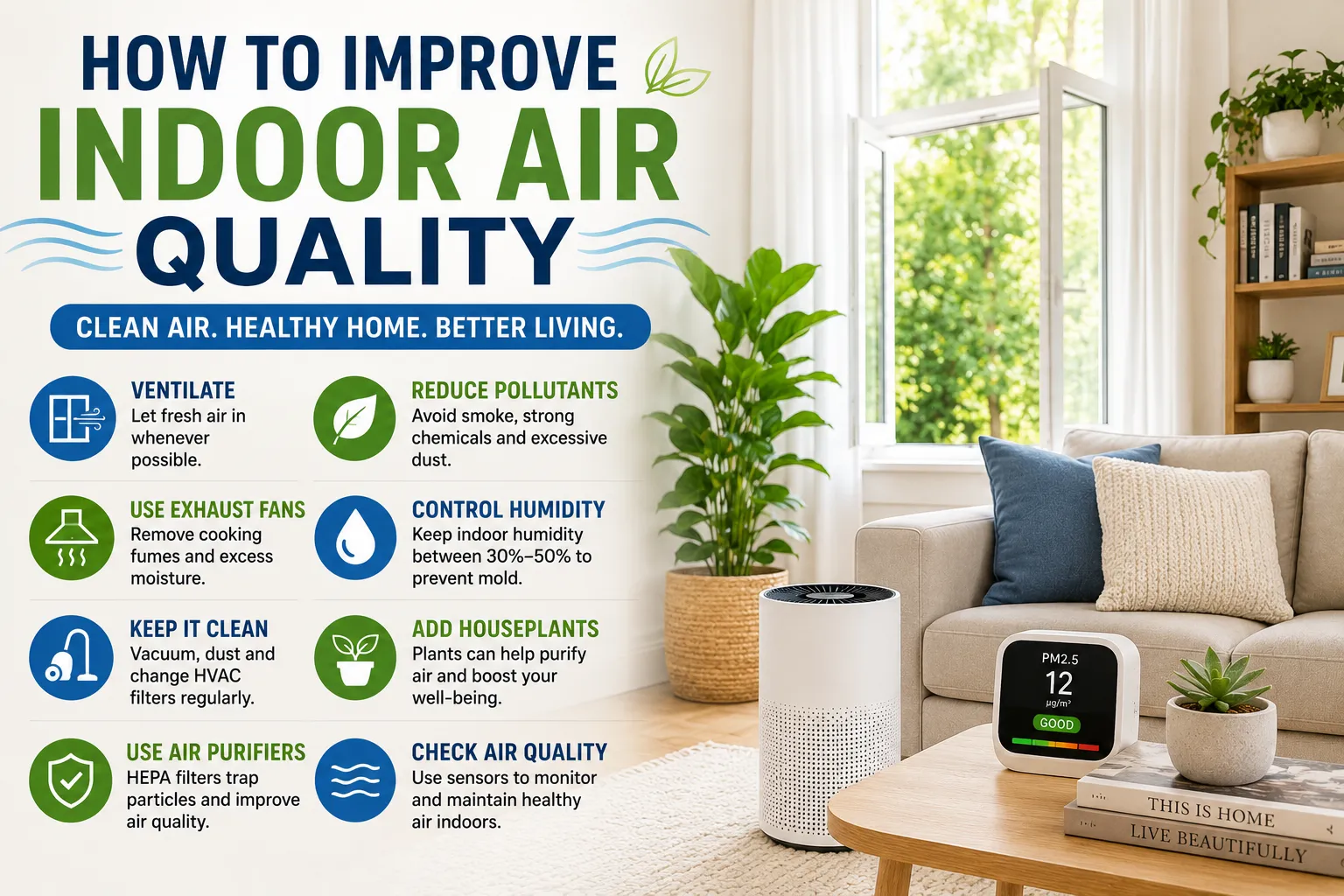
How to Improve Indoor Air Quality
The air inside a home can be easy to overlook. It is invisible, constantly changing, and often feels clean even when pollutants are present.
Yet indoor air quality can be affected by cooking, cleaning products, dust, moisture, combustion appliances, building materials, outdoor pollution, and inadequate ventilation. People spend a significant amount of time indoors, making indoor air quality an important part of maintaining a comfortable and well-maintained home.
Improving indoor air quality does not necessarily require expensive equipment or a complete home renovation. In many cases, the most effective approach is to identify pollution sources, reduce them, improve ventilation, control moisture, and use filtration where appropriate. These efforts also fit naturally into a broader approach to home maintenance projects.
What Is Indoor Air Quality?
Indoor air quality refers to the characteristics of air inside buildings that can affect people’s health, comfort, and wellbeing.
Several factors influence indoor air quality, including:
- Indoor pollution sources
- Outdoor air entering the home
- Ventilation
- Temperature
- Humidity
- Building materials
- Household products
- Heating and cooling systems
- Occupant activities
- Moisture and water damage
Common indoor pollutants can include particulate matter, volatile organic compounds (VOCs), biological contaminants, combustion pollutants, and radon.
The important point is that there is no single “air quality problem.” Different pollutants require different solutions.
Start by Controlling Pollution Sources
Source control is usually one of the most effective strategies for improving indoor air quality. Rather than relying entirely on an air purifier to remove pollutants after they enter the air, reducing or eliminating the source prevents pollution from building up in the first place.
This can mean:
- Avoiding smoking indoors
- Reducing unnecessary use of products that release strong fumes
- Storing chemicals properly
- Maintaining fuel-burning appliances
- Controlling household dust
- Repairing leaks
- Removing excess moisture
- Choosing lower-emission products when possible
- Ventilating during activities that produce pollutants
For example, if cooking produces significant airborne particles, using an exhaust hood that vents outdoors can address the pollution close to its source.
Improve Ventilation Throughout the Home
Ventilation helps replace stale indoor air with outdoor air and can dilute indoor pollutants.
When outdoor conditions are suitable, opening windows and doors can increase natural ventilation. Kitchen and bathroom exhaust fans that vent outdoors can also remove pollutants and moisture directly from the rooms where they are produced.
Ventilation is particularly useful during activities that can temporarily increase indoor pollution, including:
- Cooking
- Painting
- Cleaning
- Sanding
- Certain hobbies
- Showering
- Using fuel-burning appliances
However, opening windows is not always appropriate. If outdoor air pollution, smoke, pollen, extreme temperatures, or high humidity are significant, bringing outdoor air inside can make indoor conditions worse. Homeowners should consider outdoor conditions when deciding when to ventilate.
Use Kitchen Exhaust Fans When Cooking
Cooking can generate airborne particles, moisture, and other pollutants.
Using a range hood or exhaust fan that vents outdoors can help remove contaminants before they spread throughout the home.
If you have an exhaust hood, make sure it is actually vented outside rather than simply recirculating air through a filter.
When cooking, additional measures can include:
- Using the exhaust fan
- Keeping kitchen ventilation running for a period after cooking
- Using lids on pots when appropriate
- Avoiding unnecessary burning or charring
- Keeping cooking surfaces clean
- Opening windows when outdoor conditions permit
These simple habits can reduce the amount of pollution that spreads from the kitchen into bedrooms and living spaces.
Control Moisture and Indoor Humidity
Moisture is one of the most important factors in maintaining a healthy indoor environment.
High humidity can encourage mold growth and contribute to other indoor-air problems. Keeping indoor humidity around 30% to 50% when practical can help maintain a more balanced indoor environment.
A small digital hygrometer can help you monitor humidity.
If humidity remains high, possible solutions include:
- Improving bathroom ventilation
- Using an exhaust fan during and after showers
- Repairing plumbing leaks
- Using a dehumidifier
- Improving airflow
- Addressing water intrusion
- Using air conditioning where appropriate
Persistent moisture should not simply be covered up. The underlying cause needs to be identified and corrected. Understanding how home plumbing systems work can also help homeowners recognize where leaks and drainage problems may originate.
Prevent Mold by Keeping Areas Dry
Mold requires moisture to grow.
That means controlling moisture is one of the most important ways to prevent mold-related indoor air problems.
Pay particular attention to:
- Bathrooms
- Kitchens
- Basements
- Areas around plumbing
- Roof and ceiling leaks
- Window condensation
- Damp carpets
- Areas affected by flooding
Keeping areas clean and dry, addressing excess water, and controlling moisture can reduce exposure to biological contaminants.
If there is extensive or recurring mold, simply cleaning the visible surface may not solve the underlying problem. The moisture source needs to be addressed.
Homeowners can also benefit from understanding how to identify and prevent common safety hazards inside a home, particularly when moisture, electrical equipment, or other household hazards overlap.
Keep HVAC Filters Clean and Maintained
Heating, ventilation, and air-conditioning systems can play an important role in indoor air quality.
Filters are designed to capture airborne particles as air moves through the system. A clogged or neglected filter can interfere with system performance and reduce the effectiveness of filtration.
Follow the manufacturer’s instructions for inspecting, cleaning, or replacing filters.
For some homes and systems, higher-efficiency filters may provide additional particle removal. However, homeowners should make sure that the HVAC system can accommodate the selected filter without causing airflow problems.
Filtration is best viewed as a useful supplement to source control and ventilation rather than a replacement for either one.
For a broader understanding of the equipment and systems that require regular attention, see how major home systems work and what homeowners maintain.
Consider a Portable Air Cleaner
Portable air cleaners can be useful when additional particle filtration is needed in a particular room.
They can be especially helpful in spaces where people spend substantial amounts of time, depending on the source of pollution and the capabilities of the device.
When selecting an air cleaner, consider:
- Room size
- Clean air delivery performance
- Filter type
- Noise level
- Operating cost
- Replacement filter availability
- Energy consumption
Portable air cleaners can reduce indoor particle pollution, but their effectiveness depends on factors such as how efficiently they collect pollutants and how much air they move through the cleaning system.
Air cleaners also do not eliminate every type of pollutant.
For example, many basic particle filters are not designed to remove gaseous pollutants.
Be Careful With Household Cleaning Products
Cleaning products can contribute to indoor air pollution, particularly when used in poorly ventilated spaces.
This does not mean people should stop cleaning. Instead, use products according to their labels and provide adequate ventilation when necessary.
Good practices include:
- Following product instructions
- Avoiding unnecessary amounts
- Never mixing incompatible cleaning chemicals
- Keeping products in their original containers
- Storing products safely
- Ventilating areas where strong fumes are produced
Products used for cleaning, maintenance, personal care, and hobbies are among the potential sources of indoor pollutants.
Reduce Dust and Other Particles
Dust can accumulate in carpets, furniture, bedding, curtains, and other surfaces.
Regular cleaning can reduce the amount of settled material that gets redistributed into the air.
Useful habits include:
- Vacuuming regularly
- Cleaning hard surfaces
- Washing bedding
- Reducing unnecessary clutter
- Using doormats
- Keeping shoes near the entrance
- Cleaning pet areas
- Addressing visible dust buildup
Using doormats and leaving shoes at the door can also help reduce tracked-in dust and dirt.
If someone in the household is sensitive to dust or dust mites, more targeted cleaning practices may be appropriate.
Keep Smoke Out of the Home
One of the simplest indoor-air improvements is to prevent tobacco smoke from entering indoor spaces.
Smoking indoors introduces numerous pollutants into the home and can expose other occupants.
The best approach is to keep smoking outside.
Smoke from outdoor fires, wildfires, or other combustion sources can also enter homes. During periods of poor outdoor air quality, homeowners may need to limit outdoor-air ventilation and use appropriate filtration while keeping doors and windows closed.
Maintain Fuel-Burning Appliances
Fuel-burning appliances can produce combustion pollutants when they are improperly installed, poorly maintained, damaged, or inadequately vented.
Potential sources include appliances using:
- Gas
- Oil
- Kerosene
- Wood
- Coal
- Other fuels
Homes with combustion appliances should also have properly functioning carbon monoxide alarms. Carbon monoxide is different from carbon dioxide and requires dedicated safety equipment designed to detect it.
Maintaining these systems is part of broader home upkeep, particularly when electrical, heating, ventilation, or other major household systems are involved.
Test for Radon Where Appropriate
Radon is a naturally occurring radioactive gas that can enter buildings from the ground.
Unlike dust or smoke, radon cannot be detected by smell or sight.
Testing is therefore important in areas where radon may be a concern. If elevated levels are found, mitigation systems can be installed to reduce radon entering and accumulating inside the home.
Local recommendations and building conditions should be considered when determining how and when to test.
Be Strategic During Home Renovations
Renovations can temporarily introduce additional pollutants into the indoor environment.
Paints, adhesives, dust, flooring materials, pressed-wood products, insulation, and other construction materials can contribute emissions or airborne particles.
During renovation work:
- Ventilate appropriately.
- Isolate construction areas where possible.
- Keep dust from spreading through the home.
- Follow product instructions.
- Allow materials to off-gas according to manufacturer recommendations.
- Keep children and other occupants away from hazardous work areas.
- Clean construction dust thoroughly before normal occupancy.
When major renovations are planned, indoor air quality should be considered as part of the project rather than addressed afterward.
Use Smart Sensors to Monitor Indoor Conditions
Technology can provide another layer of awareness.
Indoor sensors can monitor conditions such as:
- Temperature
- Relative humidity
- Carbon dioxide
- Particulate matter
- Certain volatile organic compounds
A sensor can help identify patterns that might otherwise go unnoticed—for example, humidity consistently rising after showers or particle levels increasing during cooking.
However, consumer sensors have limitations. Readings can be affected by factors such as humidity, temperature, placement, calibration, and the specific pollutants they are designed to detect.
A sensor reading should therefore be treated as useful information rather than an automatic diagnosis of a health or building problem.
Improve Air Quality Room by Room
Different parts of the home have different air-quality challenges.
Kitchen
Focus on:
- Outdoor-vented range hoods
- Ventilation during cooking
- Clean cooking surfaces
- Moisture control
- Appropriate filtration
Bathroom
Focus on:
- Exhaust ventilation
- Moisture control
- Preventing condensation
- Drying wet surfaces
- Addressing leaks quickly
Bedroom
Focus on:
- Dust control
- Clean bedding
- Adequate ventilation
- Appropriate humidity
- Reducing unnecessary fragrances and pollutants
Living Room
Focus on:
- Dust removal
- Adequate ventilation
- HVAC filter maintenance
- Smoke prevention
- Appropriate air cleaning
Basement
Focus particularly on:
- Moisture
- Mold prevention
- Water intrusion
- Ventilation
- Radon testing where appropriate
Don’t Rely on Air Purifiers Alone
Air purifiers can be useful, but they are not a universal solution.
If a home has a leaking pipe, excessive humidity, smoke source, poorly vented combustion appliance, or other ongoing pollution source, filtering the air does not necessarily address the underlying problem.
A strong indoor-air-quality strategy combines three approaches:
- Source control
- Improved ventilation
- Filtration and air cleaning
Source control is generally the first priority, while ventilation and filtration can supplement it.
Think of an air purifier as part of an indoor-air-quality strategy rather than the entire strategy.
A Simple Indoor Air Quality Checklist
Homeowners can use the following checklist as a starting point:
- Keep indoor humidity around 30–50% when practical.
- Repair leaks promptly.
- Keep bathrooms adequately ventilated.
- Use kitchen exhaust ventilation when cooking.
- Replace or clean HVAC filters according to manufacturer instructions.
- Keep smoking outside.
- Maintain fuel-burning appliances.
- Use properly functioning carbon monoxide alarms.
- Reduce dust buildup.
- Control visible mold and its moisture source.
- Ventilate when outdoor conditions are suitable.
- Avoid bringing outdoor pollution indoors during poor-air-quality events.
- Consider appropriate air filtration.
- Test for radon where recommended.
- Follow safety instructions when using household chemicals.
- Consider indoor-air-quality sensors for monitoring patterns.
When Indoor Air Problems Need Professional Attention
Some indoor-air-quality problems cannot be solved with routine cleaning or a new filter.
Consider professional help when there is:
- Persistent or extensive mold
- Significant water damage
- Suspected asbestos
- Suspected radon problems
- Repeated carbon monoxide alarm activation
- Persistent chemical odors
- Serious ventilation problems
- Major combustion-appliance concerns
- Unexplained recurring indoor-air-quality problems
Professional assessment can help identify the actual source instead of treating only the symptoms.
Building a Cleaner Indoor Environment Starts With the Source
Improving indoor air quality is ultimately about managing the environment rather than simply adding more technology.
A well-maintained home with controlled moisture, sensible ventilation, properly maintained appliances, reduced pollution sources, and appropriate filtration can provide a much better indoor environment than a home that depends on an air purifier while underlying problems remain unresolved.
The most effective strategy is therefore straightforward: identify what is polluting the air, stop or reduce the source, bring in clean outdoor air when conditions allow, and use filtration as an additional layer of protection.
For homeowners, these measures can also protect the building itself. Controlling moisture, maintaining ventilation systems, and addressing leaks early can reduce problems that otherwise become expensive repairs. Good indoor air quality is not just about making a home feel fresher—it is part of maintaining a safer, more comfortable, and more durable living environment.