How Smart Heating and Cooling Systems Improve Home Comfort
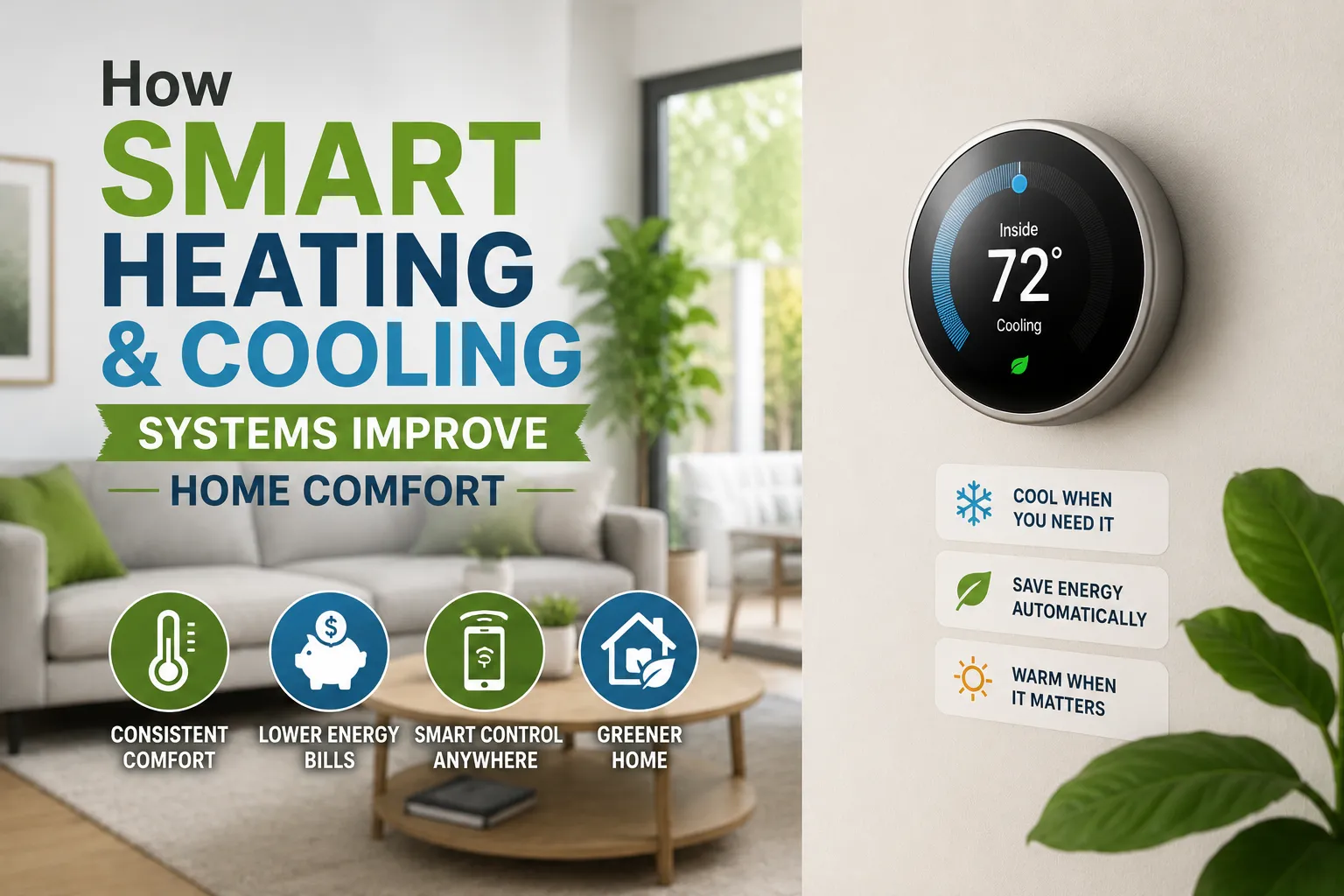
How Smart Heating and Cooling Systems Improve Home Comfort
Keeping a home comfortable throughout the year can be surprisingly difficult. Outdoor temperatures change, rooms heat up at different rates, and household routines are rarely consistent. Traditional thermostats can control temperature, but they often depend on people remembering to adjust them.
Smart heating and cooling systems take a more adaptive approach.
By combining connected thermostats, sensors, automation and smartphone controls, these systems can respond to changing conditions and household preferences. The result can be a home that feels more consistently comfortable while potentially using energy more efficiently.
The technology is not simply about controlling a thermostat from a phone. Modern systems can learn schedules, detect occupancy, monitor indoor conditions and make automatic adjustments based on predefined settings.
For homeowners exploring how heating and cooling fit into the wider connected-home ecosystem, the Complete Guide to Smart Homes provides broader context on how different smart technologies work together.
What Are Smart Heating and Cooling Systems?
Smart heating and cooling systems are connected technologies designed to automate or improve the way a home’s temperature is managed.
A smart setup can include:
- Smart thermostats
- Room temperature sensors
- Humidity sensors
- Smart vents
- Connected air conditioners
- Heat pumps
- Connected furnaces
- Home automation platforms
- Smartphone applications
The exact capabilities depend on the equipment.
At the simplest level, a smart thermostat allows homeowners to control temperature remotely. More advanced systems can use multiple sensors and automation rules to adjust conditions throughout the home.
Instead of treating the house as one uniform space, these systems can provide a more detailed picture of what is happening indoors.
Smart Thermostats Make Temperature Control More Precise
A conventional thermostat generally measures temperature in one location.
That can create problems in homes where different rooms experience different conditions.
A bedroom at the far end of a house may feel cooler than the living room. A room with large windows may heat up quickly when sunlight enters. A kitchen can become warmer while cooking.
Smart thermostats can work with additional sensors to account for some of these differences.
For example, a homeowner may prioritize the temperature of a bedroom during nighttime hours and the living room during the evening.
This makes temperature management more closely aligned with how people actually use their homes.
Automatic Scheduling Reduces Constant Adjustments
Traditional temperature control often requires manual changes.
You might turn the heating down before leaving for work and remember to increase it again before returning.
A smart thermostat can automate that process.
Homeowners can establish schedules based on their routines, such as:
- A lower temperature while everyone is away
- A comfortable setting shortly before people return
- A different temperature overnight
- A warmer setting during morning routines
- Reduced cooling when the home is empty
Once programmed, the system can handle these adjustments automatically.
This can make the home feel more comfortable without requiring constant attention.
Smart Systems Can Respond to Occupancy
Some smart heating and cooling systems can detect whether people are home using sensors or connected-device information.
That creates another opportunity for automation.
If the house is empty, the system may adjust the temperature rather than maintaining the same conditions required when everyone is present.
When occupants return, the system can restore the preferred settings.
This approach is particularly useful for households with irregular schedules.
Instead of relying entirely on a fixed timetable, the system can potentially respond to what is actually happening.
Remote Control Adds Convenience
One of the most familiar smart-home features is remote control.
Through a smartphone app, homeowners can check or change their thermostat settings from almost anywhere with an internet connection.
That can be useful when plans change.
For example, if someone leaves home and realizes the heating is still running, they may be able to adjust it remotely.
Likewise, someone returning earlier than expected can change the temperature before arriving.
Remote access is a relatively simple feature, but it eliminates the need to be physically beside the thermostat.
Learning Features Can Adapt to Household Routines
Some smart thermostats use learning algorithms to identify recurring patterns.
For example, the system may notice that occupants regularly lower the temperature at night and raise it in the morning.
Over time, it can use those patterns to automate temperature changes.
Learning features can reduce the amount of programming required, although homeowners should still review automated settings to ensure they match their actual preferences.
Household routines can change, and an algorithm may not always interpret unusual schedules correctly.
Better Temperature Control Can Improve Sleep
Temperature has an important influence on how comfortable a bedroom feels at night.
A room that becomes excessively warm can make sleeping uncomfortable, while a room that becomes too cold can also disturb rest.
Smart temperature controls can make it easier to establish a consistent nighttime environment.
For example, a household might configure the system to maintain one temperature during the evening and gradually adjust it overnight.
Room-specific sensors can provide additional control where supported.
The ideal sleeping temperature varies between individuals, so the value of smart technology is primarily in making it easier to maintain the conditions each household prefers.
Humidity Control Can Affect Comfort
Temperature is only part of indoor comfort.
Humidity also matters.
Air that is excessively dry can make some people uncomfortable, particularly during colder periods when heating systems are operating frequently.
High humidity can make warm temperatures feel even more uncomfortable and can contribute to conditions that encourage mold growth.
Some smart home systems can monitor humidity alongside temperature.
Where compatible equipment is installed, this information can help homeowners understand why a room feels uncomfortable even when the thermostat shows a seemingly reasonable temperature.
Smart Zoning Can Address Different Room Needs
One of the biggest limitations of traditional central heating and cooling is that a single thermostat can influence the temperature of an entire home.
Smart zoning systems attempt to provide more control.
A zoned system can divide a home into different areas and regulate them independently.
For example:
- Bedrooms can have one temperature range.
- Living spaces can have another.
- Rarely used rooms can receive less heating or cooling.
- A home office can be adjusted separately during working hours.
This can be especially useful in larger homes where temperature differences between rooms are significant.
However, zoning generally requires compatible HVAC equipment and installation, so it is not simply a matter of replacing a thermostat.
Smart Vents Can Improve Room-Level Control
Some smart-home systems use electronically controlled vents to influence how conditioned air is distributed.
These vents can potentially open or close according to temperature targets, occupancy or schedules.
The concept is straightforward: rather than treating every room exactly the same, the system attempts to direct heating or cooling where it is most useful.
Smart vents are not appropriate for every HVAC system, however. Incorrectly restricting airflow can potentially create problems for certain systems, so compatibility and professional guidance matter.
Smart Systems Can Help Reduce Energy Waste
Comfort and energy efficiency do not always have to work against each other.
Heating and cooling an empty house to the same temperature as an occupied house may be unnecessary.
Smart automation can reduce that waste by adjusting temperature settings based on schedules, occupancy or other conditions.
For example, a home could automatically enter an energy-saving mode when everyone leaves.
The system could then return toward the preferred temperature before occupants arrive.
Actual energy savings vary significantly depending on the home, climate, HVAC equipment, insulation, thermostat settings and household behavior.
Installing a smart thermostat does not automatically guarantee a lower energy bill.
Homeowners interested in broader strategies can also explore the Smart Home Energy-Saving Guide for more ways connected technology can support efficient household energy use.
Weather Information Can Improve Automation
Some connected systems can incorporate outdoor weather information into their operation.
Knowing that outdoor temperatures are expected to rise or fall can help systems anticipate changing indoor conditions.
For example, a smart system may recognize that a particularly hot afternoon is approaching and manage cooling accordingly.
Weather-based automation is most useful when it complements rather than replaces good temperature scheduling.
Smart Technology Can Help Identify HVAC Problems
Connected HVAC systems can provide homeowners with more information about how their equipment is operating.
Depending on the system, users may receive alerts about unusual temperature changes, maintenance requirements or potential equipment problems.
For example, if the home is failing to reach its normal temperature despite continuous heating or cooling, that could indicate a problem requiring investigation.
Some systems can also track equipment runtime.
A sudden change in how long a heating or cooling system operates could provide an early indication that something has changed.
These features do not replace professional HVAC inspections, but they can make unusual behavior easier to notice.
Maintenance Reminders Can Keep Systems Running Smoothly
Heating and cooling equipment requires regular maintenance.
Filters may need replacement or cleaning, while certain systems require periodic professional servicing.
Smart thermostats and HVAC applications can sometimes provide maintenance reminders.
That can make routine upkeep easier to remember.
A clean filter, appropriate maintenance and properly functioning equipment can all contribute to reliable operation.
Homeowners should follow the manufacturer’s maintenance recommendations and consult qualified technicians when servicing requires specialized knowledge.
Smart Heating Can Be Especially Useful in Cold Weather
Heating systems often need to operate for long periods during cold weather.
Smart controls can make that process more manageable by adjusting temperature according to household activity.
Instead of keeping the entire home at the same temperature around the clock, the system can respond to periods of occupancy.
For example, it could maintain a lower setting while everyone is asleep or away and return to a preferred setting during active periods.
This provides a balance between comfort and automation.
Smart Cooling Can Make Hot Weather More Manageable
The same concept applies to air conditioning.
During hot weather, cooling an empty home continuously may not be necessary.
A smart system can use schedules or occupancy information to modify operation.
It can also make it easier to monitor indoor conditions remotely.
For households in regions where heat waves are common, having a connected system can provide additional visibility into indoor temperatures when nobody is at home.
Integration With Other Smart-Home Devices
Smart HVAC equipment can become more useful when connected to other home technologies.
Depending on compatibility, heating and cooling controls can interact with:
- Smart speakers
- Motion sensors
- Smart blinds
- Home security systems
- Smart lighting
- Energy-monitoring devices
- Home automation platforms
For example, smart blinds can reduce direct sunlight entering a room during the hottest part of the day, potentially reducing cooling demand.
A motion sensor can provide information about room occupancy.
These integrations allow the heating and cooling system to become part of a broader home automation strategy. Understanding how different devices communicate and work together is covered in more detail in the guide to smart home integration and compatibility.
Voice Control Makes Simple Changes Easier
Voice assistants can make basic temperature adjustments convenient.
A homeowner may be able to say that they want the room warmer or cooler without walking to the thermostat.
This can be particularly useful for people with mobility limitations or when the thermostat is located in an inconvenient place.
Voice control is not essential to smart HVAC management, but it can make everyday interaction easier.
Smart Technology Does Not Fix Poor Insulation
There is an important limitation to keep in mind.
A smart thermostat cannot compensate completely for an inefficient home.
If windows leak air, insulation is inadequate or doors allow significant drafts, the heating and cooling system may have to work harder regardless of how intelligent its controls are.
Before investing heavily in smart HVAC technology, homeowners should consider the building itself.
Improving insulation, sealing air leaks and addressing poorly performing windows can sometimes provide substantial comfort benefits.
Smart technology works best when it is combined with an efficient building envelope and properly maintained HVAC equipment.
Choosing the Right Smart System
Not every smart thermostat or HVAC platform is suitable for every home.
Before purchasing, check compatibility with the existing system.
Important considerations include:
- Heating system type
- Cooling system type
- Number of HVAC stages
- Heat pump compatibility
- Existing wiring
- Need for a common wire
- Zoning requirements
- Sensor compatibility
- Home automation compatibility
- Internet connectivity
- Privacy and security features
Some systems are designed for relatively simple HVAC installations, while others support sophisticated multi-stage or zoned equipment.
When in doubt, consulting an HVAC professional can prevent an incompatible installation.
Compatibility also extends beyond the HVAC equipment itself. Different connected devices may use different communication technologies, so understanding smart home protocols can help homeowners make more informed purchasing decisions.
Protecting Smart HVAC Devices From Cybersecurity Risks
Connecting home equipment to the internet introduces another consideration: cybersecurity.
A smart thermostat is part of the connected-home ecosystem, so homeowners should use basic security practices.
These can include:
- Using strong, unique passwords
- Enabling multifactor authentication when available
- Keeping device software updated
- Securing the home Wi-Fi network
- Reviewing account permissions
- Buying devices from reputable manufacturers
- Removing old devices from accounts when they are no longer used
The risk profile varies by device, but connected-home security should not be ignored simply because the product controls temperature rather than financial information.
Homeowners building a broader connected system can also review the Smart Home Security Guide for additional considerations around protecting connected devices.
Privacy Is Another Consideration
Some smart systems collect information about household activity.
Depending on the product, data may include temperature history, occupancy patterns, device usage and account information.
Before purchasing, homeowners should review the manufacturer’s privacy policy and understand what information is collected and how it is used.
Features that make a system smarter can also require more data.
Consumers should decide how much convenience they are comfortable exchanging for connected functionality.
Smart HVAC Systems Can Make Homes More Adaptable
The biggest benefit of smart heating and cooling may ultimately be adaptability.
A traditional thermostat waits for someone to make a change.
A smart system can potentially respond to schedules, occupancy, sensors, weather conditions and other information.
That can make the home feel more responsive to everyday life.
A family leaving for vacation, a teenager returning home early, a work-from-home day or an unusually hot afternoon can all create different temperature requirements.
Automation can reduce the need to manually manage every situation.
Comfort Becomes More Personal
Modern households do not necessarily share identical temperature preferences.
One person may prefer a cooler bedroom while another prefers more warmth.
Someone working from home may spend most of the day in one room, while other household members use different spaces.
Smart sensors and zoning can provide greater flexibility in these situations.
Instead of asking the entire home to conform to one temperature setting, technology can help accommodate different needs where the HVAC system allows it.
For systems that use sensors to understand what is happening throughout the home, the guide to how smart home sensors monitor indoor conditions provides additional context.
The Most Useful Smart Features Are Often the Simplest
It is easy to become distracted by complicated smart-home features.
But the most useful improvements may be relatively basic:
- Automatic schedules
- Remote access
- Occupancy detection
- Room sensors
- Temperature alerts
- Maintenance reminders
These features address everyday problems without requiring homeowners to constantly interact with technology.
The best smart system is not necessarily the one with the longest list of features.
It is the one that quietly performs useful tasks while requiring minimal attention.
A More Comfortable Home Through Smarter Control
Smart heating and cooling systems are changing the way homeowners manage indoor comfort.
Instead of relying entirely on manual thermostat adjustments, connected systems can combine schedules, sensors, occupancy information and automation to respond more intelligently to household needs.
They can make it easier to maintain comfortable temperatures, manage different rooms, monitor equipment and reduce unnecessary heating or cooling when the home is empty.
But smart technology should be viewed as one part of a larger comfort strategy. Proper insulation, efficient HVAC equipment, good maintenance and sensible temperature settings remain important.
The real advantage of smart heating and cooling is not simply being able to control a thermostat from a phone. It is creating a home that can quietly adapt to the people living in it—keeping rooms comfortable when they are needed, reducing unnecessary operation when they are not, and making everyday temperature management far less demanding.