How Residential Electrical Systems Work and Stay Safe
How Residential Electrical Systems Work and Stay Safe
Electricity is one of the most important systems in a modern home. It powers lights, appliances, heating and cooling equipment, computers, entertainment devices and countless everyday conveniences.
Yet behind a wall outlet is a carefully designed network of wires, protective devices and electrical equipment. When that system is properly installed and maintained, electricity can be delivered safely throughout a house. When components are damaged, overloaded or improperly modified, however, electrical systems can become a source of fires, shocks and other hazards.
Understanding how residential electrical systems work can help homeowners recognize warning signs, use electricity responsibly and know when a problem requires a qualified electrician. Electrical systems are also an important part of broader home maintenance projects, particularly when a property is older or undergoing renovations.
What Is a Residential Electrical System?
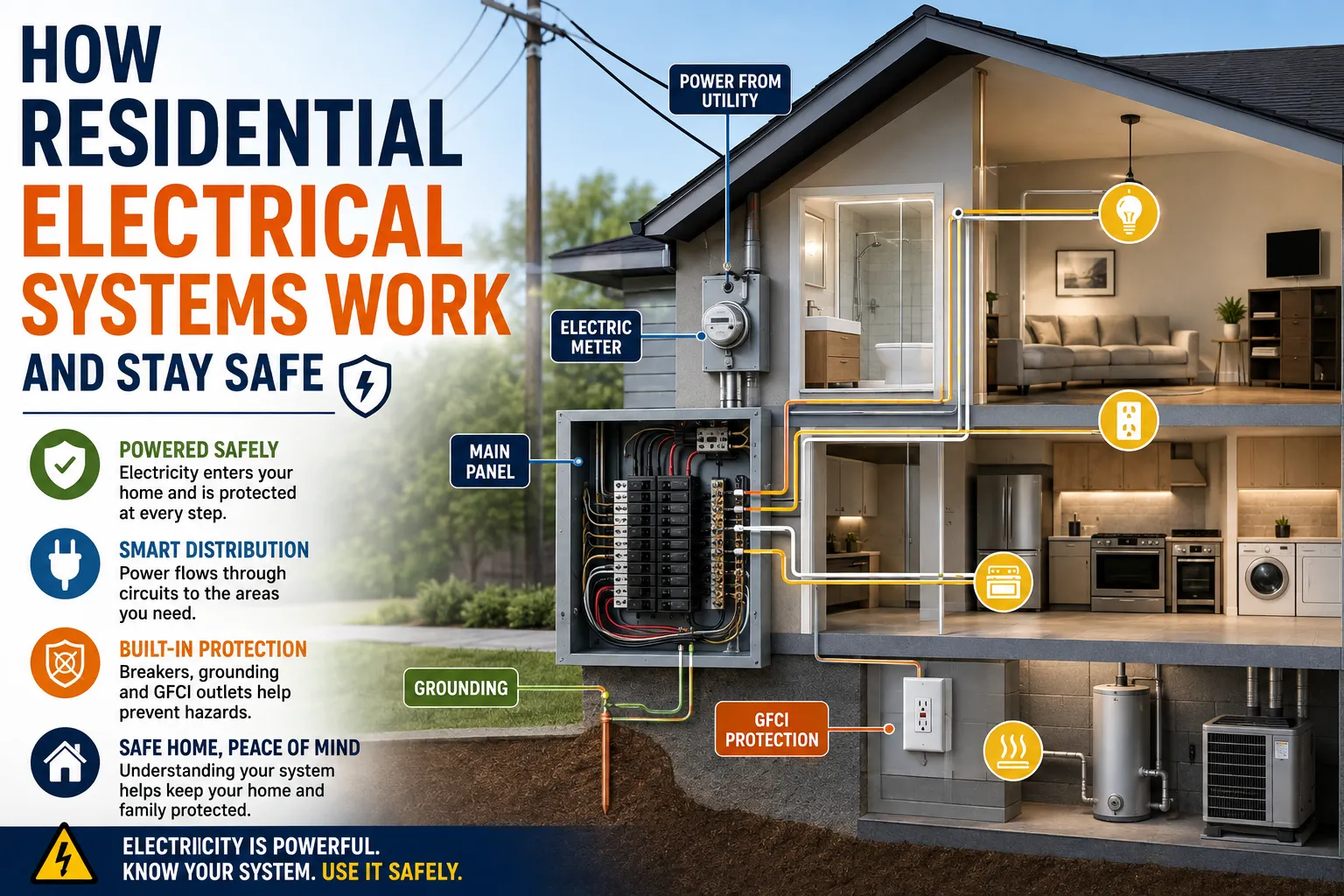
A residential electrical system is the network that brings electrical energy into a home and distributes it to individual circuits and devices.
A typical system includes:
- An incoming electrical service
- An electric meter
- A main service panel
- Circuit breakers
- Branch circuits
- Electrical cables and conductors
- Switches and receptacles
- Grounding and bonding components
- Protective devices
- Permanently connected appliances and equipment
The system is designed to deliver electricity at appropriate voltages while providing protection against conditions such as excessive current, short circuits and certain types of electrical faults.
The exact design varies depending on the age, location and construction of the home.
Electricity Enters Through the Service
Before electricity reaches a light switch or appliance, it enters the property through the electrical service.
The utility company supplies electricity through service conductors that connect the home’s electrical system to the wider power network.
An electric meter measures the amount of electricity consumed by the property.
From there, electricity reaches the home’s main electrical equipment, where it can be distributed among individual circuits.
The service is typically sized according to the home’s electrical requirements. A modern house with air conditioning, electric cooking, water heating, electric vehicle charging and numerous appliances may require considerably more electrical capacity than an older home with fewer loads.
The Electrical Panel Is the Distribution Center
The electrical panel is one of the most recognizable components of a home’s electrical system.
It contains circuit breakers that divide the home’s electrical supply into separate circuits.
Instead of sending electricity through one enormous circuit, the system distributes loads across multiple circuits designed for particular areas or types of equipment.
For example, a home may have separate circuits serving:
- Kitchen receptacles
- Bedrooms
- Lighting
- Laundry equipment
- Air conditioning
- Water heating
- Electric cooking
- Outdoor equipment
The exact arrangement depends on the home’s design and applicable electrical codes.
Homeowners who want a broader understanding of how electrical systems fit alongside plumbing, heating, cooling and other infrastructure can also explore how major home systems work and what homeowners maintain.
What Circuit Breakers Do
Circuit breakers are primarily protective devices.
They are designed to interrupt electrical current when a circuit experiences an excessive current condition.
For example, if too many electrical loads are placed on a circuit, the current can rise beyond what the wiring is designed to safely carry. A properly functioning breaker can trip and interrupt the circuit.
A short circuit can also cause a breaker to trip.
This protective function is one of the most important safety features in a residential electrical system.
Why a Tripped Breaker Should Not Be Ignored
A breaker that trips occasionally may be responding to a temporary overload.
But repeated tripping is a warning sign that should be investigated.
It can indicate:
- An overloaded circuit
- A faulty appliance
- Damaged wiring
- A short circuit
- An electrical fault elsewhere in the system
- A breaker or panel problem
Repeatedly resetting the breaker without identifying the cause is not a proper repair.
If a circuit continues to trip, the safest approach is to stop using the affected equipment and have the problem assessed by a qualified electrician.
Problems such as overloaded circuits, damaged wiring and faulty connections can also fall within the broader range of issues discussed in the home repairs guide.
Electrical Circuits Carry Current Through Conductors
Electrical wiring contains conductors designed to carry current.
In common residential systems, wiring includes conductors serving different functions, such as the energized conductor, neutral conductor and grounding conductor.
These conductors work together to provide a complete electrical system.
The exact configuration depends on the electrical system and equipment involved, which is one reason homeowners should not assume that every wire in a house can be identified safely by its appearance or insulation color alone.
Electrical wiring should always be treated as potentially energized unless it has been properly de-energized and verified by someone qualified to do so.
What the Neutral Conductor Does
In many residential AC systems, the neutral conductor provides a return path for current under normal operating conditions.
It is an important part of the circuit, but it should not be treated as harmless.
A neutral conductor can carry current and can present a shock hazard under certain conditions.
Homeowners should therefore never assume that a wire is safe to touch simply because they believe it is a neutral conductor.
What Grounding Does
Grounding is another important part of electrical safety.
A grounding system provides a path intended to help fault current flow safely under appropriate fault conditions and helps facilitate operation of protective devices.
Grounding and bonding are related but distinct concepts within electrical-system design.
Their purpose is not simply to “send electricity into the ground.” Instead, properly designed grounding and bonding systems help keep exposed conductive parts at appropriate electrical potential and provide paths that support protective operation when faults occur.
Because grounding systems can be complex, modifications should be handled by qualified professionals.
Ground-Fault Protection Can Save Lives
Ground-fault protection is designed to reduce the risk of electric shock from certain unintended current paths.
A **ground-fault circuit interrupter**, commonly called a GFCI or RCD depending on the electrical system and country, can detect an imbalance in current and disconnect power quickly.
These protective devices are especially important in locations where electricity and water may be present.
Common examples include:
- Bathrooms
- Kitchens
- Laundry areas
- Garages
- Outdoor locations
- Other damp or potentially wet areas
The terminology and installation requirements vary by country and electrical code.
Arc-Fault Protection Addresses Another Hazard
An electrical arc can occur when electricity jumps across an unintended gap.
Arcing can generate significant heat and may damage surrounding materials.
**Arc-fault circuit interrupters**, or AFCIs, are designed to detect certain dangerous arcing conditions and interrupt the circuit.
Modern electrical codes in many jurisdictions require various forms of arc-fault protection in specified residential circuits.
These devices complement, rather than replace, ordinary circuit breakers and other protective equipment.
Why Electrical Outlets Have Different Designs
Electrical receptacles may look simple, but they are designed with specific safety and electrical requirements.
Some outlets include built-in protective functions, while others are designed for particular equipment or locations.
Tamper-resistant receptacles, for example, can help reduce the risk of children inserting objects into outlet openings.
Outdoor and damp-location receptacles may require additional protection and weather-resistant equipment.
Homeowners should use outlets appropriate for their location rather than treating every receptacle as interchangeable.
Extension Cords Are Not Permanent Wiring
Extension cords can be useful for temporary situations, but they are not generally intended to replace permanent electrical wiring.
Running extension cords under carpets, through walls or in other unsuitable locations can create safety risks.
They can also become damaged by furniture, foot traffic or excessive bending.
If an appliance needs power in a location that does not have an appropriate outlet, installing a properly located receptacle may be a better long-term solution.
A qualified electrician can determine what installation is appropriate.
Power Strips Do Not Create More Electrical Capacity
A power strip can provide additional outlets, but it does not increase the amount of electricity a circuit can safely supply.
Plugging several high-power appliances into the same power strip can overload the circuit or the power strip itself.
High-power appliances such as heaters, large cooking appliances and some workshop equipment may require dedicated circuits or specific electrical arrangements.
The safest approach is to follow the manufacturer’s instructions and the requirements for the particular appliance.
Why Overloaded Circuits Are Dangerous
Electrical circuits are designed for particular loads.
When too much current flows through wiring, conductors can heat up.
If protective devices do not operate correctly, excessive heat can damage insulation and surrounding materials and potentially contribute to an electrical fire.
Warning signs of a potentially overloaded or problematic circuit include:
- Frequently tripping breakers
- Flickering lights
- Warm receptacles or switches
- Burning smells
- Discolored outlets
- Buzzing or crackling sounds
- Appliances that repeatedly lose power
These signs should not be dismissed as normal.
Warm or Discolored Outlets Need Attention
An outlet or switch should not normally become noticeably hot during ordinary use.
Warmth, discoloration, melting, scorching or unusual odors can indicate a problem such as a loose connection, excessive load or damaged component.
A homeowner should stop using the affected outlet and have it inspected by a qualified electrician.
The same applies to switches that feel unusually hot or make unusual sounds.
Flickering Lights Can Have Multiple Causes
Flickering lights are not always a sign of a major electrical fault.
A loose bulb or an aging lamp can cause flickering.
However, persistent or widespread flickering may indicate a loose connection, overloaded circuit, wiring problem or issue with electrical equipment.
If multiple lights flicker or the problem appears alongside buzzing, burning odors or breaker trips, professional assessment is particularly important.
Water and Electricity Require Special Care
Water significantly increases the risk associated with electrical equipment.
People should avoid using electrical appliances while standing in water or handling electrical equipment with wet hands.
Outdoor electrical equipment should be designed for outdoor use, and appropriate weatherproofing and protective devices should be used.
If water has entered an electrical panel, outlet or other electrical equipment, do not attempt to investigate it yourself.
The power should be handled according to appropriate emergency and electrical-safety procedures, and a qualified professional should assess the affected equipment.
Electrical risks are also part of the wider range of household dangers homeowners should recognize. For more guidance, see how to identify and prevent common safety hazards inside a home.
Electrical Fires Can Start Inside Walls
Not every electrical problem produces an obvious spark or dramatic event.
A loose connection can create resistance and localized heating. Damaged insulation can expose conductors. An overloaded circuit can generate excessive heat.
Some electrical faults may therefore develop gradually.
That is why unusual smells, discoloration, buzzing and repeated breaker trips deserve attention even when everything still appears to be working.
An electrical system does not have to stop functioning completely for it to be unsafe.
Older Homes May Have Different Electrical Systems
The age of a house can have a significant influence on its electrical infrastructure.
Older properties may have wiring, panels, outlets and protective systems that were appropriate when the home was constructed but are no longer ideal for modern electrical demands.
A home built decades ago may now be expected to support:
- Multiple computers
- Large televisions
- Air conditioning
- Electric water heating
- Modern kitchen appliances
- Home offices
- Power tools
- Electric vehicle charging
This increase in electrical demand can expose limitations in older installations.
An electrical inspection can help determine whether an older home’s system remains suitable for its current use.
Electrical Upgrades Should Be Properly Planned
Adding a new appliance does not necessarily mean simply installing a larger outlet.
High-demand equipment may require changes to wiring, circuit protection or the electrical service.
Examples include:
- Electric vehicle chargers
- Large air-conditioning systems
- Electric water heaters
- Electric ovens
- Heat pumps
- Workshops with high-power tools
The correct requirements depend on the equipment and local electrical regulations.
A qualified electrician can assess the existing system before an upgrade is installed.
DIY Electrical Work Can Create Hidden Problems
Electrical work can appear deceptively simple.
Replacing a light fixture or outlet may look like a straightforward task, but mistakes can create hazards that are not immediately visible.
Improper connections, inadequate grounding, damaged conductors or incorrectly sized components can compromise the safety of the entire circuit.
Electrical codes also vary by location, and work may require permits or inspection.
For anything beyond basic tasks that are explicitly permitted under local regulations, using a qualified electrician is the safer choice.
Regular Electrical Inspections Can Identify Problems
Unlike a leaking faucet or broken appliance, electrical problems are often hidden.
A professional electrical inspection can examine components that homeowners cannot easily evaluate.
Depending on the property and local requirements, an inspection may consider:
- The electrical panel
- Circuit protection
- Wiring condition
- Grounding and bonding
- Receptacles
- Switches
- Signs of overheating
- Improper modifications
- Outdoor electrical equipment
- Capacity for current household demands
Inspections can be particularly useful when buying an older home, renovating a property or adding major electrical loads.
Homeowners Should Know Where the Main Disconnect Is
Every homeowner should know where the home’s main electrical disconnect or service equipment is located.
Knowing how to shut off electrical power can be important during certain emergencies or when instructed by a qualified professional.
However, homeowners should not open electrical panels or attempt to work on energized equipment simply because they know where the disconnect is.
The equipment inside a service panel can contain dangerous voltages, including areas that may remain energized even when individual branch breakers are switched off.
Keep Electrical Equipment Accessible
Electrical panels, disconnects and important safety devices should not be blocked by furniture, storage boxes or other objects.
Easy access matters during maintenance and emergencies.
Likewise, electrical outlets and switches should remain in usable condition and should not be subjected to unnecessary physical damage.
Keeping the electrical system accessible also makes it easier to notice warning signs such as discoloration, damage or unusual heat.
Electrical Safety Around Children
Children are naturally curious, making electrical outlets and cords potential hazards.
Tamper-resistant receptacles, appropriate outlet covers where suitable, and keeping electrical equipment out of reach can reduce risks.
Parents and caregivers should also teach children not to insert objects into outlets or play with electrical cords.
Water and electrical devices deserve particular attention in households with young children.
Pets Can Also Damage Electrical Cords
Pets may chew electrical cables, creating exposed conductors and potential shock or fire hazards.
Damaged cords should not simply be wrapped with tape and returned to service.
The affected equipment or cord should be replaced or repaired appropriately.
Cords should also be routed in ways that reduce the likelihood of being chewed, pulled or crushed.
Use Appliances According to Their Instructions
Appliances are designed with specific electrical requirements.
Before using an appliance, homeowners should check its manufacturer’s instructions for:
- Voltage
- Power requirements
- Circuit requirements
- Grounding
- Ventilation
- Extension-cord restrictions
- Installation requirements
Large appliances should be installed according to the manufacturer’s specifications and applicable electrical codes.
Improvising electrical connections can create unnecessary risks.
What Homeowners Can Safely Monitor
There are several useful electrical checks that do not require opening electrical equipment.
Homeowners can pay attention to:
- Frequently tripping breakers
- Flickering lights
- Burning odors
- Buzzing or crackling
- Discolored outlets
- Damaged cords
- Loose receptacles
- Warm switches
- Water near electrical equipment
- Unusual behavior from appliances
These observations can provide valuable early warning.
The important distinction is between **observing a problem and attempting to repair it**.
A homeowner can identify that something appears wrong without exposing themselves to unnecessary electrical hazards.
What Requires a Qualified Electrician
Professional help is appropriate for tasks such as:
- Installing new circuits
- Upgrading electrical panels
- Replacing major wiring
- Installing high-power appliances
- Troubleshooting persistent electrical faults
- Modifying service equipment
- Repairing damaged wiring
- Installing electric vehicle charging equipment
- Addressing repeated breaker trips
- Investigating burning smells or overheating
Electrical work should comply with applicable local laws and electrical codes.
Buying a Home? Pay Attention to the Electrical System
Electrical condition is an important part of evaluating a property.
A home may look excellent cosmetically while having an outdated or poorly modified electrical system.
During a home purchase, buyers may want to determine:
- How old the electrical system is
- Whether the panel has adequate capacity
- Whether major renovations were professionally completed
- Whether the property has appropriate grounding and protection
- Whether there are visible signs of damaged wiring
- Whether the home can support planned appliances or upgrades
A professional inspection can provide information that a normal home viewing cannot.
This is particularly important for older properties or homes that have undergone extensive renovations.
A Safer Electrical System Starts With Small Habits
Residential electrical systems are remarkably reliable when they are properly designed, installed and maintained.
The safest approach is not to become an electrician overnight. It is to understand the system well enough to recognize when something is outside the ordinary.
Do not ignore repeated breaker trips. Do not use damaged cords. Do not overload outlets with high-power equipment. Keep water away from electrical devices. Avoid makeshift wiring. And when a problem involves the electrical system itself, use a qualified professional rather than taking unnecessary risks.
Keeping the Home Powered Without Taking Unnecessary Risks
Electricity is essential to modern living, but its convenience can make it easy to forget how much energy is moving through the walls and equipment of a house.
A residential electrical system depends on many components working together: service equipment delivers power, circuits distribute it, conductors carry it, and protective devices help limit the consequences of faults.
Homeowners play an important role in maintaining that system by using electrical equipment appropriately, recognizing warning signs and arranging professional inspections and repairs when necessary.
The goal is not simply to keep every light and appliance working. It is to ensure that the electrical infrastructure behind them remains **properly protected, appropriately maintained and suitable for the demands of the home**.