Common Home Energy Efficiency Mistakes
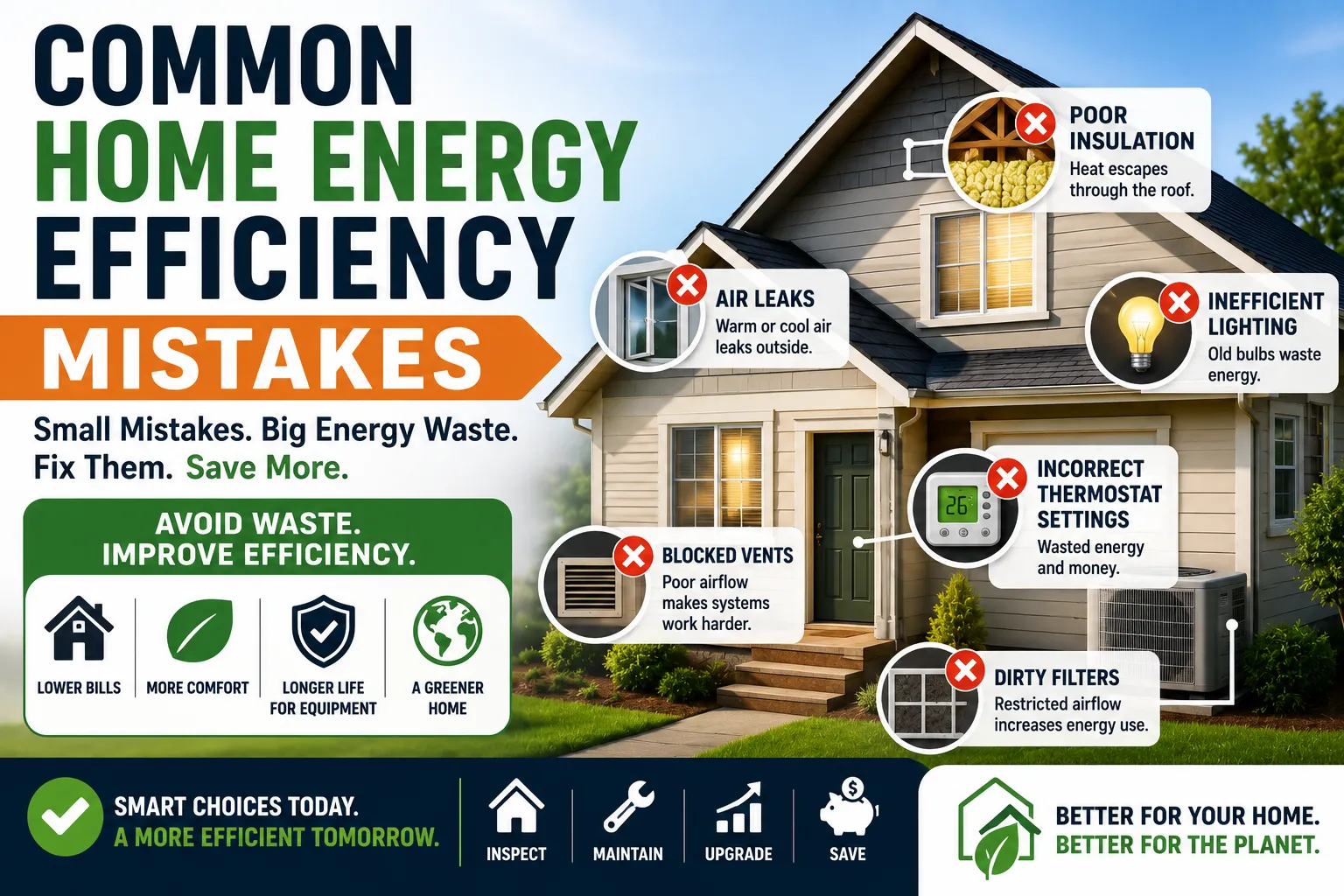
Common Home Energy Efficiency Mistakes
Making a home more energy efficient isn’t always about buying new appliances or installing expensive technology. In many cases, the biggest improvements come from fixing small problems that allow conditioned air, electricity and heat to go to waste.
A poorly sealed window, an oversized air conditioner, neglected air filters or excessive standby power can quietly increase household energy consumption month after month. Some homeowners also make the mistake of investing in one highly visible upgrade while overlooking simpler problems elsewhere in the house.
The good news is that most energy-efficiency mistakes are fixable.
This guide explores the most common home energy efficiency mistakes, why they happen, how they affect energy use and what homeowners can do to correct them. Understanding these issues is also an important part of effective home maintenance.
What Does Home Energy Efficiency Mean?
Home energy efficiency is essentially about getting the same level of comfort and performance while using less energy.
An efficient home can:
-
Stay cooler or warmer with less energy
-
Reduce unnecessary electricity consumption
-
Maintain more consistent indoor temperatures
-
Waste less energy through leaks and inefficient equipment
-
Lower utility costs
-
Reduce strain on heating and cooling systems
Energy efficiency isn’t the same thing as simply using less energy.
For example, turning off the air conditioner and sitting in an uncomfortably hot room reduces electricity consumption, but it isn’t necessarily an efficient solution.
A better approach is improving the building and equipment so the home can remain comfortable with less energy.
1. Ignoring Air Leaks
One of the most common efficiency problems is uncontrolled air movement.
Small gaps around windows, doors, plumbing penetrations and other openings can allow outdoor air to enter while conditioned indoor air escapes.
Common leakage points include:
-
Window frames
-
Door frames
-
Attic openings
-
Electrical outlets
-
Plumbing penetrations
-
Cable openings
-
Recessed lighting
-
Chimneys and flues
-
Utility penetrations
These gaps may seem insignificant individually, but collectively they can affect indoor comfort and heating or cooling demand.
How to fix it
Inspect obvious openings and use appropriate weatherstripping, caulk or sealants where suitable.
For larger or difficult-to-identify leaks, a professional energy assessment can help locate problem areas.
2. Assuming Windows Are Always the Main Problem
Homeowners often blame old windows when rooms feel too hot, too cold or drafty.
Windows can certainly contribute to energy loss, but replacing every window isn’t necessarily the best first investment.
Other issues may include:
-
Poor attic insulation
-
Air leaks
-
Inadequate shading
-
Duct losses
-
Inefficient HVAC equipment
-
Poorly sealed doors
Before spending thousands on replacement windows, determine where the home’s biggest energy losses are actually occurring.
3. Leaving Doors and Windows Open While Heating or Cooling
Running an air conditioner while windows are open is essentially paying to condition outdoor air.
The same applies to heating systems during cold weather.
This mistake can happen when someone:
-
Opens windows for fresh air
-
Leaves a door ajar
-
Keeps a poorly sealed garage door open
-
Opens windows while an HVAC system is operating
If ventilation is needed, use an appropriate ventilation strategy rather than allowing conditioned air to escape unnecessarily.
4. Neglecting Weatherstripping
Weatherstripping around doors and operable windows can deteriorate over time.
Signs of worn weatherstripping include:
-
Visible gaps
-
Drafts
-
Light around closed doors
-
Increased outdoor noise
-
Difficulty maintaining indoor temperature
Replacing worn weatherstripping is often relatively inexpensive compared with major renovations.
5. Underestimating Attic Insulation
Heat transfer through the roof and attic can have a major effect on indoor comfort.
During hot weather, a poorly insulated attic can allow substantial heat into the living space.
During colder weather, inadequate insulation can allow heat to escape.
Homeowners sometimes focus on walls and windows while overlooking the roof assembly.
What to check
Look for:
-
Thin or uneven insulation
-
Compressed insulation
-
Gaps around attic penetrations
-
Moisture damage
-
Areas with missing insulation
Because attic work can involve electrical hazards, ventilation issues and difficult working conditions, professional assessment may be appropriate.
6. Installing Insulation Without Air Sealing
Insulation and air sealing are related, but they’re not identical.
Insulation slows heat transfer.
Air sealing reduces uncontrolled movement of air.
If air can freely move through gaps around insulation, the overall performance of the building envelope can suffer.
For this reason, simply adding more insulation without addressing significant air leaks may not deliver the expected improvement.
7. Blocking Attic Ventilation
Another common mistake is treating every opening in an attic as an energy leak.
Some attic ventilation systems are intentionally designed to allow air movement.
Blocking ventilation without understanding the roof and attic design can contribute to:
-
Moisture problems
-
Condensation
-
Heat buildup
-
Roof deterioration
Don’t seal or block vents simply because they appear to be openings.
Determine whether they’re part of the home’s intended ventilation system first.
8. Buying an HVAC System That’s Too Large
Bigger isn’t always better when it comes to heating and cooling equipment.
An oversized air conditioner may cool a room quickly but cycle on and off frequently.
That can affect:
-
Comfort
-
Humidity control
-
Energy consumption
-
Equipment performance
An undersized system can also be inefficient because it may run continuously trying to meet the demand.
HVAC equipment should be appropriately sized for the property rather than selected solely by maximum capacity.
9. Ignoring HVAC Maintenance
Even an efficient HVAC system can perform poorly when neglected.
Common maintenance issues include:
-
Dirty filters
-
Blocked vents
-
Dirty coils
-
Poor airflow
-
Leaking ducts
-
Neglected outdoor units
-
Mechanical problems
Regular maintenance can help equipment operate as intended and may identify problems before they become expensive repairs.
For a broader understanding of how major household equipment and systems fit together, homeowners can also explore how major home systems work and what homeowners maintain.
Follow the manufacturer’s maintenance recommendations and use qualified professionals for work that requires specialized knowledge.
10. Forgetting to Replace or Clean Air Filters
A dirty HVAC filter can restrict airflow.
The result may be:
-
Reduced system performance
-
Increased strain
-
Poor indoor comfort
-
Longer operating times
How often a filter needs attention depends on the filter type, HVAC system and household conditions.
Homes with pets, dust or occupants with allergies may require more frequent attention.
Don’t automatically follow a one-size-fits-all replacement schedule. Check the manufacturer’s guidance and inspect the filter regularly.
11. Blocking HVAC Vents
Furniture, curtains, rugs and other objects can obstruct supply or return vents.
This can interfere with airflow and reduce the effectiveness of the HVAC system.
Walk through the home and check that vents aren’t:
-
Covered by furniture
-
Blocked by storage boxes
-
Hidden behind curtains
-
Obstructed by rugs
-
Completely closed without a reason
Keeping airflow paths clear is a simple maintenance habit.
12. Closing Too Many Vents
It may seem logical to close vents in unused rooms to save energy.
However, HVAC systems are designed around particular airflow requirements.
Closing many vents can alter pressure and airflow within the duct system.
Instead of randomly closing vents, address comfort differences through proper HVAC balancing and professional assessment where necessary.
13. Ignoring Duct Leaks
Ductwork carries conditioned air through the home.
If ducts leak, some of that air can escape before reaching the intended rooms.
This can be particularly problematic when ducts pass through:
-
Attics
-
Crawl spaces
-
Garages
-
Other unconditioned areas
A professional can inspect ductwork and identify significant leakage or insulation problems.
14. Assuming Ceiling Fans Cool Rooms
Ceiling fans can make people feel cooler, but they generally don’t lower the actual temperature of a room in the same way an air conditioner does.
Fans primarily improve comfort by moving air across the skin.
Therefore, running a ceiling fan in an empty room can waste electricity without providing a comfort benefit.
Turn fans off when nobody is using the room.
15. Using Fans Without Considering Outdoor Conditions
Opening windows and using fans can be an effective ventilation strategy under suitable conditions.
But during extremely hot weather, bringing hot outdoor air indoors may make the house warmer rather than cooler.
Before opening windows, consider:
-
Outdoor temperature
-
Humidity
-
Air quality
-
Time of day
-
Indoor temperature
Ventilate when conditions are favorable rather than automatically leaving windows open all day.
16. Leaving Lights On in Empty Rooms
It’s a simple mistake, but it adds up.
Leaving lights on when nobody is using a room wastes electricity.
This is particularly unnecessary when daylight is available.
Better habits
-
Turn off unnecessary lights
-
Use daylight where practical
-
Install occupancy sensors in suitable spaces
-
Consider timers for exterior lighting
LED lighting can also significantly reduce the electricity used for lighting compared with older incandescent technology.
17. Using Old Incandescent Bulbs Everywhere
Traditional incandescent bulbs convert a relatively large portion of their electricity into heat rather than visible light.
LEDs are substantially more energy efficient and generally last much longer.
Replacing frequently used incandescent bulbs with LEDs can be a relatively simple efficiency upgrade.
Prioritize lights that operate for many hours each day.
18. Leaving Electronics in Standby
Many electronic devices consume some electricity even when they appear to be turned off.
Examples can include:
-
Televisions
-
Game consoles
-
Computers
-
Printers
-
Speakers
-
Chargers
-
Streaming devices
The amount varies considerably by device.
For equipment that isn’t needed continuously, switching it off at the outlet or using an appropriate smart power strip can help reduce unnecessary standby consumption.
19. Keeping Chargers Plugged In Unnecessarily
Modern chargers generally consume little power when not actively charging, but a large collection of permanently connected devices can still represent unnecessary consumption.
Unplug chargers and adapters when practical, particularly when they’re not connected to anything.
The biggest savings usually come from addressing higher-energy devices rather than obsessing over a single phone charger.
20. Running Appliances When They’re Nearly Empty
Some appliances use energy regardless of how full they are.
Examples include:
-
Washing machines
-
Dishwashers
-
Clothes dryers
Running these appliances with very small loads can mean using nearly a full cycle for relatively little work.
Where appropriate, wait for a sufficiently full load.
Don’t overload appliances, however, because excessive loads can reduce cleaning performance and potentially increase wear.
21. Overusing the Clothes Dryer
Clothes dryers can consume significant amounts of energy.
Whenever practical, air-drying clothes can reduce electricity use.
If you use a dryer:
-
Clean the lint filter regularly
-
Avoid unnecessarily long cycles
-
Use moisture-sensing settings if available
-
Don’t overload the machine
-
Keep the exhaust system properly maintained
A blocked dryer vent can also create a safety hazard and reduce drying efficiency.
22. Using the Oven for Small Meals
A large oven may consume substantial energy to heat.
For small portions, alternatives such as:
-
Microwave ovens
-
Toaster ovens
-
Air fryers
may use less energy depending on the food, appliance and cooking time.
This doesn’t mean the conventional oven is inefficient by definition.
It simply means matching the appliance to the job can make sense.
23. Opening the Oven Door Repeatedly
Every time the oven door is opened, heat escapes.
The oven then has to recover the lost temperature.
Repeatedly opening the door to check food can therefore extend cooking time and increase energy use.
Use the oven light and window when possible.
24. Ignoring Refrigerator Door Seals
A refrigerator with a damaged or poorly sealing door gasket may have to work harder to maintain its internal temperature.
Check whether the gasket:
-
Has visible cracks
-
Feels loose
-
Is dirty
-
Allows noticeable gaps
Clean the seal and replace damaged components when necessary.
25. Setting the Refrigerator Too Cold
Colder isn’t necessarily better.
Most households don’t need their refrigerator set significantly colder than recommended food-safety ranges.
Follow the manufacturer’s recommended temperature settings and use an appliance thermometer if you need to verify performance.
26. Placing the Refrigerator Next to a Heat Source
Refrigerators have to remove heat from inside the cabinet.
Placing one directly beside a heat-producing appliance or in intense sunlight can increase the surrounding heat load.
Where practical, position refrigerators away from:
-
Ovens
-
Direct sunlight
-
Other significant heat sources
Always follow the manufacturer’s clearance requirements.
27. Ignoring Water Heater Settings
Water heating can be a major household energy expense.
Setting a water heater unnecessarily high can increase energy consumption and raise the risk of scalding.
Follow manufacturer guidance and applicable local requirements.
If you’re considering changing water-heater settings, make sure the temperature remains appropriate for safe use.
28. Using Too Much Hot Water
Long hot showers, running hot water unnecessarily and washing dishes under continuously running hot water can increase energy consumption.
Simple changes can help:
-
Take shorter showers
-
Repair dripping hot-water fixtures
-
Use efficient fixtures where appropriate
-
Don’t leave hot water running unnecessarily
These changes can also reduce water consumption.
29. Ignoring Hot-Water Pipe Insulation
In some homes, insulating accessible hot-water pipes can reduce heat loss between the water heater and fixtures.
This can help hot water reach the tap more efficiently.
Use appropriate insulation and follow local safety requirements, especially around gas appliances and combustion-related components.
30. Forgetting About Solar Heat Through Windows
Windows can be a significant source of unwanted heat gain.
During hot weather, direct sunlight can heat interior rooms considerably.
Solutions can include:
-
Curtains
-
Blinds
-
Exterior shades
-
Awnings
-
Solar-control window treatments
-
Landscaping that provides appropriate shade
Exterior shading can be particularly effective because it blocks sunlight before it reaches the glass.
31. Choosing Curtains Based Only on Appearance
Decorative curtains aren’t necessarily effective at controlling heat transfer.
When energy efficiency matters, consider window coverings designed to reduce solar heat gain or heat loss.
The appropriate product depends on your climate and whether your primary problem is heating or cooling.
32. Ignoring Exterior Shading
Trees, awnings, pergolas and other shade structures can affect how much solar heat reaches a home.
Strategically placed shade can improve comfort while reducing cooling demand.
However, landscaping should be planned carefully to avoid creating moisture problems, damaging foundations or interfering with roof systems.
33. Planting Trees Without Considering the House
Trees can provide valuable shade, but planting them too close to the building can create other maintenance problems.
Potential concerns include:
-
Roots
-
Branches
-
Gutters
-
Roof debris
-
Moisture
-
Pest access
Choose appropriate species and planting locations.
The goal is useful shade without creating a new set of home-maintenance problems.
34. Ignoring Home Orientation
When buying or renovating a property, homeowners sometimes focus entirely on finishes and floor plans while overlooking how the building interacts with the sun.
The amount of sunlight entering windows depends on:
-
Orientation
-
Window size
-
Shading
-
Local climate
-
Time of year
For major renovations, consider solar exposure as part of the design process.
35. Installing Energy-Efficient Appliances Without Checking the Whole System
An efficient appliance can reduce energy use, but its real-world impact depends on how it’s used.
For example, buying an efficient washing machine won’t eliminate energy waste if:
-
Loads are repeatedly run half-empty
-
Hot water is used unnecessarily
-
The machine isn’t maintained
-
Drying cycles are excessive
The appliance is only one part of the system.
36. Buying the Cheapest Appliance Instead of Considering Lifetime Cost
Purchase price isn’t the only cost.
An appliance that costs less initially may consume significantly more electricity over its lifetime.
When comparing major appliances, consider:
-
Purchase price
-
Energy consumption
-
Expected lifespan
-
Maintenance
-
Warranty
-
Repairability
-
Usage patterns
An appliance with a higher upfront price can sometimes cost less over its useful life.
37. Ignoring Energy Labels
Energy labels provide useful information when comparing appliances.
Depending on your country, the labeling system may differ, but the general principle is the same:
Don’t compare appliances based solely on appearance and purchase price.
Look at expected energy consumption and operating costs as well.
38. Replacing Everything at Once
Homeowners sometimes assume energy efficiency requires a complete renovation.
It doesn’t.
A whole-house approach can actually be more effective when improvements are prioritized.
For example:
-
Identify major energy losses.
-
Fix air leaks.
-
Improve insulation where appropriate.
-
Address HVAC problems.
-
Upgrade lighting.
-
Replace inefficient appliances as they reach the end of their useful life.
This spreads costs while allowing improvements to target actual problems.
39. Installing Solar Panels Before Improving Efficiency
Solar panels can generate electricity, but they don’t fix an inefficient home.
If a house has:
-
Poor insulation
-
Major air leaks
-
Inefficient HVAC equipment
-
Excessive energy consumption
you may want to address those issues before determining the appropriate size of a solar system.
Reducing energy demand can potentially reduce the amount of generation capacity needed.
40. Ignoring the Building Envelope
The building envelope includes the parts of the home that separate indoor and outdoor environments, including:
-
Walls
-
Roof
-
Windows
-
Doors
-
Floors
-
Foundations
Thinking about energy efficiency one appliance at a time can overlook the bigger picture.
A well-designed building envelope can make heating and cooling systems work less hard.
41. Focusing on Technology Instead of Behavior
Smart thermostats, smart plugs and energy monitors can be useful.
But technology doesn’t automatically create efficiency.
A smart thermostat can’t compensate for:
-
Open windows
-
Poor insulation
-
Major air leaks
-
A malfunctioning HVAC system
-
Constantly changing temperature settings
Technology works best when combined with good building practices.
42. Constantly Changing the Thermostat
Repeatedly adjusting the thermostat can make temperature management less predictable.
A better strategy is usually to establish reasonable settings that match occupancy and comfort.
Programmable or smart thermostats can automatically adjust temperatures according to schedules when configured appropriately.
Avoid extreme settings simply to force rapid temperature changes.
43. Installing a Smart Thermostat Without Checking Compatibility
Not every HVAC system works with every smart thermostat.
Compatibility can depend on:
-
Wiring
-
Power requirements
-
HVAC configuration
-
Heating and cooling stages
-
Heat pumps
-
Auxiliary systems
Check compatibility before purchasing and use professional installation if needed.
44. Ignoring Humidity
Temperature isn’t the only factor affecting comfort.
High indoor humidity can make a room feel warmer, while very low humidity can create discomfort.
Depending on climate and building design, managing humidity can improve comfort without simply lowering the thermostat.
Avoid trying to solve every comfort problem by changing temperature alone.
45. Forgetting About Duct Insulation
Ducts located in unconditioned spaces can gain or lose heat.
Appropriate duct insulation can help maintain the temperature of air moving through the system.
Inspect duct insulation for:
-
Damage
-
Gaps
-
Compression
-
Deterioration
Repairs should be performed appropriately for the system and local building requirements.
46. Leaving Exhaust Fans Running Too Long
Bathroom and kitchen exhaust fans remove moisture, odors and pollutants.
But unnecessarily running them for long periods can exhaust conditioned air.
Use exhaust fans when needed and follow manufacturer recommendations.
In some homes, ventilation should be part of a broader indoor air quality strategy rather than something to minimize indiscriminately.
47. Blocking Natural Ventilation
Improving energy efficiency doesn’t mean sealing a house so tightly that ventilation becomes inadequate.
A well-sealed building still needs appropriate ventilation.
Poor ventilation can contribute to:
-
Moisture
-
Condensation
-
Odors
-
Indoor pollutants
-
Poor air quality
Air sealing and ventilation should be considered together.
48. Ignoring Moisture Problems
Moisture and energy efficiency can overlap.
Water-damaged insulation may perform poorly, while persistent moisture can damage building materials.
Look for:
-
Condensation
-
Water stains
-
Musty odors
-
Damp insulation
-
Mold growth
-
Plumbing leaks
Fix moisture sources before simply adding more insulation or sealing the area.
49. Skipping a Professional Energy Assessment
Homeowners can identify many obvious efficiency problems themselves.
But some issues are difficult to see.
A professional energy assessment may identify problems involving:
-
Air leakage
-
Insulation
-
Ductwork
-
HVAC performance
-
Moisture
-
Building-envelope weaknesses
Depending on your location, assessments may use tools such as blower doors, infrared cameras or other diagnostic equipment.
50. Measuring the Wrong Things
A lower electricity bill isn’t always proof that a specific upgrade worked.
Energy consumption can change because of:
-
Weather
-
Occupancy
-
Appliance use
-
Electricity prices
-
Holidays
-
Working from home
-
Seasonal changes
When evaluating an efficiency project, compare energy use over comparable periods and account for major changes in household behavior.
How to Find the Biggest Energy-Efficiency Problems
Instead of making random upgrades, use a simple process.
Step 1: Review Utility Bills
Look for seasonal patterns and unusual increases.
Step 2: Walk Through the Home
Check windows, doors, vents, appliances and obvious leaks.
Step 3: Check HVAC Maintenance
Inspect filters and schedule professional servicing where appropriate.
Step 4: Inspect Accessible Insulation
Look for obvious gaps or damage.
Step 5: Identify High-Consumption Appliances
Pay particular attention to heating, cooling, water heating and major appliances.
Step 6: Prioritize
Fix the problems with the greatest potential impact first.
A Simple Home Energy Efficiency Checklist
Use this list as a starting point:
-
Check doors and windows for drafts.
-
Replace damaged weatherstripping.
-
Inspect attic insulation.
-
Look for obvious air leaks.
-
Keep HVAC filters clean or replace them as recommended.
-
Keep HVAC vents clear.
-
Have HVAC equipment maintained.
-
Check accessible ductwork for leaks.
-
Use LED lighting.
-
Turn off unnecessary lights.
-
Reduce unnecessary standby power.
-
Use appliances efficiently.
-
Check refrigerator door seals.
-
Avoid unnecessarily high water-heater settings.
-
Reduce hot-water waste.
-
Use window shading strategically.
-
Keep exhaust fans from running unnecessarily.
-
Monitor humidity and moisture.
-
Consider a professional energy assessment.
Which Energy Improvements Should Come First?
There is no universal priority list because every house is different.
However, a useful framework is:
First: Safety and Maintenance
Fix electrical problems, gas issues, leaks and malfunctioning equipment.
Second: Air Leakage
Seal significant uncontrolled gaps.
Third: Insulation
Improve insulation where deficiencies are identified.
Fourth: HVAC Performance
Maintain, repair or replace poorly performing equipment.
Fifth: Lighting and Appliances
Upgrade inefficient equipment as appropriate.
Sixth: Renewable Energy
Consider solar or other generation after reducing unnecessary energy demand.
This approach helps avoid spending money on expensive technology before fixing basic efficiency problems.
When an Upgrade Isn’t Worth It
Not every efficiency improvement will pay for itself quickly.
Before undertaking a major project, consider:
-
Upfront cost
-
Expected energy savings
-
Maintenance requirements
-
Equipment lifespan
-
Available incentives
-
Local climate
-
Your plans for the property
A project that makes sense in one climate may have limited value in another.
Energy Efficiency and Home Value
Energy-efficient features can make a home more attractive to some buyers.
Potentially valuable features include:
-
Efficient HVAC systems
-
Good insulation
-
Efficient windows
-
Solar systems
-
Efficient appliances
-
Smart energy management
-
Low-energy lighting
However, homeowners should avoid assuming that every upgrade will increase resale value by its full cost.
Keep documentation for major improvements, including:
-
Receipts
-
Equipment specifications
-
Warranties
-
Installation records
-
Energy assessments
This information can be useful when selling the property.
Common Home Energy Efficiency Questions
What Is the Biggest Source of Energy Use in a Home?
It depends on the climate, property and household, but heating, cooling and water heating can account for substantial energy consumption in many homes.
Does Turning Off Lights Really Save Money?
Yes, particularly when inefficient bulbs are used or lights operate for long periods. Switching to LEDs can make the savings more meaningful.
Are Smart Plugs Worth It?
They can be useful for monitoring or controlling compatible devices, particularly when they address a specific source of unnecessary consumption.
Should I Replace Windows Before Adding Insulation?
Not necessarily. The best order depends on where your home’s largest energy losses occur.
Does More Insulation Always Mean a More Efficient Home?
No. Insulation must be installed correctly, and significant air leakage, moisture problems or inadequate ventilation may need to be addressed as well.
Do Ceiling Fans Reduce Electricity Use?
They can reduce the need for air conditioning in some circumstances by improving perceived comfort, but fans themselves don’t cool a room in the same way an air conditioner does.
Is Solar Power the Best Energy Upgrade?
Not automatically. Improving the efficiency of the home may be a better first step depending on the property.
Can I Make My Home Energy Efficient Without Renovating?
Absolutely. Weatherstripping, LED lighting, HVAC maintenance, appliance habits, window coverings and reducing unnecessary energy use can all help.
Building a More Efficient Home One Problem at a Time
Home energy efficiency doesn’t have to begin with a major renovation.
In many houses, the best opportunities are surprisingly ordinary: a damaged door seal, clogged filter, poorly insulated attic, leaking duct or appliance that’s reaching the end of its useful life.
The biggest mistake is treating energy efficiency as a collection of isolated products.
A new appliance can’t compensate for a major building-envelope problem. Solar panels don’t fix wasted energy. A smart thermostat can’t repair leaking ducts. More insulation won’t necessarily solve a moisture problem.
The most effective strategy is to look at the home as a complete system.
Make Efficiency a Maintenance Habit
The most energy-efficient home isn’t necessarily the newest or most expensive one. It’s a home where the building envelope, appliances, heating and cooling equipment, ventilation and household habits work together.
Start with the problems that are easiest to identify and most likely to affect energy use. Seal meaningful air leaks, maintain HVAC equipment, improve insulation where needed, use appliances thoughtfully and monitor your home’s energy patterns over time.
Then consider larger investments based on evidence rather than assumptions.
The smartest energy upgrade is usually the one that solves a real problem instead of simply adding another piece of technology.